
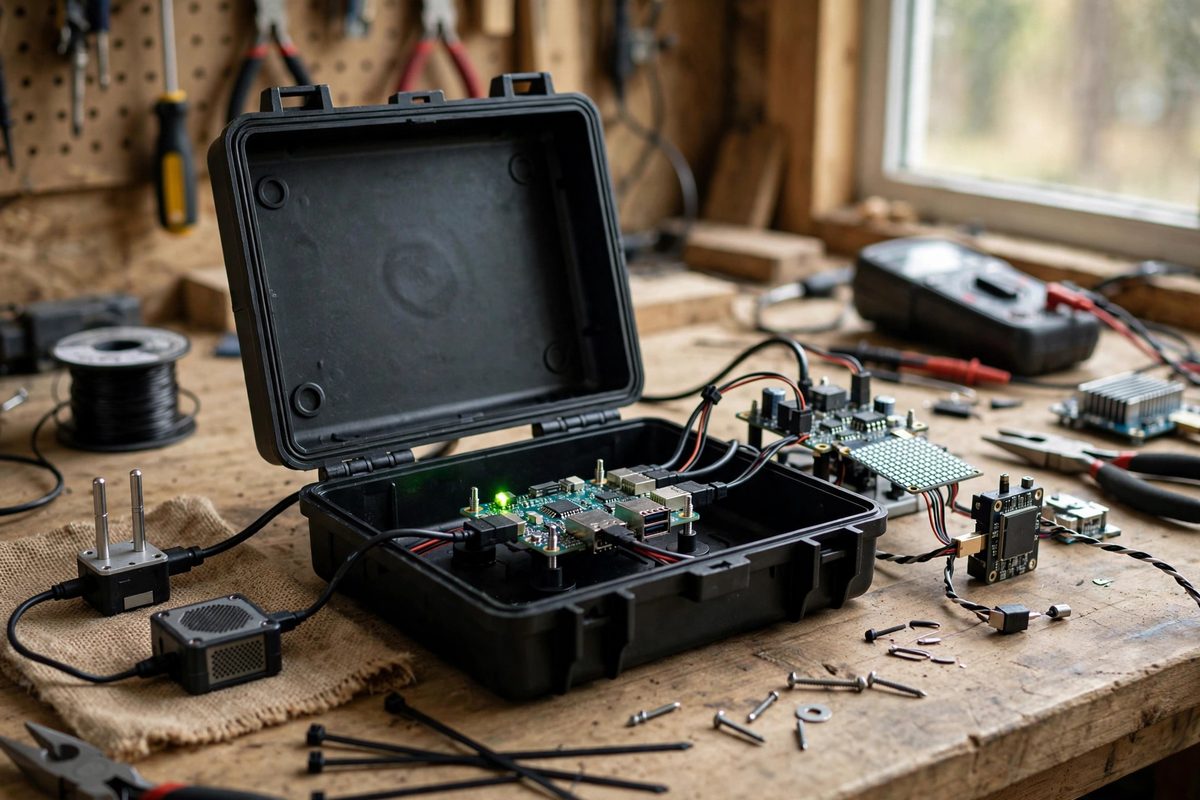
A Raspberry Pi deployed remotely, a sensor node, a sign controller, a gate monitor, will eventually lose power without warning, and every unclean shutdown risks corrupting the SD card. A read-only root filesystem eliminates that risk at the source: if the operating system never writes to the card during normal operation, a power cut cannot corrupt it. The Pi becomes as power-failure-proof as a device can be, which is exactly what remote deployments need.
Why SD cards corrupt on power loss
SD cards and their controllers expect orderly shutdowns. When power vanishes mid-write, the filesystem can be left in an inconsistent state: directory entries half-updated, journal entries incomplete, wear-leveling metadata scrambled. Most of the time the Pi recovers on the next boot, but occasionally it does not, and a remote Pi that fails to boot is a site visit. The failure rate compounds with write frequency, which is why a Pi logging data every minute corrupts sooner than one that just sits there.
Making the root filesystem read-only does not stop all writes; it stops the operating system from writing to the card. Application data still needs somewhere to go, which is handled with RAM-backed filesystems for temporary data and deliberate, infrequent writes for anything that must persist. The corruption risk drops to near zero because the card sees almost no write traffic.
The overlay filesystem approach
The standard method uses an overlay filesystem: the SD card's root partition is mounted read-only, and a writable layer in RAM (tmpfs) is overlaid on top of it. The system sees a normal writable filesystem and behaves normally, but all writes go to RAM and vanish on reboot. Configuration changes made during a session do not persist unless deliberately saved, which is both the protection and the tradeoff.
Modern Raspberry Pi OS includes tooling for this. The widely used approach enables the overlay filesystem through the configuration, optionally with the boot partition also set read-only. After enabling, verify by writing a test file, rebooting, and confirming it is gone. If it persists, the overlay is not active and the protection is imaginary.
Handling logs and runtime data
With the root read-only, system logs, PID files, and other runtime data must live in RAM. Point the logging daemon at a tmpfs mount or configure it to log to memory with limited size, so a chatty service cannot fill the RAM disk and crash the system. Size the tmpfs mounts generously enough for normal operation but bounded, since unbounded RAM disks are a different kind of failure.
For application data that must survive reboots, sensor readings, counters, state, use a separate small partition mounted read-write, and write to it infrequently and atomically: write to a temporary file and rename it into place, so a power cut during the write leaves either the old data or the new data, never a half-written file. Better yet, buffer data in RAM and flush it on a schedule, minimizing both the write count and the window of vulnerability.
Making configuration changes
The read-only root complicates updates, which is intentional. Establish a maintenance procedure: remount the root read-write, make the change, verify it, and remount read-only. For remote Pis, script this so an SSH session can flip the filesystem, apply an update, and flip it back in one operation, with verification at each step. Never leave a remote Pi in read-write mode after maintenance; the one time you forget is the one time the power fails.
System updates deserve extra care. Update the OS with the overlay disabled or in a maintenance window, test thoroughly, and only then return to read-only operation. An update applied sloppily to a read-only system can leave the Pi in a state where it boots read-only with a broken configuration and no easy remote fix.
Monitoring the remote Pi
A read-only Pi still needs watching: a heartbeat or watchdog that reports in regularly, so silence means something is wrong. Configure the hardware watchdog to reboot the Pi if the system hangs; with a read-only root, a watchdog reboot is safe rather than risky, since there is no filesystem state to corrupt. Log the heartbeat centrally so a dead Pi is noticed in minutes, not weeks.
Read-only root, RAM for runtime data, deliberate persistent writes, scripted maintenance, and a watchdog. The remote Pi stops being a corruption waiting to happen and becomes the reliable appliance it was meant to be.
Related Guides
- Watchdog Timer Service Setup for Remote Pi Nodes: A Raspberry Pi deployed as a remote sensor node, a camera, or an environmental monitor will eventually hang. It might be a kernel panic, a wedged
- MQTT Broker Heartbeat Optimization on Pi: MQTT's keep-alive heartbeat is the quiet mechanism that holds an IoT system together: clients ping the broker on a schedule, and the broker uses
- Optimizing eMMC Storage Write Lifecycles on Pi: Raspberry Pi boards used as IoT devices often boot from eMMC storage, either on compute modules or via eMMC-to-SD adapters, and eMMC flash wears out
- Configuring Systemd Watchdog Timers on SBC Nodes: A single-board computer running headless in a closet, a greenhouse, or a remote sensor post has one failure mode that hurts more than any other: the