
Multiway switching, controlling one light from two or more locations, runs on three-wire cable between the switches: two travelers plus a common, with ground alongside. Sizing that cable correctly is about more than matching the breaker amperage. The travelers carry the switched current, the cable runs are often long, and the wiring method affects both voltage drop and code compliance. Getting the sizing right means the switches work reliably for decades; getting it wrong means dim lights, warm cables, or a failed inspection.
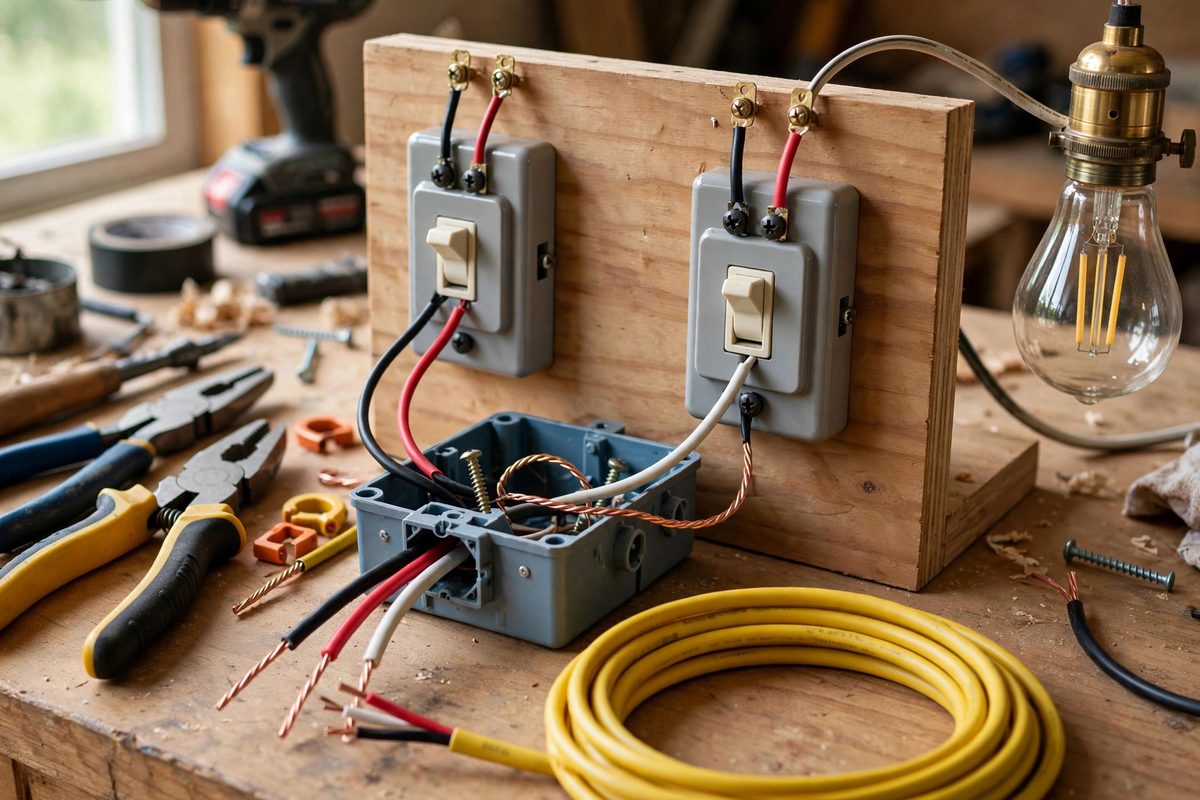
How Multiway Circuits Load the Cable
In a three-way or four-way switching setup, the current path runs from the power source through the common of the first switch, across one of the two travelers to the second switch, through its common to the light, and back via the neutral. Only one traveler carries current at a time, but the cable must be sized for the full load current on any single conductor, because whichever traveler is active carries everything. The neutral, where present in the cable, carries the return current. Multiway travelers are not signal wires; they are full power conductors carrying the complete load current, and must be sized as such. The cable's ampacity must meet or exceed the circuit breaker's rating under the installation conditions, with derating applied for ambient temperature and bundled cables where applicable.
Ampacity and the Breaker Relationship
The fundamental rule: conductor ampacity must be at least the breaker rating protecting the circuit, with the breaker sized for the load. For lighting circuits, this typically means cable sized for 15 or 20 amps depending on the breaker. But ampacity tables assume standard conditions, and real installations deviate. Cables bundled together in a conduit or run through hot attics need derating: the tables provide correction factors, and the derated ampacity must still cover the breaker. When in doubt, upsize: the cost difference between adjacent wire sizes is trivial compared to replacing an undersized cable later. Never protect a cable with a breaker larger than the cable's (derated) ampacity; the breaker exists to protect the wire.
Voltage Drop on Long Traveler Runs
Multiway switches often sit far apart, hallways, staircases, large rooms, and the traveler cable runs the full distance between them plus the run to the light. Voltage drop accumulates over that length, and lighting is sensitive to it: incandescent and halogen lamps dim noticeably, and even LEDs, while more tolerant, can show subtle brightness differences or driver issues at the far end. Size for voltage drop as well as ampacity: calculate the round-trip length of the longest current path, apply the load current, and check that the drop stays within a few percent. On long runs, this often pushes the wire size up beyond what ampacity alone requires: ampacity is about safety, voltage drop is about performance, and the wire must satisfy both.
Cable Types and Wiring Methods
Three-wire plus ground cable comes in the standard types for the wiring method: nonmetallic sheathed cable for residential work, armored cable or conduit with individual conductors where required. The color coding matters for clarity and code: the travelers are typically the red and black (or two non-white colors), the common and neutral follow the circuit's convention, and the bare or green is ground. In multiway wiring, the white wire is sometimes repurposed as a traveler or common, permitted only with proper re-identification at every visible point, because a white wire that is not a neutral is a trap for the next person. Modern code increasingly requires a neutral at switch locations for smart switches, which affects cable choice: running a cable that includes a neutral future-proofs the installation even if the current switches do not need it.
Box Fill and Termination Space
Multiway switches land in boxes with many conductors: three-wire cables in, three-wire cables out, grounds, possibly neutrals, and the switch device itself. Box fill calculations are mandatory and frequently the limiting factor: each conductor, clamp, and device counts toward the box's volume allowance, and an overfilled box is a code violation and a practical nightmare of jammed wires and stressed connections. Size switch boxes generously, deep boxes or larger gang boxes, because the labor saved during installation and any future servicing dwarfs the small cost difference. Terminate carefully: travelers must land on the correct terminals and the common must be identified correctly, because a miswired multiway circuit produces switches that work only in certain combinations.
Safety and Code Compliance
Multiway circuits have specific code requirements: proper grounding, correct conductor identification, box fill limits, and in many jurisdictions, permits and inspections. Turn off the breaker and verify dead with a tester before touching anything; multiway circuits are notorious for staying energized through unexpected paths, because the travelers can be hot from either end depending on switch positions. If any part of the sizing, derating, or code requirements is uncertain, consult the local code and, for anything beyond basic replacements, a licensed electrician. Electricity does not grade on effort.
Size multiway cable for the full load current on any traveler, derate honestly for conditions, check voltage drop on the long runs, include a neutral for the future, and give the boxes room to breathe. The switches will work from every location, every time, for the life of the building.
Related Guides
- Derating Conductor Ampacity in Multi-Cable Bundles: A conductor's ampacity, the current it can carry safely, is really a temperature rating in disguise. The copper can handle far more current than the
- Sizing Neutral Wires for Non-Linear Loads: In a balanced three-phase system, the neutral carries only the imbalance between phases, which is why neutrals were traditionally sized smaller than
- Sizing Branch Circuit Breakers for Continuous Loads: A continuous load, one that runs for three hours or more at a stretch, heats a breaker differently than an intermittent one, and the breaker must be
- Conduit Fill Capacity Ratios for Commercial Romex: Running Romex (nonmetallic sheathed cable) through conduit seems straightforward until the conduit fill rules enter: the electrical code limits how