
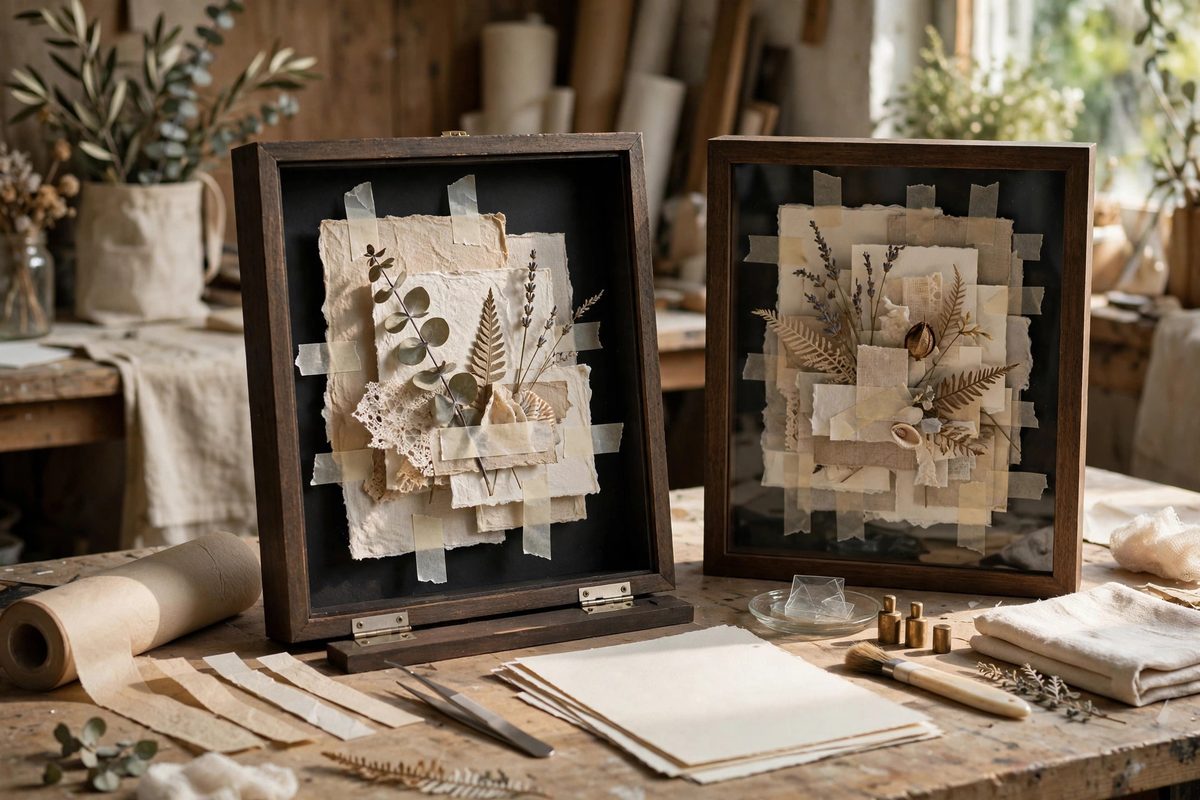
Shadow boxes present art with depth: objects and layered elements floating in a deep frame, casting real shadows. Mounting work inside them archivally means the piece can be displayed for decades without the mount failing, staining, or damaging the art. Hinging with archival tissue, the conservator's method of attaching paper art with small folded tissue hinges and reversible adhesive, is the gold standard. It holds the work securely, remains invisible, and can be undone without harm, which is the definition of archival.
Why Hinges Instead of Adhesive
Full adhesion, gluing the art down across its back, is permanent and destructive: it prevents the paper from expanding and contracting with humidity, which causes cockling and stress, and it cannot be reversed without damaging the art. Hinges attach at a few points along one edge, typically the top, letting the paper hang freely and move naturally. The art is held, not trapped.
In a shadow box, this matters doubly. The enclosed environment experiences temperature and humidity swings, and the art inside needs to breathe with them. A fully adhered piece in a shadow box will eventually show the stress; a hinged piece rides the changes without complaint.
Materials: Tissue and Adhesive
Use true archival hinging tissue: thin, strong, acid-free Japanese tissue (kozo or mulberry) made for the purpose. It is nearly invisible when applied, strong enough to hold the art's weight, and compatible with conservation adhesives. Regular tissue paper, masking tape, or "archival" craft tapes are not substitutes; they fail, stain, or become permanent in ways that conservators spend careers undoing.
The adhesive is wheat starch paste or methylcellulose, both reversible with water. These adhesives bond well, dry without discoloration, and, crucially, can be softened and removed decades later without harming the art. This reversibility is what makes the mount archival: future conservators can undo your work cleanly.
The Hinging Technique
Cut small hinges, typically rectangles of tissue folded into a T or V shape. One part of the hinge adheres to the back of the art near its top edge; the other adheres to the mount board behind it. The fold between them acts as a flexible joint, letting the art hang and move. Two or three hinges across the top edge suffice for most pieces; larger or heavier work gets more.
Apply paste sparingly with a small brush, position the hinge, and cover with a blotter and light weight while it dries. Work cleanly: paste on the art's face is a stain, and excess paste squeezed from under the hinge dries as a visible ridge. Less paste, well placed, holds better than a generous smear.
- Hinge from the top edge so the art hangs plumb; side or bottom hinges fight gravity.
- Keep hinges small and positioned where the mount board or mat will conceal them.
- Let hinges dry fully under weight before handling; premature handling stretches the tissue.
- For heavy or three-dimensional elements, supplement hinges with archival corner pockets or sewn mounts.
Mounting Inside the Shadow Box
The hinged art mounts to an archival backing board cut to fit the shadow box, and the board mounts into the frame. Build the depth in layers: the backing board, then spacers or risers that hold the art at the desired depth, then the art itself. Elements at different depths create the shadow box's dimensional effect; plan the layering before hinging anything.
Keep all materials in the box archival: acid-free backing, no rubber bands, no hot glue, no pressure-sensitive tapes inside the enclosure. The sealed environment concentrates off-gassing from non-archival materials, which then deposits on the art. Everything inside the box should be something you would trust against the artwork for fifty years.
Sealing and Display
Seal the shadow box's back with archival tape or a fitted dust cover to keep out dust and insects, which are genuine threats to enclosed art. Hang the box where it avoids direct sunlight and extreme humidity; archival mounting protects against material failure, not against UV fading or mold.
Document the mounting: a note inside the dust cover recording the materials and date helps future conservators understand what they are working with. Archival practice includes the paperwork; the next person to open the box should know what you did and why.
Hinge with kozo tissue, paste with starch, hang from the top, and keep everything inside the box worthy of the art. The shadow box shows the work at its most dimensional; the mounting should be engineered to be forgotten, holding invisibly for decades.
Related Guides
- Binding Glue Flexibility in Altered Book Spines: An altered book asks its spine to do something bookbinding never intended: open flat, fold back on itself, carry added bulk from collage and paint
- Sewing French Link Stitch Spines on Rebound Bibles: Rebinding a well-worn Bible is a commission of trust: the book is often a family heirloom, and the new binding must open flat, last generations, and
- Kettle Stitch Binding Schedules for Rebuilt Folios: Rebuilding folios in an altered book means the signatures no longer behave like the ones the binder originally sewed, and the kettle stitch schedule