
In vocational welding instruction, the weld is the test, but waiting until the final exam to evaluate welds wastes the learning: students practice mistakes for weeks before anyone corrects them. Formative inspection, evaluating welds during the learning process with structured checklists, gives students specific, actionable feedback while there is still time to improve. A good checklist turns "that looks bad" into "your travel speed is inconsistent, see the rippled width," which is the difference between criticism and instruction.
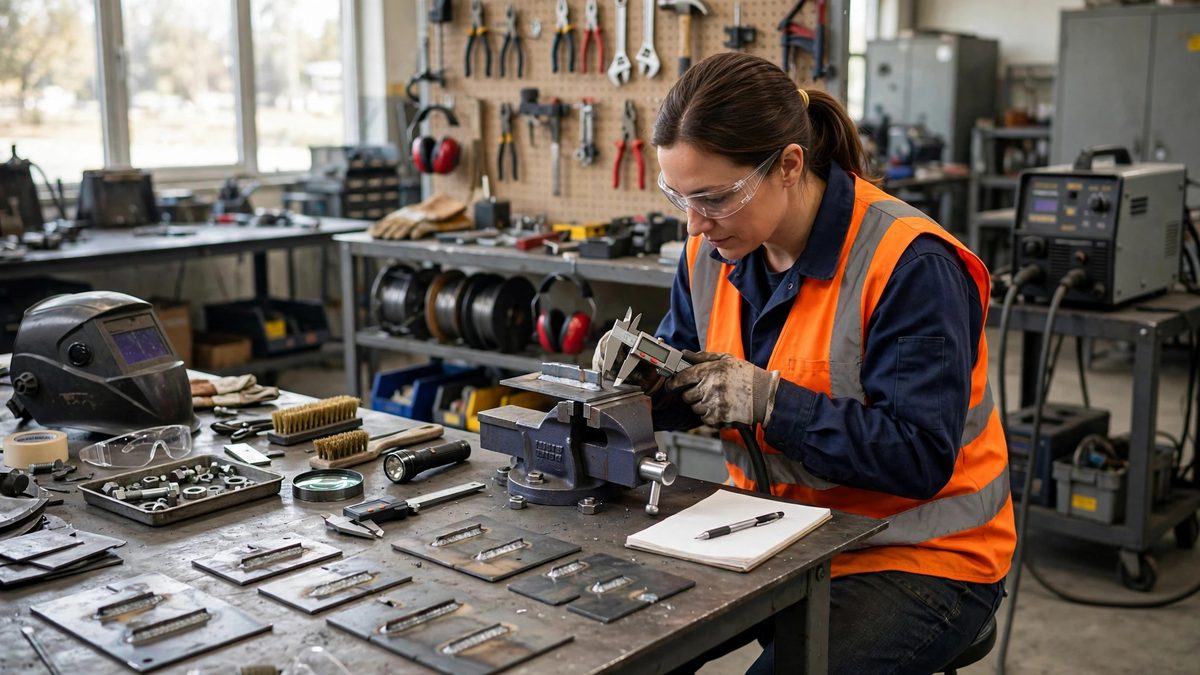
Formative vs. Summative Assessment
Summative assessment judges the final product: pass or fail, grade assigned, course over. Formative assessment informs the learning while it is happening: it identifies what is wrong, why it is wrong, and what to change, with no grade attached to the finding. In welding, this distinction is critical because weld quality is a motor skill developed through corrected repetition. A student who lays fifty beads with excessive travel speed and hears about it only at the final practical has practiced the error fifty times; the error is now a habit. The same student inspected after every five beads, with the travel speed issue named and a correction prescribed, practices the correction forty-five times instead. The checklist is the instrument of that frequent, specific feedback: it makes the inspection consistent across students and across instructors, and it gives the student a concrete record of what to work on.
Anatomy of an Effective Checklist
An effective formative checklist is organized by observable weld characteristics, each tied to its likely causes and corrections. Bead width and consistency: uniform width indicates steady travel speed, while widening and narrowing reveals speed variation, with the correction being to watch the puddle, not the arc. Reinforcement and penetration: excessive crown suggests too slow travel or too much wire, while lack of fusion at the toes suggests too fast or too cold. Porosity: surface pores point to contamination, gas coverage, or moisture, each with its specific remedy. Undercut: the groove melted at the toes indicates excessive heat or dwell at the edges, corrected by technique adjustment. Spatter, arc strikes, and cleanliness round out the list. Each item needs three columns: what to look for, what it likely means, and what to try next. The checklist teaches diagnosis, not just defect-spotting, because the vocational goal is a welder who can correct their own work.
Sequencing Checklists Through the Curriculum
Checklists should grow with the student. Early in the program, the checklist is short and focused on fundamentals: safety compliance, basic bead appearance, consistent travel. The beginner cannot usefully evaluate ten characteristics at once; three done well beat ten done superficially. As skills develop, the checklist expands: joint-specific items for fillets, grooves, and out-of-position work; then code-oriented criteria like undercut limits and porosity allowances per the relevant standard. The progression mirrors the learning: from "can you run a bead" to "can you produce a code-quality weld." Each checklist version should be introduced with demonstration: the instructor welds examples of each defect and each acceptable condition, so students calibrate their eyes before inspecting their own work. An uncalibrated inspector, student or otherwise, cannot use a checklist meaningfully.
Self-Inspection as a Learning Tool
The most powerful use of the checklist is in the student's own hands. Require students to inspect and score their own welds against the checklist before the instructor reviews them. This does two things: it trains the visual evaluation skill that working welders use constantly, since no inspector watches every production weld, and it forces the student to confront the gap between intention and result honestly. The instructor's role shifts from sole judge to calibration check: comparing the student's self-assessment with the instructor's, and discussing discrepancies, which are themselves diagnostic. A student who consistently rates their porosity as acceptable when it is not has a calibration problem, not a welding problem, and the conversation addresses the real issue. Over the course, the self-inspections should converge with the instructor's: that convergence is measurable evidence of developing professional judgment.
Documentation and Progress Tracking
Keep the completed checklists: they are a longitudinal record of each student's development, showing which defects appeared, when they were corrected, and what persists. This record serves the student, who can see genuine progress over weeks, which sustains motivation through the frustrating middle of skill acquisition; it serves the instructor, who can spot patterns, like a whole class struggling with vertical-up technique, indicating a teaching gap rather than individual failures; and it serves the program, providing evidence of competency development for accreditation or employer inquiries. Review the records periodically with each student in a short conference: celebrate corrected defects explicitly, because the student who fixed their undercut problem needs to hear that the fix worked, and set the next targets from the data, not from impression.
Formative welding inspection with structured checklists turns practice into deliberate practice: frequent, specific, diagnostic feedback while correction is still possible. Build the checklists around observable characteristics tied to causes and fixes, sequence them with the curriculum, put them in students' hands for self-inspection, and track the results. The welds improve because the feedback improved first.
Related Guides
- Formative Rubrics for High School Shop Labs: Shop class runs on projects, but projects alone do not teach; feedback does. Formative rubrics, scoring guides used during the work to steer it
- Rubrics for Structural Rigidity in Student Frame Kits: Student frame kits, the balsa towers, popsicle-stick bridges, and dowel structures of the classroom, are really lessons in thinking structurally. A
- Objective Quality Rubrics for Student Sheet Metal Seams: Grading student sheet metal work by gut feel produces two problems: students do not know what to improve, and instructors cannot defend the grades. A
- Milestone Rubrics for Student Mechanical Assemblies: Grading a student's mechanical assembly, a gearbox, a linkage, a small engine model, is tricky. The finished object either works or it does not, but