
Grading student sheet metal work by gut feel produces two problems: students do not know what to improve, and instructors cannot defend the grades. A well-built quality rubric fixes both by translating craftsmanship into observable, measurable criteria. Instead of a vague sense that a seam looks good, the rubric specifies what to check: the fold is within a stated tolerance of the layout line, the seam shows no gaps above a stated size, the surface has no tool marks deeper than a stated limit. Objective criteria make assessment fair, feedback actionable, and instruction focused on the skills that actually matter.
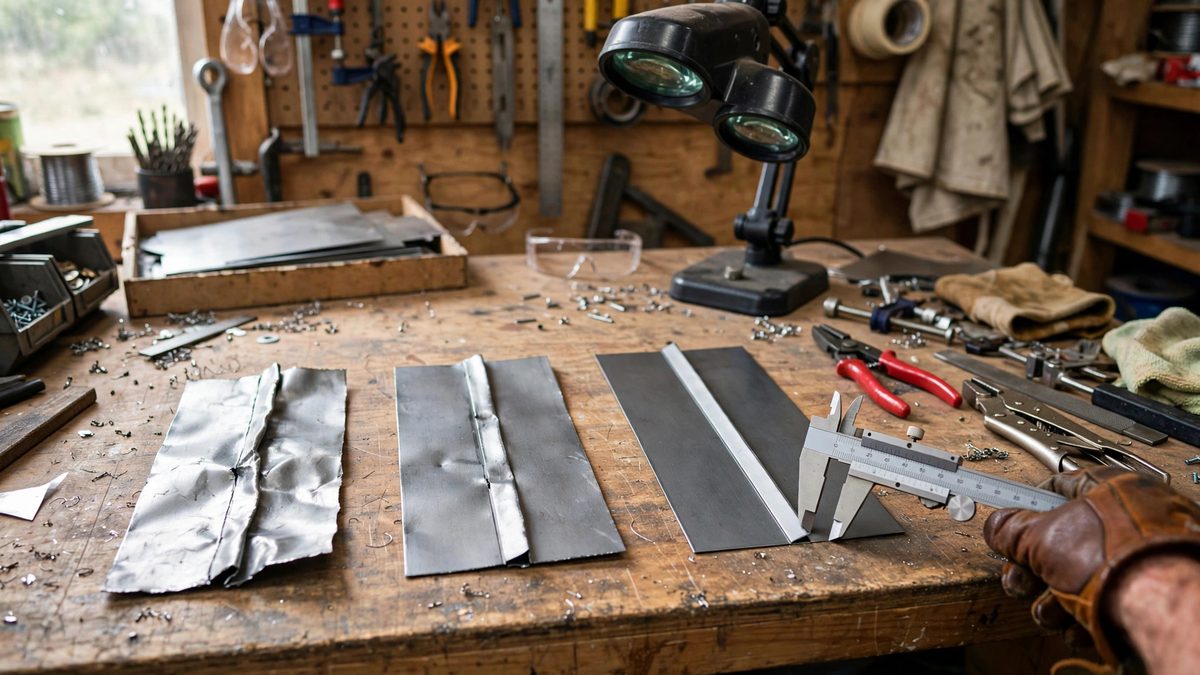
Why objectivity matters in shop assessment
Shop instructors carry strong tacit knowledge: they can see a bad seam instantly. But tacit knowledge does not transfer through a grade. A student who receives a low mark with no specifics learns only that the instructor was displeased, which teaches compliance rather than craftsmanship. Objective criteria externalize the instructor's eye into language the student can use for self-assessment before the work is ever submitted. There is a fairness dimension too. When criteria are explicit and measurable, every student is judged against the same standard, which protects both the student and the instructor. And rubrics make instruction better, because writing one forces the instructor to decide what actually matters in a seam, which often clarifies the teaching itself.
Choosing measurable criteria
Good rubric criteria share three properties: they are observable on the finished work, they are measurable with simple tools, and they connect to a real quality requirement. For sheet metal seams, strong criteria include dimensional accuracy of the finished part measured against the drawing, gap size at the seam measured with feeler gauges, uniformity of the fold radius, alignment of mating edges, and surface condition assessed against a defined standard. Each criterion needs performance levels with concrete thresholds: what earns full marks, what earns partial marks, and what fails. Avoid criteria that smuggle subjectivity back in, such as neatness or effort. If a criterion cannot be checked with a ruler, a gauge, or a defined visual standard, rewrite it until it can.
A sample rubric structure
A practical seam rubric might assess five dimensions. Dimensional accuracy: all critical dimensions within a tight tolerance for full marks, widening bands for partial marks. Seam fit-up: no visible gaps at the joint for full marks, with defined gap limits for lower scores. Fold quality: bends at the correct angle within a degree or two, with consistent radius and no cracking at the bend. Edge condition: edges deburred and safe to handle, with no sharp burrs detectable by a standard wipe test. Surface condition: no dents, deep scratches, or hammer marks in visible areas, with minor handling marks acceptable at lower performance levels. Weight the criteria by importance: a seam that is dimensionally wrong but pretty is still wrong, so accuracy should carry the most weight. Keep the rubric to one page. A rubric nobody reads is decoration.
Using the rubric as a teaching tool
The rubric's highest value comes before assessment, not during it. Hand it out with the assignment and walk through it, showing examples of work at each performance level. Better yet, have students assess sample seams with the rubric before they cut their own metal; calibrating their eye against the standard teaches the quality concepts directly. Encourage self-assessment during the build: a student who checks their fold against the rubric's angle tolerance mid-project is practicing the exact quality discipline the trade demands. When grading, mark the rubric and return it with the work so the student sees precisely where marks were lost. The conversation shifts from why did I get this grade to how do I close these specific gaps, which is the conversation that produces better metalworkers.
Calibrating instructors
Rubrics only ensure fairness if instructors apply them consistently. When multiple instructors grade with the same rubric, calibrate by having everyone assess the same set of sample seams independently, then compare and discuss the differences. The disagreements are valuable: they reveal criteria that are still ambiguous and need tighter definitions. Revisit the rubric each term and refine the criteria that generated the most disputes or the least useful feedback. A rubric is a living document, and its second version is always better than its first. Keep the language stable enough that students experience a consistent standard, but do not treat the first draft as sacred.
Balancing rigor with encouragement
Objective standards must not become a machine for discouraging beginners. Set the full-marks thresholds at a genuinely professional standard, but structure the performance levels so that a careful beginner can earn solid marks while seeing exactly what separates their work from mastery. Recognize improvement explicitly: a student whose seams progress from failing to competent across the term has learned something real, and the assessment system should acknowledge it. The rubric measures the work, but the instructor's comments should address the worker. Combine the objective score with specific, forward-looking feedback, and the rubric becomes what it should be: a map from where the student is to where the craft demands they go.
Build seam rubrics from observable, measurable criteria with concrete performance levels, teach with them before assessing with them, calibrate the instructors who use them, and keep them humane. Objective assessment does not make shop class colder. It makes the path to good work visible, which is the warmest thing a teacher can offer.
Related Guides
- Rubrics for Structural Rigidity in Student Frame Kits: Student frame kits, the balsa towers, popsicle-stick bridges, and dowel structures of the classroom, are really lessons in thinking structurally. A
- Milestone Rubrics for Student Mechanical Assemblies: Grading a student's mechanical assembly, a gearbox, a linkage, a small engine model, is tricky. The finished object either works or it does not, but
- Formative Rubrics for High School Shop Labs: Shop class runs on projects, but projects alone do not teach; feedback does. Formative rubrics, scoring guides used during the work to steer it
- Formative Welding Inspection Checklists for Vocational: In vocational welding instruction, the weld is the test, but waiting until the final exam to evaluate welds wastes the learning: students practice