
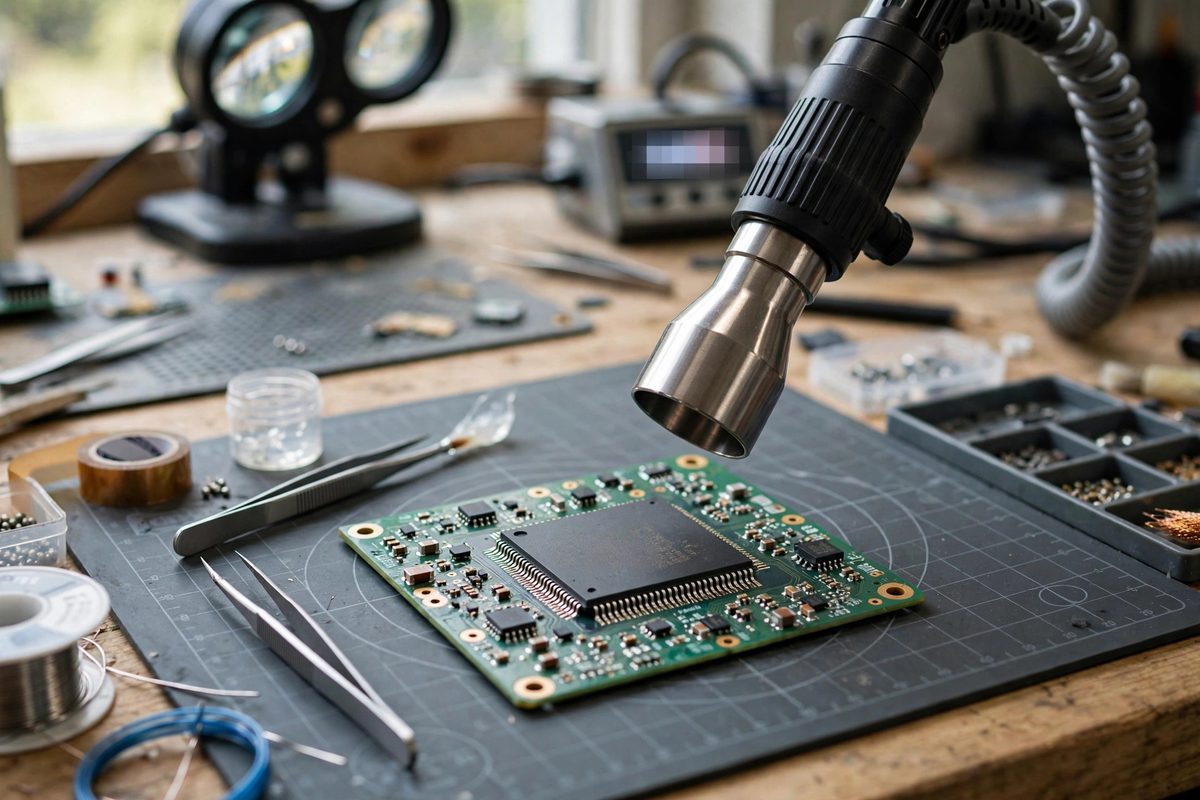
Removing or soldering a fine-pitch QFP, the square flat-pack with leads on all four sides at half-millimeter spacing, with a hot air gun is a thermal precision operation. The nozzle size determines where the heat goes: too large and it cooks neighboring components and lifts pads across the board; too small and it heats unevenly, leaving some leads soldered while others reflow, which tweens the chip and bridges the fine leads. Nozzle sizing for QFP work is about matching the heat footprint to the package while respecting everything around it.
What the Nozzle Controls
The nozzle shapes the hot air stream: its diameter sets the heated area, and its design (straight, focused, slotted) sets the distribution within that area. For QFP rework, the goal is to heat all the package's leads to reflow temperature simultaneously and evenly, because a QFP removed or placed with uneven heating suffers bent leads, solder bridges, and pad damage. Simultaneous, even heating is the entire requirement, and the nozzle is the primary tool for achieving it.
The nozzle also controls collateral heating. Hot air does not stop at the nozzle's edge; it spreads, reflects off the board, and bathes the surroundings. A nozzle sized exactly to the QFP still heats a margin around it; the sizing question is how much margin the neighboring components tolerate.
Sizing to the Package
The working rule: the nozzle's effective heated area should cover the QFP's lead footprint, the square spanning the outermost leads on all four sides, with modest margin. For a QFP with a 14mm lead span, a nozzle in the roughly 12 to 18mm range typically serves; the exact choice depends on the nozzle's airflow pattern and the density of surrounding components. When in doubt between two sizes, the decision follows the neighborhood: open board favors the larger nozzle for even heating, crowded board demands the smaller one for selectivity.
Specialized QFP nozzles exist with square or slotted patterns that direct air at the four lead rows specifically, heating the leads while sparing the package center and the surroundings. These are worth their cost if QFP rework is frequent; for occasional work, a properly sized round nozzle with good technique suffices.
Airflow and Temperature Balance
Nozzle size interacts with the gun's airflow and temperature settings. A large nozzle at high airflow delivers enormous total heat; reduce the airflow or temperature to compensate, aiming for the minimum heat that reflows all leads evenly. A small nozzle needs higher temperature or longer dwell to heat the whole package, which risks overheating the directly-blasted area while the far leads lag.
- Preheat the board from below if the station supports it; bottom heat reduces the top heat the nozzle must deliver.
- Keep the nozzle moving in small patterns rather than dwelling; dwelling overheats one zone.
- Watch the solder, not the clock; reflow is visible as the leads' solder turns liquid and reflective.
- Shield heat-sensitive neighbors with Kapton tape or aluminum shields when the margin is tight.
Technique for Removal and Placement
For removal, heat until all leads reflow, then lift the chip straight up with tweezers or a vacuum pickup; any lateral motion drags molten solder across the fine-pitch pads and bridges them. For placement, tin or paste the pads, position the chip, and heat until it self-centers on the molten solder's surface tension, then remove heat and hold still until the solder solidifies. Movement during cooling is the great bridge-maker.
Clean and inspect after every QFP operation: wick away excess solder, check for bridges under magnification, and verify each lead's joint. Fine-pitch joints hide defects that coarser work would show plainly; the inspection is part of the procedure, not an optional extra.
Protecting the Board and Neighbors
The board itself has thermal limits: prolonged hot air delaminates the substrate, discolors solder mask, and damages nearby plastic connectors and electrolytic capacitors long before the QFP is harmed. Work efficiently: the total heat exposure is temperature times time, and minimizing time through proper nozzle sizing and preheating protects everything. If a removal is taking too long, stop and reassess the heat delivery rather than continuing to bake the board.
Keep a mental (or written) map of the heat-sensitive components near each QFP you rework. Connectors, crystals, and small plastic parts have lower thermal tolerance than the silicon chip; the nozzle size and shielding plan should protect the weakest neighbor, not just serve the target.
Size the nozzle to the lead footprint, balance heat against the neighborhood, move the air, watch the solder, and inspect everything. QFP hot air work is thermal surgery; the right nozzle is the right instrument, and technique does the rest.
Related Guides
- Hot Air Rework Profile Ramp Speeds for BGA Balls: Reworking a BGA with hot air means reflowing dozens or hundreds of hidden solder balls simultaneously, and the ramp speed, how fast the package heats
- The Invisible Architecture: How Surface Mount Calibration Became the Quiet Backbone of Modern Technology: The Precision Hidden in Plain Sight Every time you unlock your phone with a fingerprint, your car brakes automatically to avoid a collision, or a
- Solder Paste Viscosity and Stencil Release: Stencil printing solder paste looks simple until the stencil lifts and half the pads come up with it, or the paste slumps into bridges before the
- QFN Thermal Center Pad Voiding Mitigation Steps: QFN packages hide their most important solder joint underneath: the large thermal center pad that carries heat out of the chip and, on many parts
- Profiling Nitrogen Convection Ovens for Lead-Free SMT: Lead-free solder asks more of a reflow oven than leaded solder ever did. The alloys melt hotter, wet less eagerly, and punish marginal profiles with