
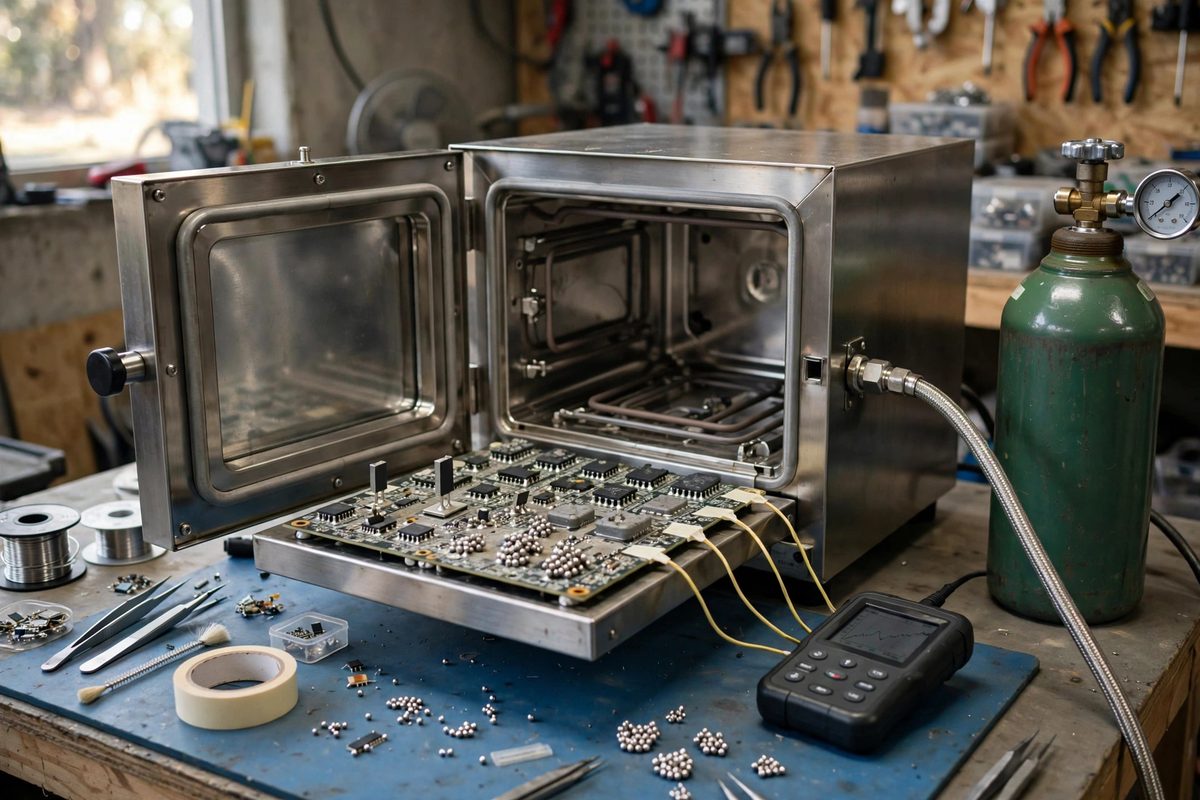
Lead-free solder asks more of a reflow oven than leaded solder ever did. The alloys melt hotter, wet less eagerly, and punish marginal profiles with tombstoning, graping, and dull joints. A nitrogen atmosphere changes the equation: by displacing oxygen during reflow, it lets the flux work instead of fighting oxidation, which widens the process window that lead-free otherwise narrows. But nitrogen is not a magic gas you simply turn on. The oven profile still has to be right, and nitrogen adds its own variables to manage. This guide covers how to profile a nitrogen convection oven for lead-free surface-mount work, from thermocouple placement to reading the curve.
Why nitrogen helps lead-free specifically
Every hot metal surface in the oven grows oxide, and lead-free alloys, with their higher tin content and higher melting points, oxidize faster and wet worse than the old tin-lead blends. Flux fights this by chemically reducing oxides, but at lead-free temperatures the flux is near the edge of its active life just when wetting needs to happen. Nitrogen, by holding residual oxygen in the low hundreds of parts per million through the hot zones, slows re-oxidation so the flux that survives is enough to do the job. The practical results are better wetting on challenging finishes, fewer solder balls, and shinier fillets. What nitrogen does not do is fix a bad profile. If your soak is too short or your peak too cool, the joints will still be wrong, just wrong in a shinier atmosphere.
Thermocouple placement that tells the truth
A profile is only as honest as its thermocouples. Attach fine-gauge thermocouples to representative points on a sacrificial assembly: a large component body, a small chip component, an exposed copper pour, and the board edge. The heavy thermal masses lag the air temperature and reveal whether your soak is actually equalizing the board; the light components show the peak the small joints really see. Tape the thermocouple tips flat against the surfaces with high-temperature tape, keeping the tips in intimate contact, because a thermocouple measuring oven air instead of board temperature will lie to you by tens of degrees. Run the profile with the oven loaded as it will be in production, since an empty oven heats very differently from a full one. Profile the process, not the machine.
Shaping the lead-free curve
A lead-free profile has the same four regions as any reflow curve, with tighter demands in each. The ramp should climb steadily without thermal shock to components, the soak must genuinely equalize temperatures across light and heavy masses, the reflow peak needs to exceed the alloy's melting point by enough margin for complete wetting, and the cooling rate must be controlled to form a fine grain structure. Read the curve at the thermocouples, not at the oven's setpoints: what matters is the temperature the joints experienced. Look for the coldest joint's time above liquidus, which is the number that decides whether every joint on the board actually reflowed, and the hottest joint's peak, which is the number that decides whether anything was damaged. The window between those two is your process margin, and nitrogen's gift is that it makes that window wider by improving wetting at the cool end.
Managing the nitrogen itself
Nitrogen concentration is a process variable like any other, so treat it that way. Measure oxygen levels in the hot zones with the oven's analyzer rather than assuming the flow setting delivers the target, because leaks, open doors, and conveyor gaps all dilute the atmosphere. Establish the flow rate that holds your target residual oxygen with the oven fully loaded and running, and then leave it alone; chasing the flow knob run to run introduces variation that shows up as mysterious wetting differences. Remember that nitrogen is an asphyxiant in enclosed spaces. The oven exhaust must be properly vented, and the room needs normal ventilation. This is not theoretical caution. A nitrogen leak into a small, sealed room displaces oxygen silently, so respect the gas handling with the same seriousness you give the electrical and thermal hazards of the oven.
Reading defects back to the profile
When lead-free boards come out wrong under nitrogen, the defects still point at the curve. Tombstoning on small chips usually means uneven heating across the component, so check the soak equalization between its two ends. Graping, where the joint looks like a cluster of distinct balls instead of a smooth fillet, means the paste's flux was exhausted before coalescence, which points to too long or too hot a soak, or insufficient peak. Dull, grainy joints suggest the time above liquidus was marginal at that location. Solder balls scattered around components often trace to a ramp rate that drove off volatiles too violently. Because nitrogen improves wetting, a defect that persists under nitrogen is telling you the profile error is large, not borderline. Trust the defect's testimony and adjust the curve, not the gas.
Documenting and holding the profile
A good profile is an asset, so capture it. Save the thermocouple curves, the oven setpoints, the conveyor speed, the nitrogen flow and measured oxygen levels, the paste and board finish, and the date. Re-profile on a schedule and after any change: a new paste, a different board thickness, a heater service, or even a seasonal change in incoming board temperature all move the real curve. Spot-check production boards periodically with a single thermocouple on the most challenging joint. Profiling feels like overhead until the first time a saved profile lets you return a drifting process to known-good in minutes instead of losing a shift to guesswork.
Nitrogen makes lead-free reflow more forgiving, but the profile still does the real work. Place thermocouples honestly, shape the curve for the alloy's demands, verify the atmosphere you are actually getting, read defects back to the profile, and document what works. The gas is the assistant. The curve is the process.
Related Guides
- The Invisible Architecture: How Surface Mount Calibration Became the Quiet Backbone of Modern Technology: The Precision Hidden in Plain Sight Every time you unlock your phone with a fingerprint, your car brakes automatically to avoid a collision, or a
- Solder Paste Viscosity and Stencil Release: Stencil printing solder paste looks simple until the stencil lifts and half the pads come up with it, or the paste slumps into bridges before the
- QFN Thermal Center Pad Voiding Mitigation Steps: QFN packages hide their most important solder joint underneath: the large thermal center pad that carries heat out of the chip and, on many parts
- Hot Air Gun Nozzle Sizing for Fine Pitch QFP Chips: Removing or soldering a fine-pitch QFP, the square flat-pack with leads on all four sides at half-millimeter spacing, with a hot air gun is a thermal
- Hot Air Rework Profile Ramp Speeds for BGA Balls: Reworking a BGA with hot air means reflowing dozens or hundreds of hidden solder balls simultaneously, and the ramp speed, how fast the package heats