
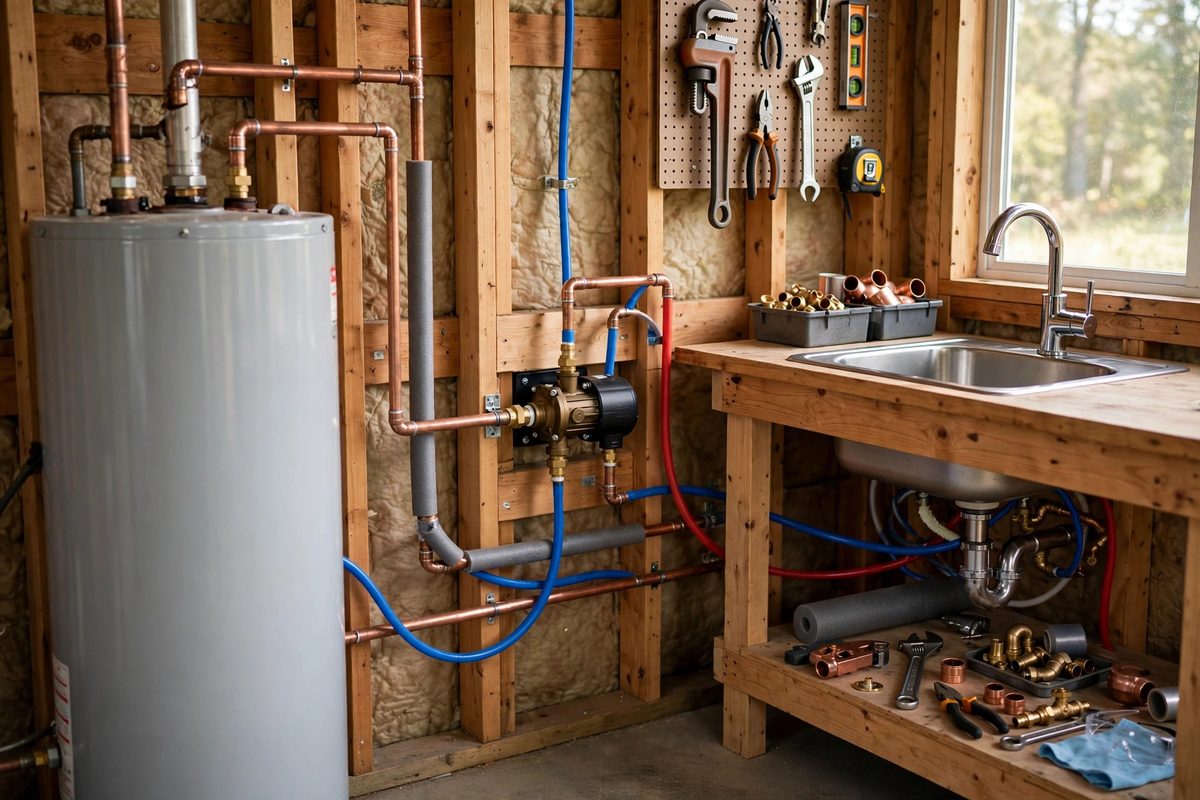
An on-demand recirculation loop keeps hot water waiting at the tap instead of in the water heater: a small pump circulates hot water through a dedicated return line, so opening the faucet delivers hot water in seconds rather than after a long, wasteful wait. Sizing the pump is the design decision that makes or breaks the system. Too small and the far fixtures still run lukewarm; too large and the pump wastes energy, erodes piping, and short-cycles the water heater. The sizing follows from the loop's heat loss and head loss, not from rules of thumb about house size.
What the Pump Must Overcome
The pump has two jobs: move enough water to replace the heat the loop loses to its surroundings, and push that water through the piping's friction resistance. The flow requirement comes from heat loss: the loop's piping radiates heat along its entire length, and the pump must circulate water fast enough that the temperature drop from heater to farthest fixture stays small, typically just a few degrees. Longer loops and uninsulated piping lose more heat and need more flow. The head requirement comes from friction: every foot of pipe, every elbow, every valve adds resistance, and the pump must develop enough pressure to push the design flow through the total resistance. These two requirements together define the duty point: a specific flow at a specific head, which is what the pump curve must satisfy.
Calculating Heat Loss and Flow
Estimate the loop's heat loss from the piping length, diameter, insulation, and the temperature difference between the water and the surroundings. Insulated piping loses a fraction of what bare piping loses, which is why insulating the recirculation loop, supply and return, is the single most effective efficiency measure: it directly reduces the required pump flow. Convert the heat loss to a flow rate using the water's heat capacity and the allowable temperature drop: the flow must carry enough thermal energy to make up the loss while dropping only a few degrees. The result is usually a modest flow, a few gallons per minute or less for residential loops, which surprises builders expecting a big pump. Overshooting the flow wastes pump energy continuously and accelerates pipe erosion; the correct flow is the minimum that holds the temperature, not the maximum the pump can deliver.
Calculating Head Loss
Head loss comes from pipe friction over the loop's total developed length, including an equivalent length for each fitting, plus the loss through the water heater or heat exchanger, check valves, and any balancing valves. Small-diameter piping dominates the calculation: friction loss rises steeply as diameter shrinks, so a loop plumbed in undersized pipe needs dramatically more pump head. This is the classic recirculation failure: a 1/2-inch loop that would have worked beautifully in 3/4-inch needs a pump three times as powerful, with the energy cost and noise to match. Size the loop piping generously during rough-in; the incremental pipe cost is trivial compared to a lifetime of oversized pumping. Add up the components honestly, including the water heater's internal pressure drop, which manufacturers publish and installers often ignore.
Selecting the Pump
With the duty point known, select a pump whose curve passes through or near it, preferably with a variable-speed or multi-speed option. Variable speed is the modern answer: set the pump to maintain the design flow, and it automatically backs off when conditions change, saving energy. A pump wildly oversized for the duty point, throttled by a valve to behave, wastes energy as heat and noise; a pump slightly above the duty point with speed control trims to fit exactly. Consider the pump's materials: bronze or stainless housings for potable water, never standard cast iron, which corrodes. Check the temperature rating suits continuous hot water duty. And plan for serviceability: isolation valves on both sides of the pump and union connections mean the pump can be replaced without draining the system, which matters because even good pumps eventually wear.
Controls: When the Pump Runs
A recirculation pump running 24/7 wastes energy heating the loop during hours nobody uses hot water, and it wears the pump prematurely. Controls restrict operation to useful periods. A timer schedules circulation around the household's hot water habits, mornings and evenings. An aquastat stops the pump when the return water reaches temperature, preventing overheating the loop. Demand controls, push buttons or motion sensors at fixtures, run the pump only when hot water is actually requested, which is the most efficient option and eliminates standby losses almost entirely. Thermostatic crossover valves at the far fixture, for retrofits without a dedicated return line, use the cold line as the return and close when hot water arrives. Match the control strategy to the household: a timer suits predictable schedules, demand controls suit irregular ones, and the energy savings from proper controls often exceed the savings from pump sizing itself.
Size the recirculation pump from the loop's actual heat loss and head loss, pipe the loop generously, insulate everything, and control the pump to run only when useful. Hot water arrives in seconds, the energy bill barely notices, and the pump lasts because it was never asked to do the wrong job.
Related Guides
- Calculating Flow Rates for Recirculating Hot Loops: A recirculating hot water loop promises hot water at the tap without the long wait and the wasted water down the drain. But size the pump wrong and
- Sediment Filter Micron Sizing for Well Water Mains: Well water carries sediment: fine sand, silt, rust flakes, and the occasional surprise from a shifting water table. Without filtration, that grit
- Expansion Tank Pressure Pre-Charge Tuning: Water expands when heated, and in a closed plumbing system with a check valve or pressure regulator blocking the way back to the main, that expansion
- Expansion Tank Diaphragm Failure Diagnostic Steps: A waterlogged expansion tank announces itself indirectly: the pressure relief valve weeps or pops, the pressure gauge swings wildly, pipes knock when