
Fiber reactive dyes need alkalinity to bond with cotton: the high pH opens the cellulose to reaction and fixes the color permanently. The standard activator is soda ash, sodium carbonate, which drives the pH up hard and fast. But soda ash's aggression is also its drawback: it can shift colors, damage delicate fibers, and demand careful handling. Sodium bicarbonate, ordinary baking soda, offers a gentler path. As a buffer rather than a brute-force alkali, it holds the dye bath in the mildly alkaline range where fiber reactives still fix, more slowly and more controllably. Understanding bicarbonate buffering gives tie-dyers a tool for subtler color and kinder processing.
What buffering means in the dye bath
A buffer resists pH change: it absorbs small additions of acid or base without letting the pH swing wildly. Sodium bicarbonate in solution establishes an equilibrium that holds the pH in the mildly alkaline zone, roughly around pH 8, rather than driving it to the harsh 10.5-plus of soda ash. Fiber reactive dyes fix across a range of alkaline pH, with the reaction faster at higher pH and slower at lower pH. The bicarbonate-buffered bath therefore dyes more slowly than a soda ash bath, which is a feature, not a bug: the slower fixation gives the dyer extended working time, more controllable color development, and less risk of the dye striking so fast that it cannot level. The chemistry trades speed for grace.
When bicarbonate beats soda ash
Choose bicarbonate when the project benefits from gentle, extended processing. Fine color gradations and careful multi-color work gain from the longer open time; the dye stays workable while you manipulate the folds and apply adjacent colors. Delicate fabrics that soda ash would harshen, lightweight cottons and some blends, tolerate bicarbonate better. Colors that soda ash shifts, particularly some yellows and pastels that go brassy or dull at high pH, often come out cleaner in the buffered bath. Low-water immersion techniques, where the fabric sits in a concentrated dye solution, also suit bicarbonate, since the buffer maintains the pH steadily through the long contact time. Conversely, when maximum color yield in minimum time is the goal, such as production dyeing of saturated blacks, soda ash's aggression remains the right tool.
Preparing the bicarbonate bath
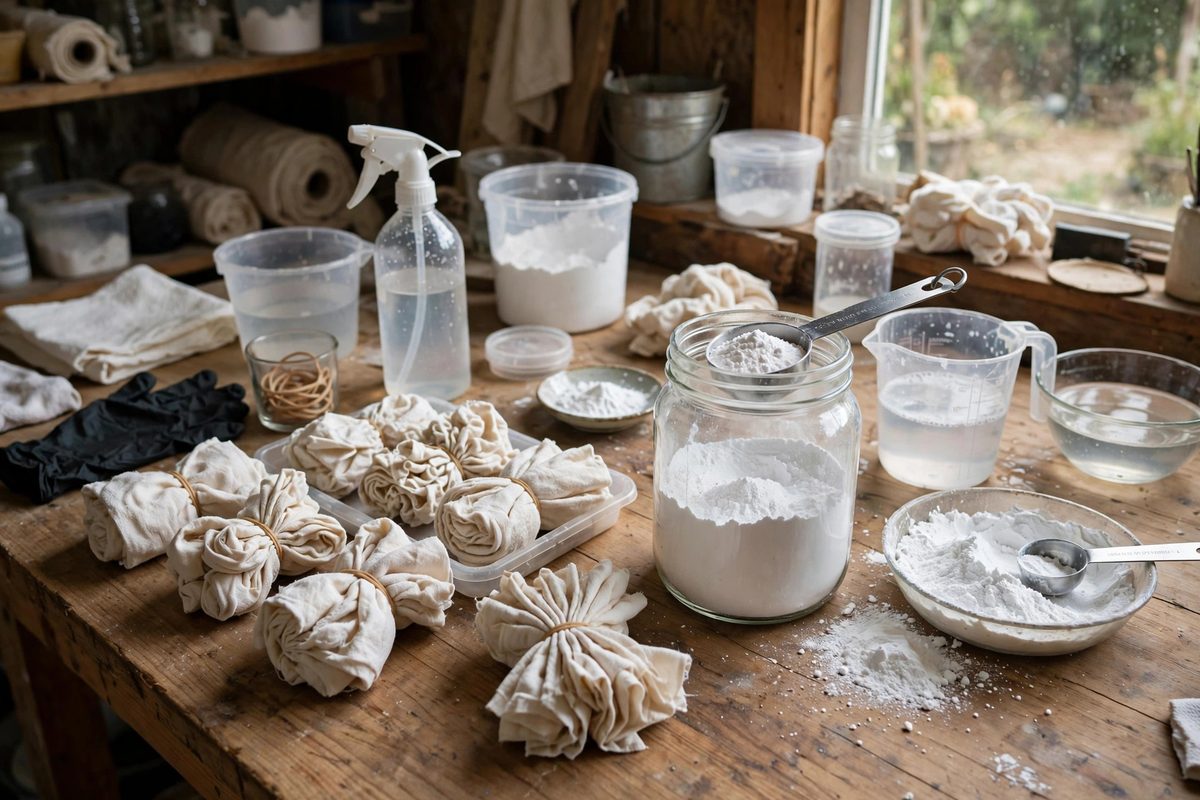
Dissolve the bicarbonate fully in warm water before adding dye; undissolved granules create local pH spots that dye unevenly. The bath concentration sets the buffering capacity: enough bicarbonate to hold the pH steady against the acids the dyeing process generates, but not so much that undissolved residue complicates rinsing. Pre-soak the prepared, scoured fabric in the bicarbonate solution so the fibers carry the buffer into the dyeing step; this pre-loading is what makes the mild alkalinity effective throughout the goods rather than just in the surrounding liquid. For tie-dye application, where dye is squirted onto bound fabric, the bicarbonate pre-soak is the standard method: the bound, buffered bundle then receives the dye and batches, wrapped, for the extended reaction time.
Batching time and temperature
Cold batch dyeing with bicarbonate needs time: the slower fixation at moderate pH means the wrapped bundles should batch for the better part of a day, often overnight or longer, at warm room temperature. Rushing the batch is the primary cause of pale, washout-prone results with this method; the dye needs the full time to complete its reaction with the fiber. Keep the batching bundles warm but not hot, since excessive heat with extended time can damage the fiber and shift colors, while cool conditions slow the reaction further. The patience the method demands is repaid in color quality: fully reacted dye is washfast dye, and the gentle conditions preserve the fabric's hand.
Rinsing and washing out
After batching, rinse in cool water to remove the bulk of unfixed dye, then wash progressively warmer with a mild detergent formulated for dye washout. The washout step is critical with any fiber reactive process: dye that reacted with the fiber stays, dye that merely stained the surface must leave, or it will bleed in later washings. Bicarbonate's gentleness does not exempt the work from thorough washout; if anything, the extended batching time means more hydrolyzed dye to remove. Wash until the water runs clear, and consider a final wash with hot water for light colors where any residual staining shows. The finished piece should survive its first real laundering without drama.
Safety and handling
Sodium bicarbonate is among the safest dye chemicals in the studio: it is food-grade, non-caustic, and requires no special handling beyond keeping the powder out of eyes and lungs during measuring. This safety profile is itself a reason to prefer it where it serves, especially in teaching settings and with young dyers. The dyes themselves still demand normal precautions: dust masks when handling powders, gloves during dyeing, and no eating or drinking at the dye table. Gentle chemistry does not mean careless practice.
Sodium bicarbonate buffers the tie-dye bath into the mild alkaline zone where fiber reactives fix slowly, controllably, and kindly. Pre-soak the goods, batch with patience, wash out thoroughly, and enjoy the extended working time. For subtle color and gentle processing, the buffer beats the brute force.
Related Guides
- Sodium Bicarbonate Buffering for Direct Powder Dyes: Tie-dye lives on bright, saturated color, and the chemistry behind that brightness is pH. The fiber-reactive dyes used in tie-dye need an alkaline
- Sodium Hexametaphosphate Binding in Hard Water Dyeing: Hard water is the invisible saboteur of dyeing. Calcium and magnesium ions bind fiber-reactive dyes before they ever reach the fabric, producing
- Soda Ash Soaking Chemistry for Direct MX Dye Saturation: Soda ash, plain sodium carbonate, is the unsung workhorse of tie-dye. Fiber-reactive MX dyes only bond to cellulose in an alkaline environment, and
- Urea Solution Mixing Ratios for Ice Dyeing Cotton: Ice dyeing lays fiber-reactive dye powder over ice on scrunched cotton, and as the ice melts, the dye solution blooms through the fabric in