
UV resin cures in seconds under the right light, which makes it irresistible for small jewelry like pendants. But that instant cure has a catch: ultraviolet light penetrates only so far into the resin, and any resin the light does not reach stays liquid. Layer thickness limits, how deep each pour can be while still curing through, are the governing constraint of UV resin work. Pour thicker than the light penetrates and the pendant has a cured skin over a gooey center that will eventually leak, yellow, or fail.
How UV Curing Penetrates
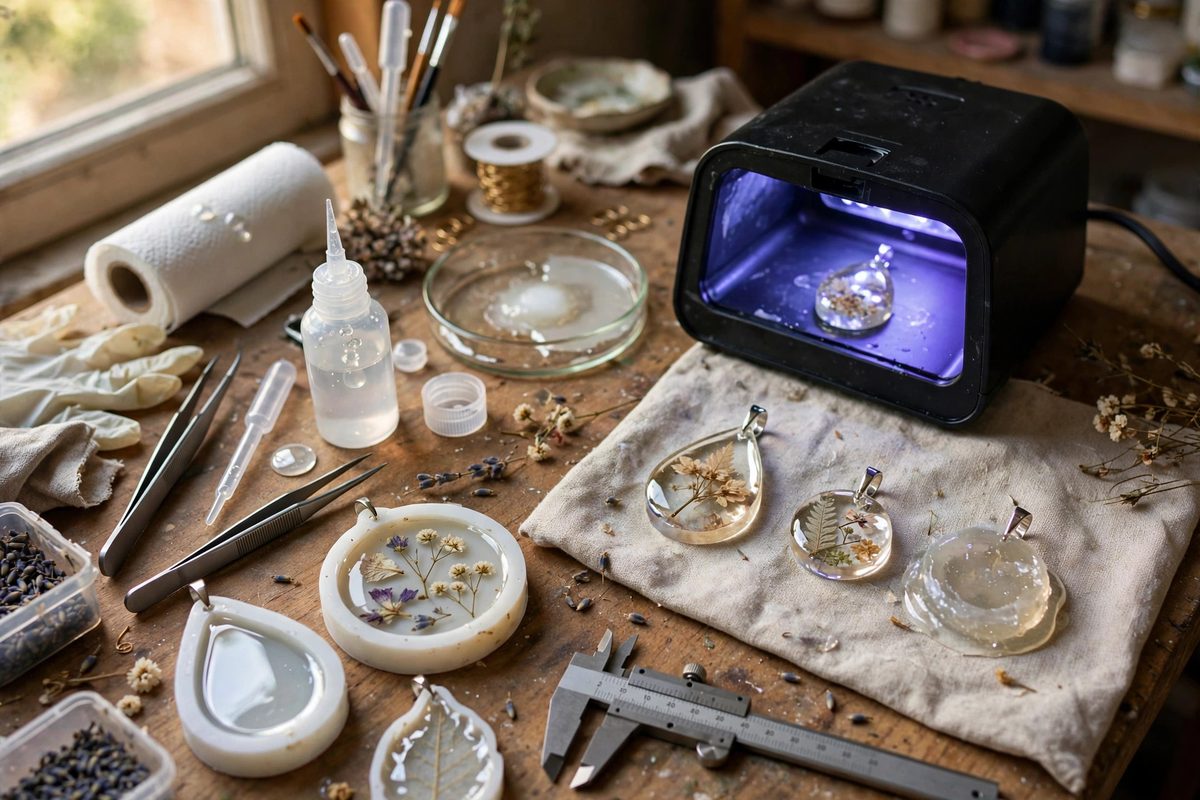
UV curing is a photochemical reaction: photons strike photoinitiators in the resin, which trigger the polymerization. The light is absorbed as it travels through the resin, so intensity falls with depth; the top cures fast and hard, while deeper resin receives progressively less light. Pigments, dyes, mica powders, and inclusions all absorb or scatter UV, reducing penetration further. A clear thin layer cures through easily; a pigmented thick layer may not cure at the bottom at all.
This is fundamentally different from two-part epoxy, which cures by chemical reaction throughout its mass regardless of light. UV resin's cure is a line-of-sight process: if the light cannot see it, it does not cure. Every pendant design must respect that line of sight.
Practical Thickness Limits
For clear UV resin under a proper UV lamp, layers around two to three millimeters cure reliably through. Add colorants and the safe thickness drops; heavily pigmented or opaque layers may need to stay near a millimeter. These are working guidelines, not specifications: lamp power, wavelength match to the resin's photoinitiators, and cure time all shift the numbers. Test your specific resin and lamp combination rather than trusting general figures.
Build pendants as a stack of thin cured layers rather than one deep pour. Each layer cures fully before the next goes on, which guarantees complete polymerization through the whole piece. The layer lines are invisible in clear resin when each layer cures properly; they become visible only when a layer under-cures and the interface clouds.
Lamp Power and Cure Time
Not all UV lights cure all UV resins. The resin's photoinitiators respond to specific wavelengths, typically in the near-UV range, and a lamp emitting the wrong wavelengths cures slowly or incompletely no matter how long you wait. Match the lamp to the resin's requirements; the resin's documentation specifies the effective wavelength band.
- Cure longer than the minimum; extra time is cheap insurance for through-cure.
- Rotate or flip the pendant when the design allows, curing from multiple angles.
- Replace aging UV bulbs; their output fades long before they burn out.
- Keep the lamp at the recommended distance; too far weakens intensity dramatically.
Inclusions and Colorants
Every inclusion is a UV shadow. Dried flowers, glitter, metal leaf, and embedded objects block light from the resin beneath and behind them, creating uncured pockets. Place inclusions in thin layers where light reaches around them, cure thoroughly, and be extra generous with cure time on inclusion layers. Opaque inclusions near the bottom of a thick layer are the classic cause of the gooey-center pendant.
Colorants deserve the same caution. A drop of transparent dye reduces penetration modestly; opaque pigment reduces it severely. When working with heavily colored UV resin, treat each layer as thin regardless of what clear resin would allow, and consider whether two-part epoxy might serve the design better than fighting UV's limits.
Testing for Complete Cure
The finished pendant should be hard, tack-free, and odorless throughout. Press a fingernail into an inconspicuous spot; fully cured resin resists denting. If the surface is tacky after proper curing, the top layer may need more light, or airborne inhibition may be at play (some resins cure tacky in air and need a final cure under a cover or in water). Tackiness that persists is a signal, not a cosmetic issue; address it before the piece leaves the bench.
When in doubt, cut open a test piece. A sacrificial pendant from the same batch, sectioned to reveal its interior, shows the truth about through-cure that no surface test can. The interior should be uniformly hard; any soft or gummy region means the layers were too thick or the cure too short.
Thin layers, matched lamp, generous cure time, and caution around anything that blocks the light. UV resin rewards the patient layer-builder with crystal-clear pendants; it punishes the deep-pourer with hidden goo. Build thin and cure completely.
Related Guides
- Open Bezel UV Resin Sealing With High-Tack Backing Tape: An open bezel is a metal frame with no back, which means UV resin poured into it has nothing to sit on until it cures. High-tack backing tape solves
- Silicone Mold Degassing to Stop Micro Bubbles: Micro bubbles in silicone molds are the invisible defect that ruins visible castings. The mold looks perfect, but tiny air bubbles trapped in the
- Bezel Wall Clearances for Clear Jewelry Embedments: Clear resin jewelry lives or dies by optical clarity, and the bezel wall, the metal rim holding the resin, is where clarity most often fails. Resin