
Adaptive clearing keeps the cutter engaged at a constant, controlled amount no matter how the geometry changes, and hard maple is the material that proves why this matters. Maple is dense, hard, and unforgiving of tool abuse: spike the cutter engagement in a corner and the tool deflects, chatters, or breaks; baby it everywhere and the job takes forever. Setting the engagement limits correctly lets the toolpath run fast in open areas and back off precisely where the geometry tightens, which is the whole promise of the strategy.
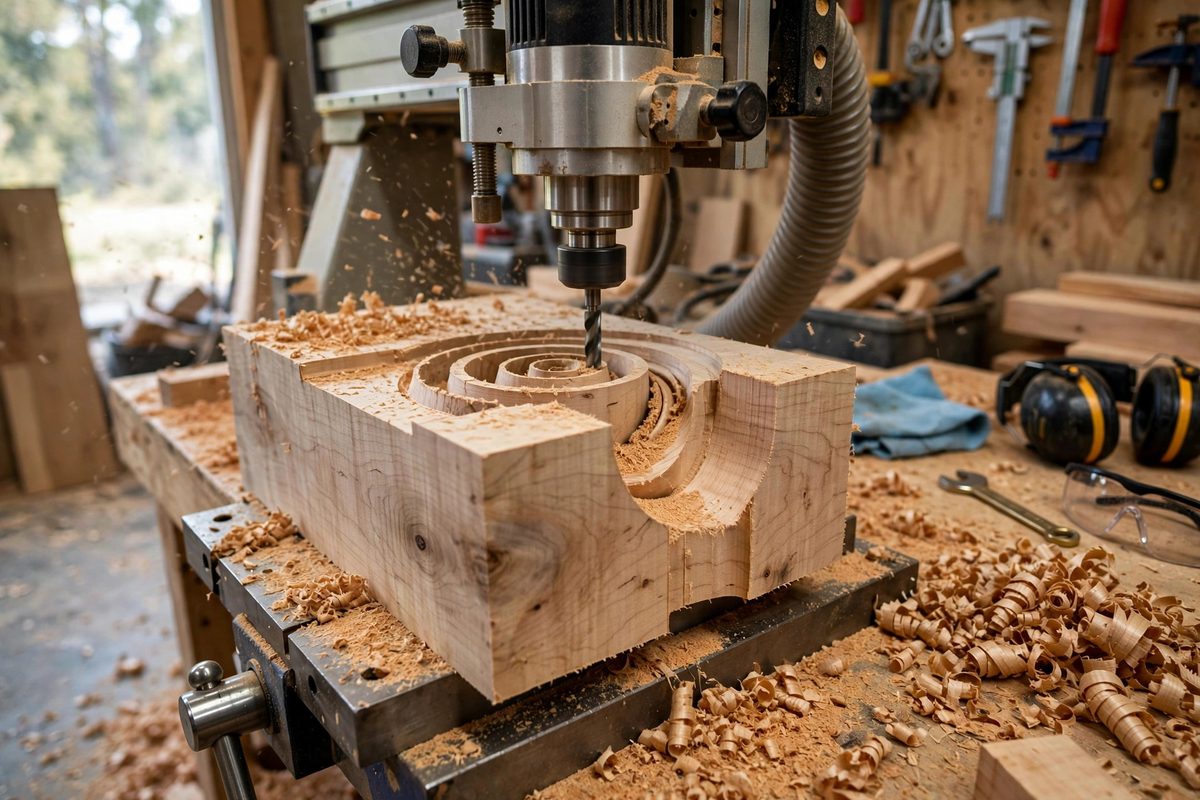
What adaptive clearing controls
In a conventional pocket toolpath, the cutter's engagement with the material varies wildly: light in open areas, suddenly heavy when the tool enters a corner or a narrow channel. That variation is what breaks tools and leaves chatter marks, because feeds and speeds are set for one engagement and the geometry delivers another. Adaptive clearing maintains a roughly constant radial engagement by adjusting the stepover and the path shape continuously, trochoiding around tight spots instead of plowing through them.
The engagement limit you set, usually expressed as a percentage of the cutter diameter or as an optimal load value, is the contract with the toolpath engine: never engage more than this. The engine then generates whatever looping, peeling motions are needed to honor it. Your job is to pick a limit the tool and the maple can actually sustain.
Engagement limits for hard maple
Hard maple's density and hardness put it at the demanding end of hardwoods. A reasonable starting point for a quality carbide end mill is an optimal load in the range of roughly 10 to 20 percent of the cutter diameter for roughing, with the lower end for smaller cutters and the upper end for rigid setups with larger tools. These are starting values, not commandments; the right number depends on the tool's flute count, the machine's rigidity, and the depth of cut.
Depth of cut interacts directly with engagement. Adaptive strategies typically run deep axially, often the full flute length or a large fraction of it, because the light radial engagement keeps the cutting forces manageable even at depth. This is the opposite of conventional roughing, which goes shallow and wide. If you carry conventional depth habits into adaptive clearing, you leave most of the strategy's efficiency on the table.
Reading the cut: sound, chips, and finish
The cut tells you whether the engagement limit is right. The sound should be a steady hum or light cutting noise with no squealing, chattering, or sudden load changes as the tool moves through different geometry; constancy of sound is the audible signature of constant engagement working. The chips should be small, consistent curls or flakes, not dust (which means the feed is too slow or the engagement too light) and not long stringy ribbons (which suggest rubbing).
Inspect the pocket walls after a test cut. A good adaptive rough leaves a uniform scallop pattern with no chatter marks and no burnished or burned spots. Burn marks in maple mean the tool rubbed instead of cutting, usually from too-light engagement combined with too-slow feed; surprisingly, increasing the engagement slightly often cures burning by getting the cutting edge properly into the material.
Machine rigidity sets the ceiling
The engagement limit the tool can handle and the limit the machine can handle are different numbers, and the machine's number governs. A hobby-grade router with noticeable gantry flex will chatter at engagement levels that a rigid machine handles easily. Start conservative on a new machine, prove the cut is clean, then increase the optimal load in small steps until the sound or finish degrades, then back off to the last good value. That value is the machine's honest limit for that tool in maple.
Workholding matters here too. Adaptive clearing at full depth generates real lateral forces, and a sheet of maple held by a few edge clamps can shift or vibrate. Make sure the holding is up to the forces the efficient toolpath produces; the fastest toolpath in the world is useless if the part moves.
Rest machining and the cleanup pass
Adaptive clearing is a roughing strategy; it leaves a consistent small amount of stock for a finishing pass. Set the rest machining and the stock-to-leave values so the finisher has uniform material to remove: uneven remaining stock forces the finishing tool into the same engagement variation the adaptive path was avoiding. A light finishing pass at full depth with a small stepover then produces the clean walls and floors the roughing made possible.
Set the engagement the maple and the machine can sustain, run deep, listen to the cut, and finish uniformly. Adaptive clearing done right makes hard maple feel like a cooperative material, which it never is under a conventional toolpath.
Related Guides
- Adaptive Clearing Stepover Limits for Hardwoods: Adaptive clearing, the high-efficiency toolpath that keeps constant cutter engagement by flowing around the part, transformed roughing on CNC
- Helical Ramp Angle Limitations in Hard Alloy Slotting: Cutting a slot in hard alloy, titanium, hardened steel, or nickel alloy, usually starts with getting the tool into the material, and helical ramping
- Trochoidal Milling Chip Thinning Controls: Trochoidal milling cuts slots and pockets with a rolling circular toolpath instead of plowing straight ahead, and it exists for one reason: chip
- Scallop Height Stepover Math for Smooth 3D Reliefs: A ball-nose end mill carving a 3D relief leaves a series of parallel grooves, and between adjacent grooves sits a ridge: the scallop. Scallop height