
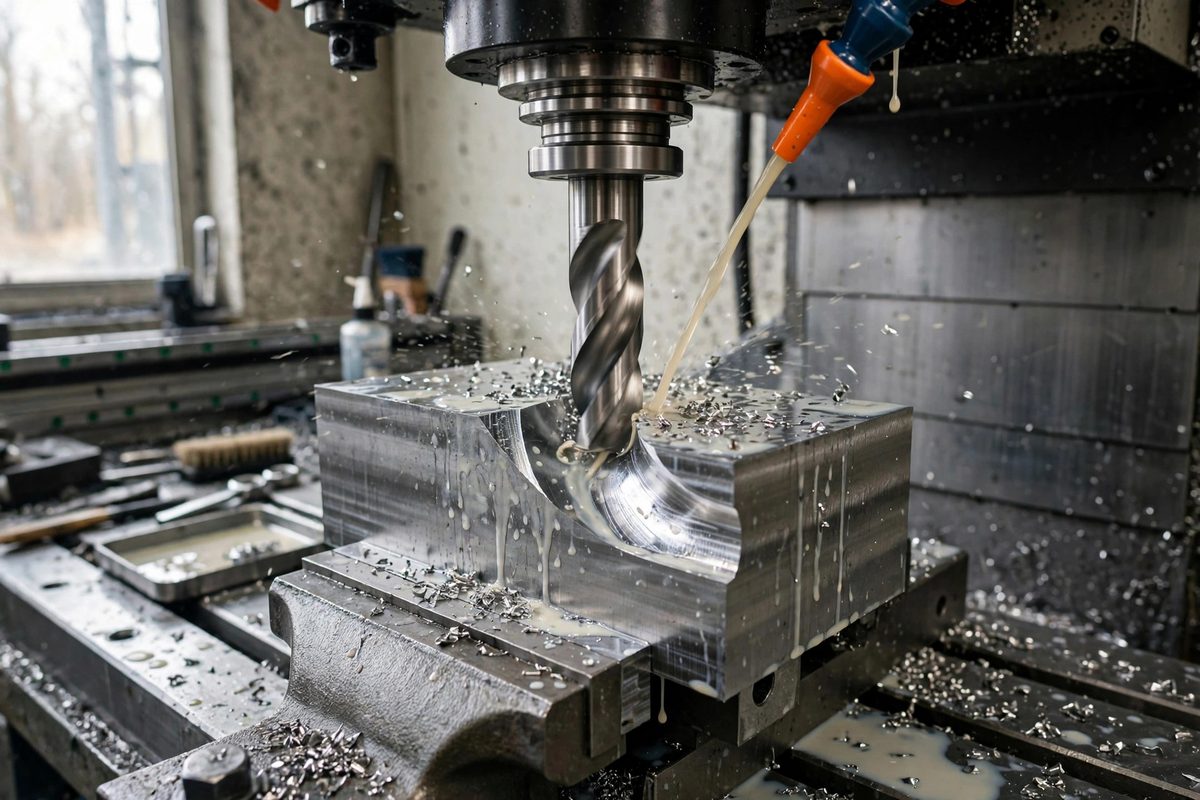
Cutting a slot in hard alloy, titanium, hardened steel, or nickel alloy, usually starts with getting the tool into the material, and helical ramping is the preferred entry: the tool spirals down, engaging gradually instead of plunging. But the ramp angle has hard limits in tough materials. Too steep and the tool overloads; too shallow and the cycle time balloons. The correct angle is an engineering decision, not a default.
Why Helical Ramping Suits Hard Alloys
A straight plunge drives the tool's full end face into the material, loading the tool axially in its weakest direction and generating enormous heat at the center where cutting speed is zero. In hard alloys, that combination breaks tools and work-hardens the material. Helical ramping keeps the tool moving sideways as it descends, so the cutting happens on the tool's periphery where the flutes cut efficiently, with a small axial component. The radial engagement stays controlled, heat evacuates with the chips, and the tool enters the slot without the shock of a plunge. For slotting, where the tool is fully engaged on both sides once in the cut, a gentle entry sets up the whole operation; a brutal entry work-hardens the slot floor and punishes the tool for the rest of the pass.
What Limits the Ramp Angle
The ramp angle determines how much material the tool removes per revolution of the helix: steeper angle means deeper axial advance per orbit, which means higher chip load on the end teeth. In hard alloys, the end teeth tolerate far less chip load than the peripheral teeth, because the cutting speed at the tool center approaches zero and the material does not shear cleanly there. The practical limit is the axial depth per revolution the tool can handle without the center overloading; for hard alloys this is small, often just a degree or two of ramp angle, compared to the steeper angles aluminum tolerates. Tool manufacturers publish maximum ramp angles per material family; treat those as ceilings, not targets. Exceeding the limit shows up as chipped tool centers, squealing entry, and a slot floor with a work-hardened skin.
Diameter, Helix, and Chip Evacuation
The helix diameter matters as much as the angle. A wider helix gives the chips room to escape and reduces the radial engagement; a helix barely larger than the tool traps chips in the slot, recutting them and generating heat. In hard alloys, where heat is the enemy, favor the widest helix the slot geometry allows. The ramp angle and helix diameter interact: for a given angle, a wider helix means more axial advance per revolution is spread over a longer path, effectively easing the cut. Program the entry as a true helix, not a series of stepped plunges; steps create dwell marks and shock loads at each level. Keep coolant or air blast directed into the entry zone during ramping, since chip evacuation at the bottom of a fresh slot is at its worst.
Tool Choice for Ramping Entries
Not all end mills ramp equally. Tools with end teeth designed for ramping, with proper dish and gash geometry, cut on entry far better than flat-bottomed tools with weak centers. Variable-helix and variable-pitch geometries damp the vibration that ramping entries excite. Coating choice matters in hard alloys: a coating suited to the material reduces the friction and heat at the tool center during entry. Check the tool's rated maximum ramp angle for the specific alloy; a tool rated for steel may have a much lower limit in titanium. Using the right tool at a conservative angle beats using a marginal tool at an aggressive angle every time. The entry is where tools die; spend the tool budget there.
Verifying and Tuning the Entry
Listen to the entry: a correct helical ramp sounds smooth and continuous, while an overloaded ramp squeals, chatters, or thumps with each orbit. Inspect the first slot's entry zone under magnification; a clean entry shows uniform tool marks, while an overloaded one shows smeared, work-hardened material and possibly chipped tool marks transferred to the floor. Measure tool wear after the first part; excessive wear on the tool's center confirms the angle was too steep. Tune by reducing the angle in small steps until the entry runs quietly and the tool survives the expected tool life. Log the proven angle, helix diameter, feeds, and speeds for the alloy; hard alloy slotting parameters are earned knowledge, and the log is the shop's memory.
Helical ramp angles in hard alloys are limited by what the tool's center can cut: stay within the manufacturer's ceiling, favor wide helices for chip evacuation, choose tools designed to ramp, and tune by ear and inspection. A gentle entry makes the whole slot possible.
Related Guides
- Adaptive Clearing Engagement Limits for Hard Maple: Adaptive clearing keeps the cutter engaged at a constant, controlled amount no matter how the geometry changes, and hard maple is the material that
- Trochoidal Milling Chip Thinning Controls: Trochoidal milling cuts slots and pockets with a rolling circular toolpath instead of plowing straight ahead, and it exists for one reason: chip
- Adaptive Clearing Stepover Limits for Hardwoods: Adaptive clearing, the high-efficiency toolpath that keeps constant cutter engagement by flowing around the part, transformed roughing on CNC
- Scallop Height Stepover Math for Smooth 3D Reliefs: A ball-nose end mill carving a 3D relief leaves a series of parallel grooves, and between adjacent grooves sits a ridge: the scallop. Scallop height