
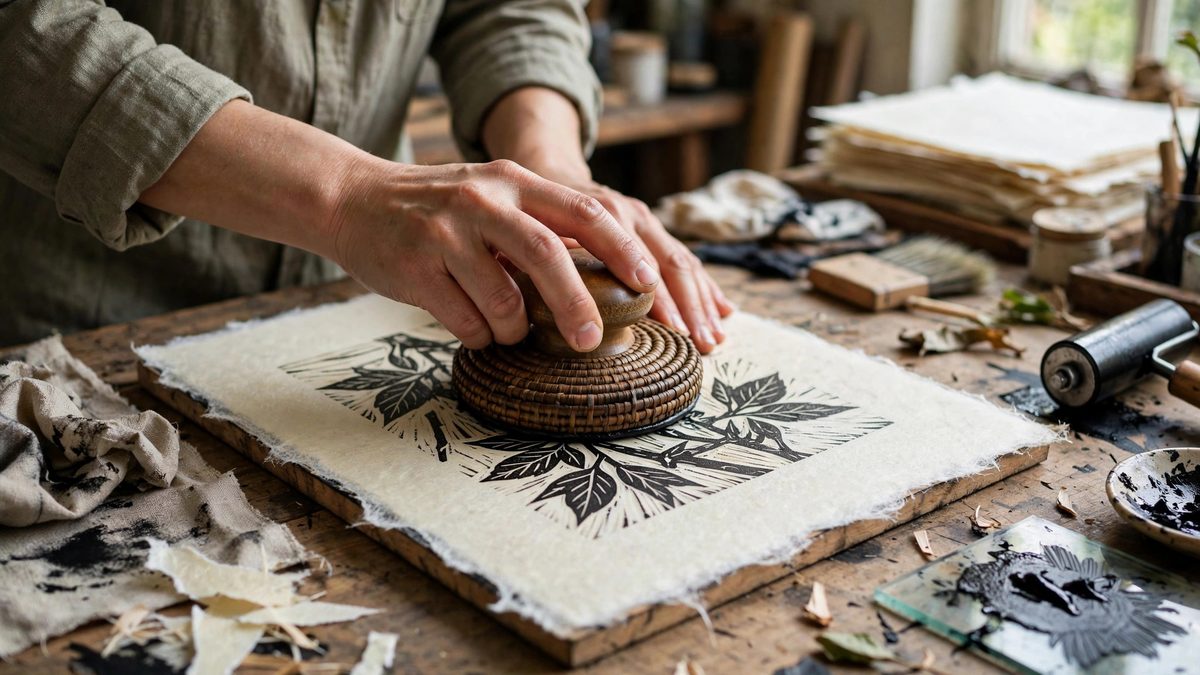
Kozo paper, the long-fibered Japanese paper beloved by printmakers, takes linocut ink beautifully when burnished by hand with a baren. But kozo's soft, textured surface has pressure limits: too little pressure and the ink never transfers fully, too much and the paper embosses, stretches, or tears. Finding the pressure window is the skill behind clean hand-pulled prints on kozo.
Why Kozo Responds to Pressure Differently
Kozo fibers are long and strong, which gives the paper its famous toughness, but the sheet itself is soft and compressible with an open texture. Under the baren, the paper compresses into the carved block's inked surface; the ink transfers where the paper meets the raised areas. Light pressure leaves the paper bridging across the texture, touching only the highest ink, which prints pale and uneven. Heavy pressure forces the paper deep into the carved lines, embossing the sheet and potentially tearing the fibers at the line edges. The correct pressure is the minimum that achieves full, even ink transfer: enough to mate the paper to the ink film completely, no more. This window is narrower on kozo than on harder Western papers, which is why the technique needs attention.
Reading the Transfer
Peek at the print early and often during the first pulls. Lift a corner of the paper carefully and check the transfer: pale or patchy areas need more pressure or more ink, while embossed lines or a stretched, wavy sheet mean too much pressure. The ideal pull shows solid, even ink with the paper flat and unmarked on the back except for the faintest impression. Kozo's translucency is actually an advantage here: you can often see the transfer developing through the back of the sheet as you burnish, watching the dark areas fill in. Learn to read that ghost image; it tells you where to add another pass and where to stop.
Baren Technique for Even Pressure
Use a proper baren with a smooth, flat face, or a well-chosen substitute like the back of a spoon for small areas. Work in overlapping circular or spiral motions, covering the whole block systematically rather than scrubbing one spot. Keep the pressure moderate and consistent; the most common error is bearing down hard in the middle and going light at the edges, which prints a dark center fading to pale margins. Distribute your body weight evenly through the arm, not through the wrist, to avoid pressure spikes. For large blocks, work in zones, completing each zone before moving on, and overlap the zones slightly. A thin protective sheet between baren and paper reduces friction and prevents the baren from scuffing the kozo surface.
Ink, Moisture, and Paper Prep
Pressure limits interact with ink and moisture. Slightly damp kozo is more pliable and transfers ink at lower pressure than bone-dry kozo; many printers lightly mist the paper before printing. But wet kozo tears far more easily, so damp means barely humid, not wet. The ink should be rolled to a smooth, even film, tacky enough to transfer but not so stiff that it demands crushing pressure. Too much ink on the block forces you to press harder to avoid squash-out at the line edges; the right ink film prints cleanly at moderate pressure. If you find yourself leaning on the baren, check the ink and the paper moisture before pressing harder; the problem is rarely a lack of force.
Edition Consistency
Hand burnishing varies from impression to impression unless you systematize it. Develop a fixed routine: same number of passes, same pattern, same pressure, and pull the edition in one session if possible, since your pressure drifts with fatigue. Number and inspect each print; cull or set aside any that fall outside your standard, because an edition is only as good as its weakest impression. Rest between prints on long editions; tired arms press unevenly. Kozo rewards the patient, consistent printer with prints of remarkable depth and softness, the very qualities that make the paper worth the trouble.
Kozo's pressure window is the minimum force for full transfer: read the ghost image through the sheet, burnish in even overlapping passes, keep the paper faintly humid and the ink film right, and systematize the routine. Respect the limit and the paper gives you everything.
Related Guides
- V-Gouge Cutting Geometry on Mounted Linoleum: The V-gouge is the defining tool of linocut: it carves the lines that will print. But the V shape is not just a shape; it is a cutting geometry, and
- Oil-Based Relief Ink Tack Control on Wood Blocks: Relief printing lives or dies on ink tack: the stickiness that transfers ink from roller to block to paper cleanly. Oil-based relief inks are prized
- Multi-Block Registration Pins for Color Reduction Cuts: Reduction linocut destroys the block as it goes: each color layer is carved away after printing, so there is no going back to fix a misregistered