
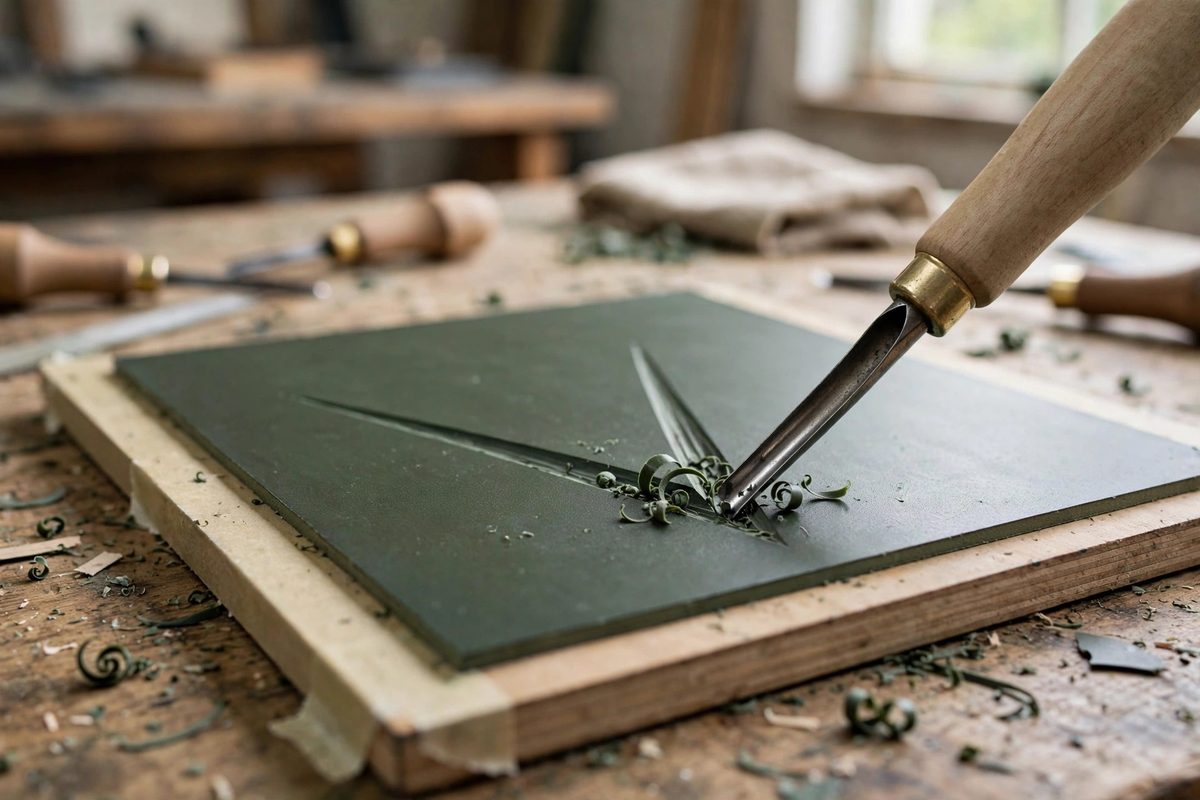
The V-gouge is the defining tool of linocut: it carves the lines that will print. But the V shape is not just a shape; it is a cutting geometry, and how that geometry meets the linoleum determines whether your lines are crisp and controlled or ragged and skittery. Mounted linoleum, bonded to a wood or MDF block, behaves differently from loose lino. Understanding the angle of attack, the bevel, and the material's response turns the V-gouge into a precision tool.
How the V Cuts
A V-gouge has two cutting edges meeting at a point, like a tiny plow. Pushed forward, each edge shears a shaving off the surface, and the two shavings curl out of the channel, leaving a V-shaped trough. The width of the trough depends on how deeply the tool sits: press lightly and only the point engages, cutting a hairline; lean in and the wider part of the V engages, cutting a broader line. This depth-to-width relationship lets one gouge produce a whole range of line weights, but depth control is entirely in the hand, which is also the source of most trouble. The cutting happens at the bevel, the angled face behind each edge; a sharp bevel slices, a dull one tears. A truly sharp V-gouge cuts with noticeably less effort and far cleaner walls.
Angle of Attack
The handle angle, how steeply the tool meets the block, controls the cut's character. A low angle, with the handle nearly parallel to the block surface, lets the bevel ride along and produces a shallow, skimming cut: thin lines, fine detail, minimal resistance. Raise the handle toward 30 or 40 degrees and the tool digs deeper, cutting wider, bolder lines, but also demanding more force and increasing the risk of the tool diving or catching. Beginners cut too steeply, muscling the tool and producing ragged channels. The correction: lower the handle, lighten the pressure, and let the sharp edge do the work. For long lines, lock your wrist and push from the shoulder at a consistent low angle; uniform depth means uniform width.
Mounted Block Advantages
Linoleum mounted on a rigid block changes the cutting feel in two helpful ways. First, the block does not flex or creep under the tool the way a loose sheet can, so cuts track truly and fine detail does not wander. The tradeoff: you cannot bend the block to meet the tool on curves the way you can flex a loose sheet. Instead, rotate the block itself: keep the gouge stationary in your dominant hand and turn the block with the other hand to steer through curves. Mounted blocks reward this because their weight and stability make rotation smooth and controlled. Anchor the block with a bench hook or non-slip mat so it rotates without sliding.
Steering Curves and Corners
Curves are cut by rotating the block, not by twisting the tool. Twisting the gouge mid-cut changes the angle of attack and usually gouges one wall of the channel deeper than the other, producing a lopsided line. For tight curves, take small bites: advance the tool a short distance, rotate the block slightly, advance again. Corners, where two straight cuts meet, need a different approach: cut up to the corner from one direction, lift the tool, reposition, and cut into the corner from the other direction. Cutting through a corner in one motion almost always overshoots; the tiny overlap where two cuts meet cleans up easily, the overshoot does not.
Clearing and the Printed Line
Remember that you are carving the negative: every channel you cut prints as white (or the paper color), and everything you leave standing prints as ink. A single V cut produces a thin white line on a black field, useful for detail and texture. To make a bold white area, you clear with wider tools, but the V-gouge defines the edges of that area. Keep the channel walls clean: ragged walls catch ink during roll-up and print as fuzzy, gray edges instead of crisp white. If a channel wall tears, clean the edge with a light, low-angle pass rather than recutting deeper. And clear the shavings as you go: a shaving trapped under the tool lifts the cutting edge and changes the depth mid-line.
Sharpening the V
A V-gouge dulls with use, and linoleum's slight abrasiveness accelerates the process. The tell is increased effort and tearing rather than slicing. Sharpening a V requires honing both bevels evenly to preserve the point's symmetry; an asymmetric V cuts a lopsided channel. A slip stone or a shaped strop fits into the V's interior, and a flat stone or strop handles the outside bevels. A few careful strokes per side, tested on a scrap, usually restores the edge. Do not grind aggressively: removing too much metal changes the V angle and shortens the tool's life. Sharp tools are safer: a sharp gouge moves with light pressure while a dull one invites the heavy pushing that leads to slips. Cut away from your body and keep the guiding hand behind the tool's path, always.
The V-gouge rewards a light hand and a low angle. Let the bevel ride, rotate the block through curves, and keep the edge sharp. Master those three habits and the tool will cut exactly the line you imagined.
Related Guides
- Oil-Based Relief Ink Tack Control on Wood Blocks: Relief printing lives or dies on ink tack: the stickiness that transfers ink from roller to block to paper cleanly. Oil-based relief inks are prized
- Baren Burnishing Pressure Limits on Kozo Papers: Kozo paper, the long-fibered Japanese paper beloved by printmakers, takes linocut ink beautifully when burnished by hand with a baren. But kozo's
- Multi-Block Registration Pins for Color Reduction Cuts: Reduction linocut destroys the block as it goes: each color layer is carved away after printing, so there is no going back to fix a misregistered