
Open hardware lives or dies on its bill of materials. A beautifully documented circuit board with a BOM that says "10k resistor" is not reproducible: which 10k resistor, what tolerance, what package, what voltage rating, from where? BOM transparency, the practice of specifying every part completely enough that a stranger can source and build the project, is the unglamorous foundation of hardware sharing. Without it, "open source hardware" is a schematic and a wish. With it, a design becomes a thing other people can actually make.
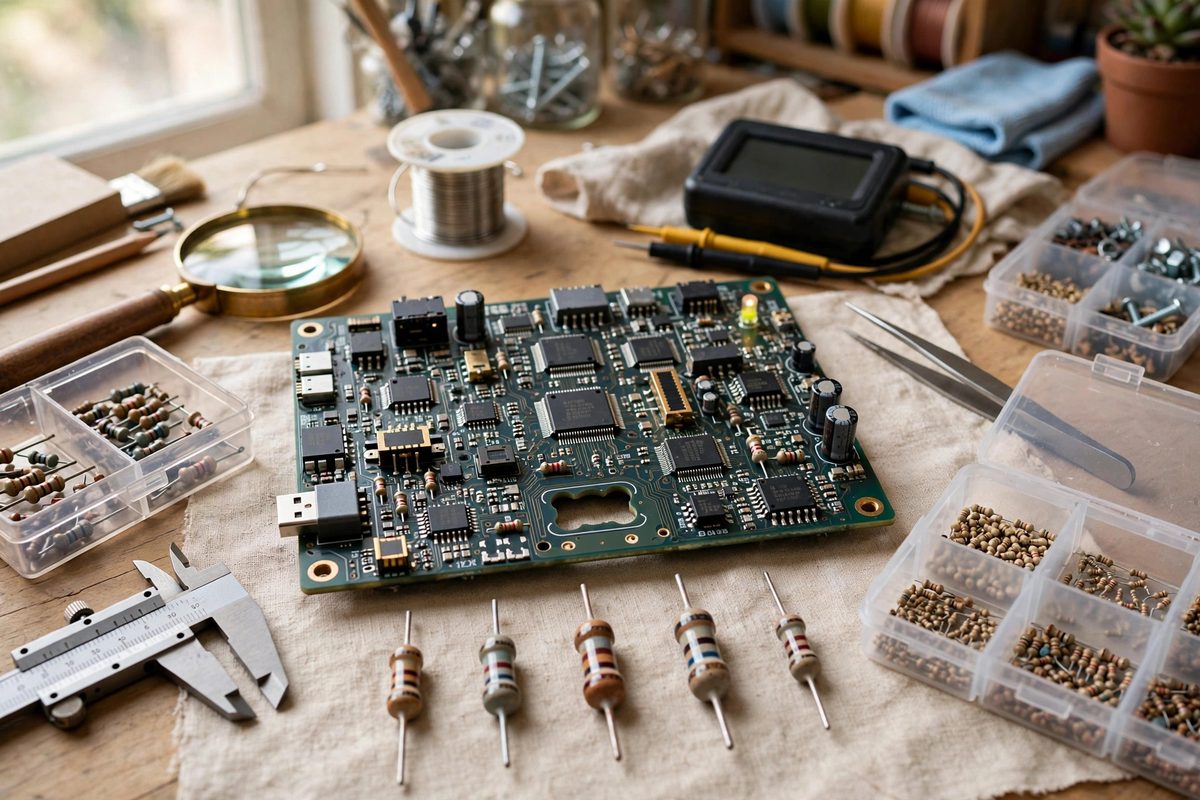
What a Transparent BOM Contains
Each line of a transparent BOM identifies the part unambiguously and provides sourcing paths. The essentials: a complete part description including value, tolerance, rating, and package; the quantity; the designator references showing where it goes; and at least one orderable manufacturer part number. Better BOMs add alternates, equivalent parts from other manufacturers, because single-source lines go stale. The best add sourcing notes: "any 1% 0603 thick-film," "critical: low-ESR type," "substitute freely," which tell the builder where precision matters and where it does not. What transparency excludes is equally important: no "or equivalent" without defining equivalent, no distributor SKUs as the only identifier (they change), no missing packages, no mystery parts identifiable only by a photo. The test is simple: hand the BOM to a competent builder on another continent and ask whether they can order everything without asking you a question.
Why Partial BOMs Fail
Incomplete BOMs fail in predictable ways that waste builders' time and kill projects. The wrong-package failure: "capacitor 100n" ordered in the wrong footprint, discovered at assembly. The wrong-rating failure: a resistor with adequate resistance but inadequate power rating, which works until it burns. The unobtainable-part failure: a specific component that was in stock when the designer built it and is now end-of-life, with no alternate listed. The counterfeit-risk failure: a BOM specifying only a generic description pushes builders toward the cheapest listing, which for some components means fakes. Each failure teaches the builder that the project is not really reproducible, and builders who get burned stop building. Transparency is therefore not generosity; it is quality control on the project's reproducibility, and projects that lack it quietly die from builder attrition.
Standards and Formats
Transparency benefits from standard formats that tools can process. A CSV or spreadsheet BOM with consistent columns, designator, quantity, description, manufacturer part number, alternate, notes, is the baseline: human-readable, machine-parseable, version-controllable. Structured formats that integrate with the EDA tool, exported directly from the schematic, eliminate transcription errors: the BOM should be generated, not retyped. Include the BOM in the project's version control alongside the design files, so it evolves with the design and its history is visible. Reference the BOM revision in build documentation: "build with BOM rev C," because a BOM that drifts from the design files is worse than no BOM. Some projects publish interactive BOMs linked to the board layout, which is excellent for assembly but does not replace the sourcing-grade line items. The format matters less than the completeness and the maintenance: a perfect template with stale data fails the same test.
The Sourcing Reality
A transparent BOM confronts the reality that parts availability is regional, temporal, and economic. Design for sourcing resilience from the start: prefer jellybean parts with multiple manufacturers over exquisite single-source components, because the BOM's transparency is worthless if the parts cannot be bought. Note lifecycle status for critical parts and provide alternates proactively, not after the part goes end-of-life. Consider the builder's minimum order economics: a BOM requiring ten different distributors for small quantities prices out casual builders, so consolidating toward fewer suppliers, or noting which parts can be salvaged or substituted, is a genuine accessibility improvement. For specialized parts, the project maintainer can bulk-buy and resell, or document a group-buy process; this is logistics work, unglamorous and essential, and it is part of what "sharing hardware" actually entails.
Transparency as a Design Discipline
Writing a transparent BOM disciplines the design itself. The designer who must specify every part completely discovers the unspecified assumptions: the capacitor whose voltage rating was never considered, the connector chosen by habit rather than availability, the "standard" part that is standard only in one country. This discovery improves the design before anyone builds it. It also forces honesty about cost: a transparent BOM with real part numbers can be costed accurately, and the true build cost, stated plainly, sets honest expectations. Projects that hide their BOMs often hide their costs too, and the builder's surprise at checkout is another form of attrition. Transparency, maintained as a discipline from the first prototype, compounds: each revision's BOM is a small effort, while reconstructing a BOM for a finished undocumented design is a forensic project.
BOM transparency is the difference between publishing a design and sharing it. Specify every part completely, provide alternates, use generatable formats, design for sourcing reality, and let the discipline improve the design. The builders on other continents will thank you by actually building it.
Related Guides
- Attribution Licensing for Physical Open Hardware CAD: You release a CAD design for a tool, a jig, or a machine, and you want two things: for people to build on your work, and for your name to stay
- Core Tenets of the Open Hardware Rights Charter: Open hardware, the idea that physical objects can carry the same freedoms as open-source software, needs a clear statement of rights to be more than
- Licensing Non-Functional Aesthetic CAD Enclosures: Maker CAD files occupy a strange legal middle ground. A bracket that holds a motor is a functional object; an enclosure shaped like a vintage radio
- Defining Public Domain Boundaries in Open 3D Scans: 3D scanning has made it trivially easy to capture the physical world as digital meshes: museum artifacts, architectural details, machine parts