
Maker CAD files occupy a strange legal middle ground. A bracket that holds a motor is a functional object; an enclosure shaped like a vintage radio is an aesthetic one. When you share or sell CAD files for enclosures whose value is in how they look rather than what they do, the licensing questions get interesting, and getting them right protects both you and the community.
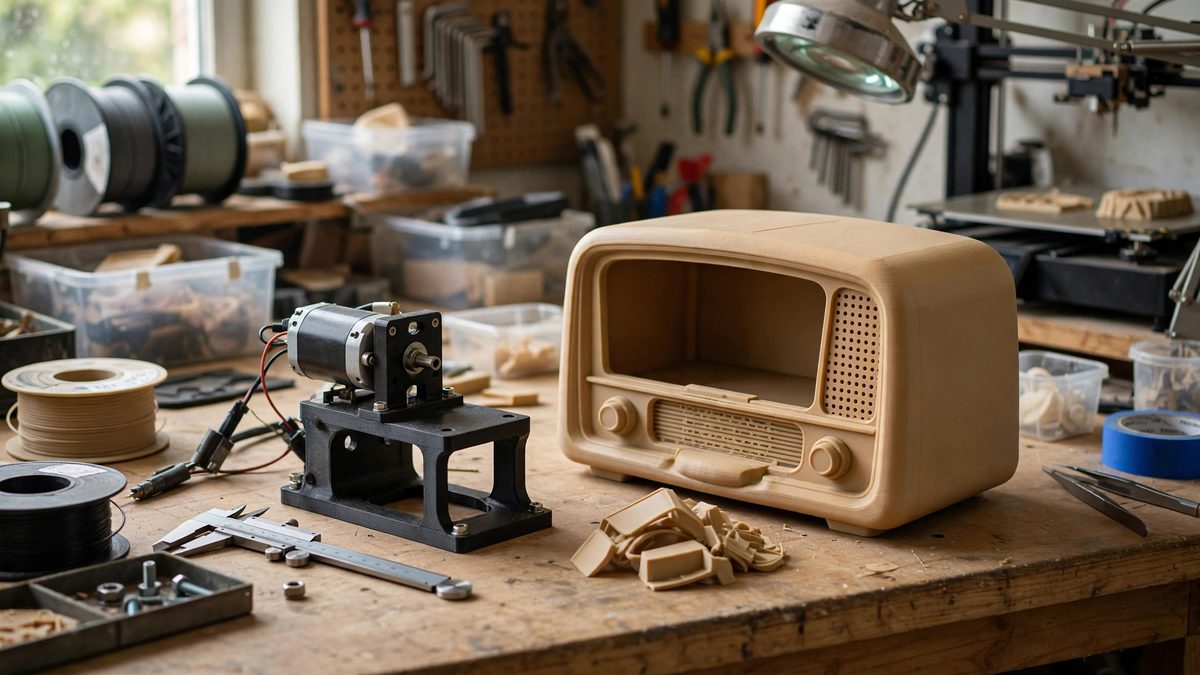
Why aesthetic enclosures are different
Functional designs are hard to protect: in most jurisdictions, the shape of a thing dictated by its function cannot be locked up the way a creative work can. Aesthetic enclosures flip that. When the curves, textures, and proportions exist to look a certain way rather than to perform, the design starts to look more like a creative work, which changes what rights you hold and what licenses make sense. Understanding which side of the line your enclosure falls on is the first licensing decision, because it determines what you actually have to license.
Open licenses and what they grant
Open hardware and creative licenses exist on a spectrum from permissive to share-alike. A permissive license lets anyone use, modify, and sell the design with minimal obligations, usually just attribution. A share-alike or copyleft license requires derivatives to be shared under the same terms, which keeps the design in the commons. For aesthetic enclosures, where the value is the look, think carefully about which behavior you want to encourage: permissive licenses maximize adoption, share-alike licenses maximize the growth of the shared design pool. Neither is morally superior; they are different strategies.
The commercial-use question
The most common licensing friction in maker communities is commercial use. Someone downloads your enclosure, prints a hundred, and sells them. If that bothers you, say so in the license before it happens, because retroactive complaints have no standing and poison the community. Non-commercial clauses are available in several license families, but be honest with yourself about enforcement: a non-commercial clause you never enforce is just a suggestion, and one you enforce selectively is a grudge. Choose the clause you will actually live with.
Attribution in practice
Almost every open license requires attribution, and almost nobody does it well. Make attribution easy: put your name, the license, and a link in the file's documentation, in the filename or a README, and ideally as text embossed or printed into the design itself where it does not hurt the aesthetics. The easier you make compliance, the more of it you get. Treat attribution as marketing rather than policing; every credited reuse is an advertisement for your design work.
Derivatives and remixes
Maker culture runs on remixes: someone takes your enclosure, changes the proportions, adds a feature, and shares the result. Decide in advance how you feel about this, because the license decides it for you once published. Share-alike licenses keep remixes in the open; permissive licenses let remixers close their versions. If your enclosure has a distinctive aesthetic identity you care about, consider whether you want that identity diluted across unattributed variants. There is no wrong answer, but there is a wrong time to decide, which is after the remix already exists.
Writing it down
Whatever you choose, write it down clearly with the files. A LICENSE text file in the download, a stated license on the project page, and the license name in the CAD file's metadata cover the bases. Ambiguity defaults to nobody's benefit: downloaders cannot know your intent, and you cannot enforce terms you never stated. Clarity is the cheapest legal protection available.
An aesthetic enclosure is creative work wearing a maker's clothes. License it deliberately, make compliance easy, and decide your commercial and remix terms before the community decides them for you.
Related Guides
- Attribution Licensing for Physical Open Hardware CAD: You release a CAD design for a tool, a jig, or a machine, and you want two things: for people to build on your work, and for your name to stay
- Core Tenets of the Open Hardware Rights Charter: Open hardware, the idea that physical objects can carry the same freedoms as open-source software, needs a clear statement of rights to be more than
- BOM Transparency Standards in Physical Hardware Sharing: Open hardware lives or dies on its bill of materials. A beautifully documented circuit board with a BOM that says "10k resistor" is not reproducible
- Defining Public Domain Boundaries in Open 3D Scans: 3D scanning has made it trivially easy to capture the physical world as digital meshes: museum artifacts, architectural details, machine parts