
3D scanning has made it trivially easy to capture the physical world as digital meshes: museum artifacts, architectural details, machine parts, natural forms. Sharing those scans openly accelerates making enormously, letting anyone print, study, or remix a captured object. But openness raises a hard question that the scanning community has not fully answered: which scans belong to everyone, and which belong to someone? A scan of a centuries-old sculpture and a scan of a currently manufactured replacement part sit in very different legal and ethical territory, even though the scanning process is identical. Defining the public domain boundaries for open 3D scans is the shared work that keeps the commons both useful and legitimate.
Why scans are legally peculiar
A 3D scan occupies an awkward position in intellectual property law. The scan is arguably a slavish reproduction of the object, and reproductions that add no original creative expression traditionally earn no new copyright. But scanning involves choices, resolution, cleanup, hole-filling, decimation, that look like authorship, and some jurisdictions grant rights in the digital file even when the underlying object is public domain. Meanwhile the object itself may carry its own rights: a contemporary sculpture is copyrighted, a patented mechanism is protected regardless of who scans it, and trademarks persist on logos captured incidentally. The scan is thus a bundle of potentially conflicting claims: rights in the object, rights in the file, and the scanner's own assertions. Treating all scans as uniformly free ignores this complexity; treating them all as restricted kills the commons.
The clear public domain core
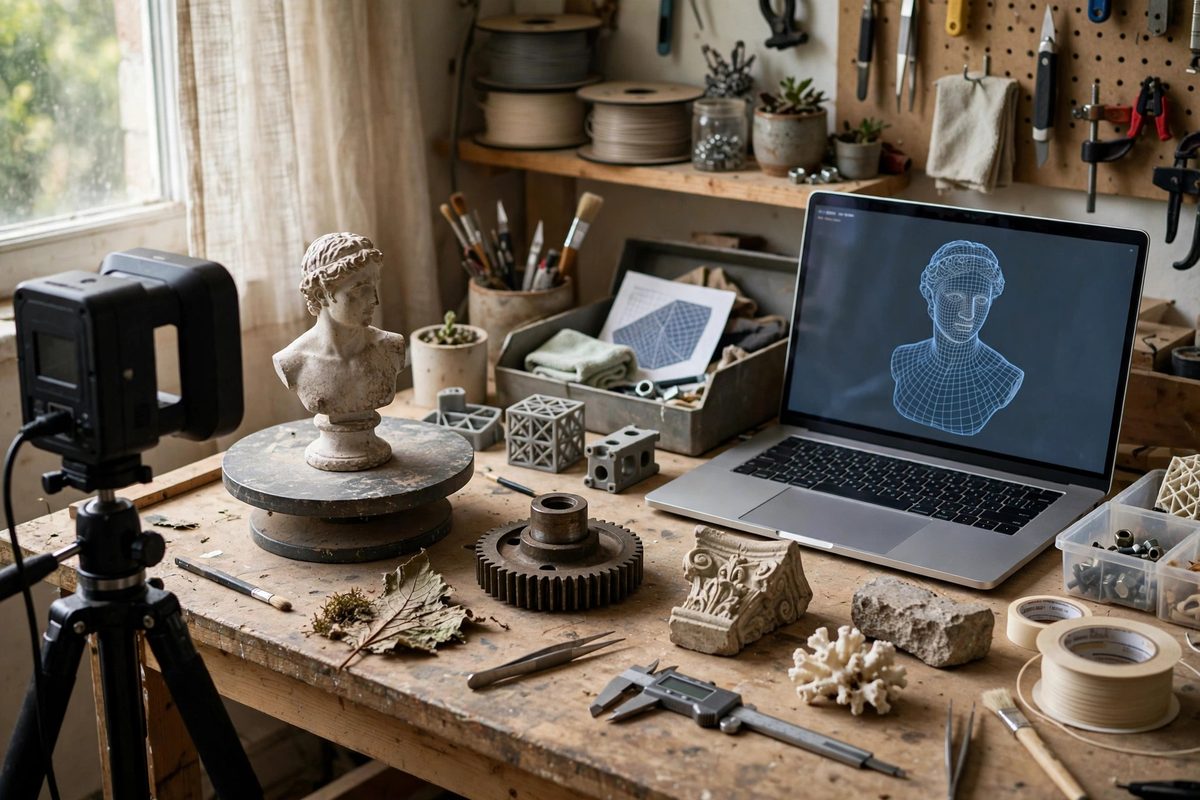
Some categories are straightforward. Scans of natural objects, rocks, shells, botanical specimens, capture things nobody owns, and the resulting meshes belong in the commons without controversy. Scans of utilitarian objects whose designs are long out of any protection, ancient tools, historical hardware, are similarly clear. Government works and artifacts explicitly released into the public domain by their custodians form another solid core. The community should treat these categories as the undisputed heart of open scanning: scan them, share them, remix them freely, and say so clearly in the licensing metadata. A commons with a confident, well-documented core is more useful than a larger commons clouded by uncertainty.
The contested boundaries
Difficulty concentrates at the edges. Museum artifacts present the sharpest case: the object may be millennia old and unquestionably public domain, while the museum asserts rights over photography and scanning on its premises, sometimes through contract terms at the door rather than copyright. Functional parts raise patent questions: scanning a patented component and sharing the mesh may enable infringement even if the scan itself is legal to make. Contemporary artworks and designs carry the artist's copyright into any scan. Cultural heritage objects raise ethical claims beyond law: some communities assert stewardship over scans of sacred or sensitive artifacts regardless of legal public domain status. Each boundary needs its own reasoning. A single rule for all scans will be wrong for most of them.
Licensing as boundary-marking
Clear licensing is how the community marks these boundaries in practice. Scans of public domain objects should carry public domain dedications or equivalent permissive terms, stated explicitly rather than assumed. Scans with encumbered objects need licenses that reflect the actual rights situation, which sometimes means sharing for study but not for commercial reproduction. The license metadata should travel with the file: embedded where the format allows, and documented on the hosting page regardless. Just as important is documenting provenance: what was scanned, where, when, and under what terms of access. A scan with clear provenance and an honest license is useful even when its reuse is limited, because users can evaluate the boundaries themselves. An unlicensed scan of unknown origin is a liability no matter how beautiful the mesh.
Ethics beyond law
Legal public domain status does not settle every question. Scanning human remains, sacred objects, or culturally sensitive sites may be legal and still wrong without the consent of the relevant communities. The open scanning community has begun developing norms around consent and respectful use that go beyond what statutes require, and these norms deserve the same seriousness as legal compliance. When in doubt, ask: contact the custodians, the community, or the creators before scanning and sharing. The commons is a social project as well as a legal one, and its legitimacy depends on trust. A scan shared over the objections of its stakeholders poisons the well for everyone.
A working manifesto
The open 3D scanning community should stand for this: scan the public domain boldly and share it freely with clear dedications. Document provenance and license honestly for everything else. Respect the contested boundaries by marking them, not by ignoring them. Seek consent where ethics demand it, beyond what law requires. Build the tooling, formats, and repositories that make licensed, provenanced scans easy to share and hard to strip of their metadata. And keep arguing about the hard cases in the open, because the boundaries will keep moving and the commons stays healthy only through continuous, honest deliberation.
Open 3D scanning needs boundaries to stay open: a confident public domain core, honestly marked edges, licenses that travel with files, and ethics that exceed the law. Define the boundaries well and the commons grows on solid ground. Leave them vague and it grows on quicksand.
Related Guides
- Attribution Licensing for Physical Open Hardware CAD: You release a CAD design for a tool, a jig, or a machine, and you want two things: for people to build on your work, and for your name to stay
- Core Tenets of the Open Hardware Rights Charter: Open hardware, the idea that physical objects can carry the same freedoms as open-source software, needs a clear statement of rights to be more than
- BOM Transparency Standards in Physical Hardware Sharing: Open hardware lives or dies on its bill of materials. A beautifully documented circuit board with a BOM that says "10k resistor" is not reproducible
- Licensing Non-Functional Aesthetic CAD Enclosures: Maker CAD files occupy a strange legal middle ground. A bracket that holds a motor is a functional object; an enclosure shaped like a vintage radio