
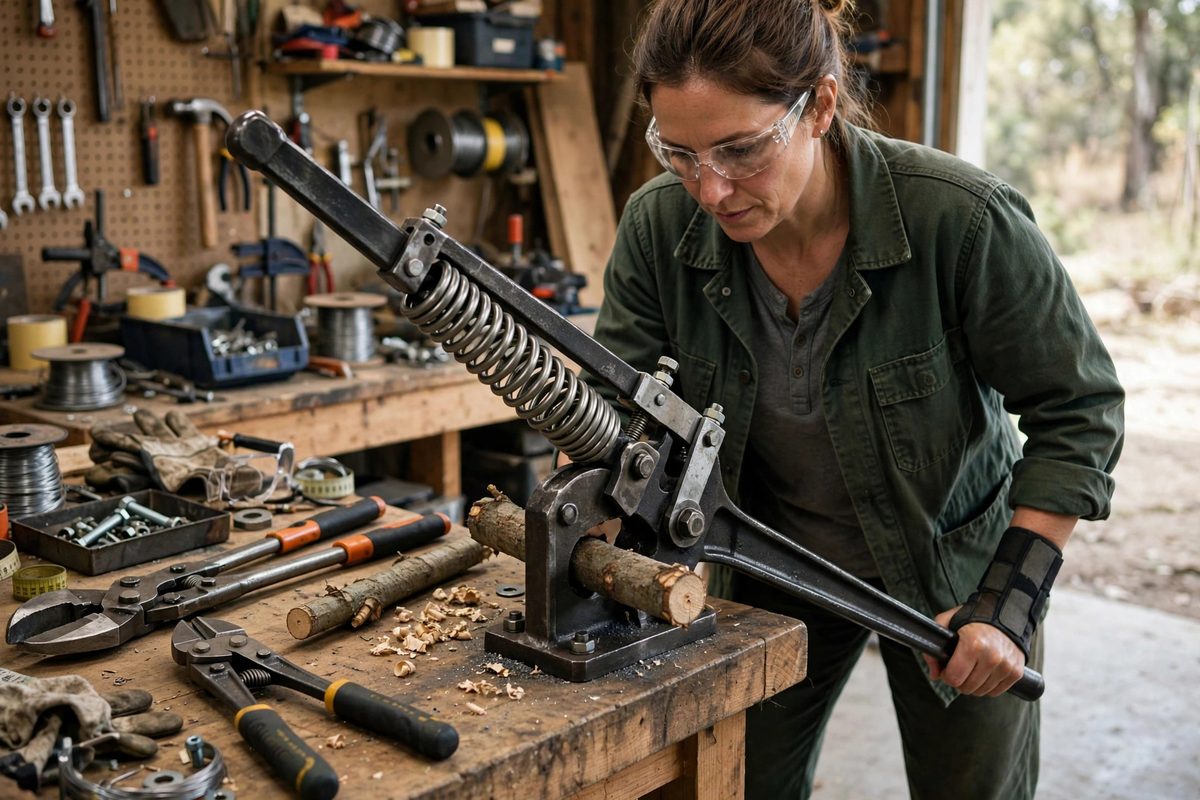
Heavy lever tools, bolt cutters, long-handled loppers, big crimpers, ask the operator to fight gravity as well as the workpiece. The tool's own weight becomes part of the effort on every stroke. A well-tensioned counterbalance spring carries that dead weight, so the user's effort goes into the cut instead of into holding the tool up.
What the spring is balancing
A lever tool has a resting position and a working stroke. Between strokes, gravity pulls the heavy handles or jaws back toward rest, and the operator either holds them up or lets them fall and lifts again. The counterbalance spring is sized to roughly cancel the tool's own weight through its range of motion, so the handles feel nearly weightless. It does not assist the cutting or crimping force; that still comes from the user. Its whole job is removing the tool's mass from the effort equation, which matters most for users with limited strength or endurance.
Sizing the tension to the tool
The right tension balances the tool without overpowering it. Too weak and the handles still droop; too strong and the spring fights the operator on the working stroke and can snap the handles back dangerously when released. The practical test: with the tool unloaded, the handles should stay wherever you put them through the stroke, neither falling nor springing. Start with a spring rated near the tool's handle weight at the spring's attachment radius, then adjust. Since leverage multiplies the spring's effect by its mounting position, small changes in attachment point tune the feel more than swapping spring sizes.
Spring types and mounting
Extension springs, tensioned between two points, are the common choice for retrofit counterbalances; torsion springs at the pivot suit purpose-built designs. Mount the spring so its pull line stays reasonably aligned with the handle's motion through the stroke, because a spring that goes slack at one end of travel or binds at the other is useless at exactly the positions that need it. Use hardware rated well above the spring's force: mounting eyes, hooks, and anchors that fail under spring tension become projectiles. Inspect mounts on a schedule, since vibration and cycling fatigue metal over time.
Balancing across the stroke, not just at rest
A single spring has a linear force curve while the tool's weight has a rotational one, so perfect balance through the whole stroke is not achievable with one spring. Aim for good balance through the middle of the working range, where the operator spends the most time. The ends of travel can be slightly heavy or slightly springy without ruining the feel. If the imbalance at the extremes bothers the user, a second smaller spring with a different attachment radius can flatten the curve further, though at some point the added complexity outweighs the gain.
Adjustability for different users
In shared or adaptive settings, one tension does not fit all. A spring tension that feels weightless to one user may feel fighty to another with less grip strength. Where feasible, make the tension adjustable: multiple anchor holes, a turnbuckle in the spring line, or swappable springs of known ratings. Label the settings so users can return to what works for them. The adjustment itself should be tool-light and safe, with no need to fight a loaded spring during the change.
Safety around stored energy
A tensioned spring holds real energy. Keep fingers clear of the spring's line of travel during adjustment, wear eye protection when installing or removing springs, and use proper spring hooks rather than improvised wire. A spring that lets go during installation moves fast. Once installed and guarded, the counterbalance is quiet and safe; the danger is entirely in the setup and service, so give those moments full attention.
Size the spring to the tool's weight, mount it to stay engaged through the stroke, make it adjustable for the user, and respect the stored energy during service. The tool gets lighter in the hand without getting weaker in the cut.
Related Guides
- Single-Lever Quick Adjustment Mechanisms for Vises: A traditional vise demands two things many makers cannot easily give: the grip strength to spin a handle repeatedly and the patience to crank the jaw
- Universal Grip Geometry for Hand Tremors: Hand tremors turn ordinary tool handles into adversaries: the tool amplifies the shake, precision evaporates, and fatigue sets in fast. Universal
- One-Handed Clamp Quick Release Trigger Geometries: One-handed bar clamps are the solo woodworker's third hand: squeeze the trigger to advance the jaw, press the release to open it. But the trigger
- Bi-Directional Latch Geometries for Hand Weakness: Most latches assume a capable hand: pinch a small tab, push against a stiff spring, twist while pressing, all in one coordinated motion. For someone