
A traditional vise demands two things many makers cannot easily give: the grip strength to spin a handle repeatedly and the patience to crank the jaw across inches of empty travel before it even touches the work. Single-lever quick-adjustment mechanisms solve the second problem completely and ease the first: one lever disengages the screw so the jaw slides freely to the workpiece, and then a short throw of the same lever, or a few turns, applies clamping force. For anyone with limited hand strength or stamina, it changes a vise from an obstacle into a tool.
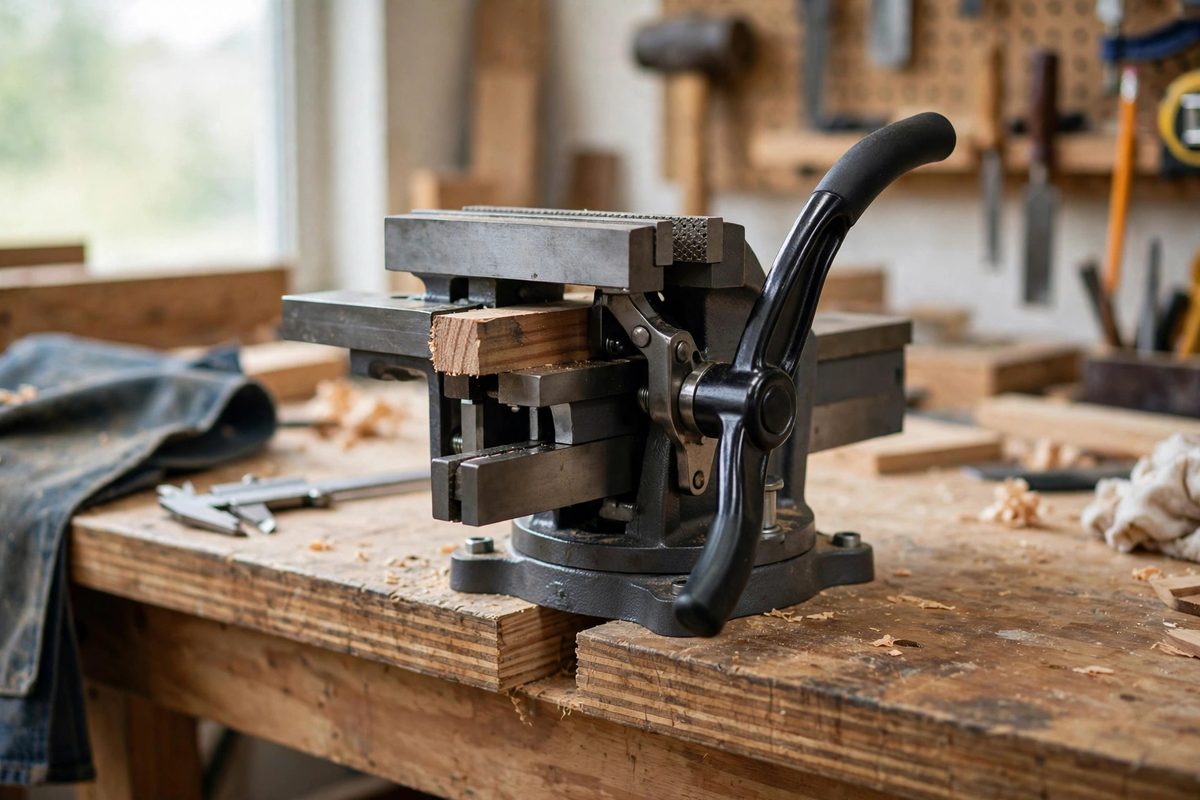
How Quick-Adjustment Mechanisms Work
The core idea is a half-nut or split-nut that can engage and disengage the vise screw. In the engaged position, turning the handle drives the jaw exactly like a traditional vise. Pull or flip the lever, and the nut drops away from the screw threads, freeing the jaw to slide along the screw by hand. Push the jaw up to the work, flip the lever back, and the nut re-engages: now a small turn of the handle, or a cam action on the lever itself, applies full clamping force. Some designs use a cam lever that both releases and clamps in one motion, eliminating the screw handle entirely for the final tightening. The mechanism is mechanical, not powered, which keeps it reliable and affordable.
Why This Matters for Accessibility
Consider what a standard vise asks of the user: dozens of handle rotations to open the jaw, position the work, then dozens more to close it, all requiring sustained grip and wrist rotation. For someone with arthritis, carpal tunnel, or reduced hand strength, that repetitive cranking is painful or impossible, and it happens on every single clamping operation. Quick adjustment collapses the travel time to a second: slide, engage, tighten. The remaining effort is a short, controlled motion rather than a long repetitive one. This is the essence of inclusive design: the tool adapts to the user's capacity instead of demanding the user adapt to the tool.
Types of Single-Lever Designs
Several mechanisms achieve the same goal. The half-nut lever is the classic: a lever on the vise body lifts the nut off the screw for free sliding. Cam-lock vises replace the screw handle with a lever that drives the jaw through a cam, giving fast travel and strong clamping in one motion, though usually with less total clamping force than a screw vise. Trigger-style mechanisms, borrowed from caulking guns and bar clamps, advance the jaw with repeated squeezes and release with a thumb lever. Each has trade-offs: half-nut designs keep the full strength of a screw vise, cam designs are fastest, and trigger designs need the least hand strength per action but may not hold as rigidly under heavy loads like sawing or filing.
Choosing the Right Vise for the Work
Match the mechanism to the forces involved. For light work like holding small parts for drilling or assembly, a cam or trigger vise is plenty and wonderfully fast. For heavy work like sawing, filing, or bending metal, you want the holding power of a screw vise with quick adjustment, because the screw's mechanical advantage is what resists the working forces. Check the jaw width and opening capacity against your typical workpieces: a quick-adjust vise that cannot open wide enough for your work is no improvement. And look at how the vise mounts: a vise that needs two hands to reposition on the bench undermines the accessibility gains of the quick adjustment.
Retrofitting an Existing Vise
If you already own a traditional vise, a full replacement is not the only option. Some vises can be fitted with quick-release nuts as aftermarket parts, and a few designs allow adding a lever to an existing half-nut. Even without a mechanism change, you can reduce the cranking burden: keep the screw clean and lubricated so it turns easily, add a longer or larger-diameter handle for more leverage with less grip force, or mount a small parts vise with quick adjustment alongside the big vise for the frequent light clamping jobs. The goal is to reserve the heavy cranking for the rare jobs that truly need it.
Maintenance Keeps It Quick
Quick-adjustment mechanisms depend on clean, smooth-moving parts. Sawdust, metal chips, and dried lubricant in the nut or cam track will make the lever stiff and the sliding jaw gritty, which defeats the purpose. Blow out the mechanism regularly, keep the screw lightly oiled, and check that the engaging lever moves freely through its full range. A mechanism that sticks halfway can fail to engage the nut fully, and clamping on a partially engaged nut damages the threads. A minute of maintenance keeps the one-lever promise true.
Single-lever quick adjustment is one of those rare improvements that helps everyone while being essential for some. Faster setup, less repetitive strain, and full clamping power when you need it: if your vise still makes you crank through inches of empty air, it is worth asking why.
Related Guides
- Counterbalance Spring Tension in Heavy Lever Tools: Heavy lever tools, bolt cutters, long-handled loppers, big crimpers, ask the operator to fight gravity as well as the workpiece. The tool's own
- Universal Grip Geometry for Hand Tremors: Hand tremors turn ordinary tool handles into adversaries: the tool amplifies the shake, precision evaporates, and fatigue sets in fast. Universal
- One-Handed Clamp Quick Release Trigger Geometries: One-handed bar clamps are the solo woodworker's third hand: squeeze the trigger to advance the jaw, press the release to open it. But the trigger
- Bi-Directional Latch Geometries for Hand Weakness: Most latches assume a capable hand: pinch a small tab, push against a stiff spring, twist while pressing, all in one coordinated motion. For someone