
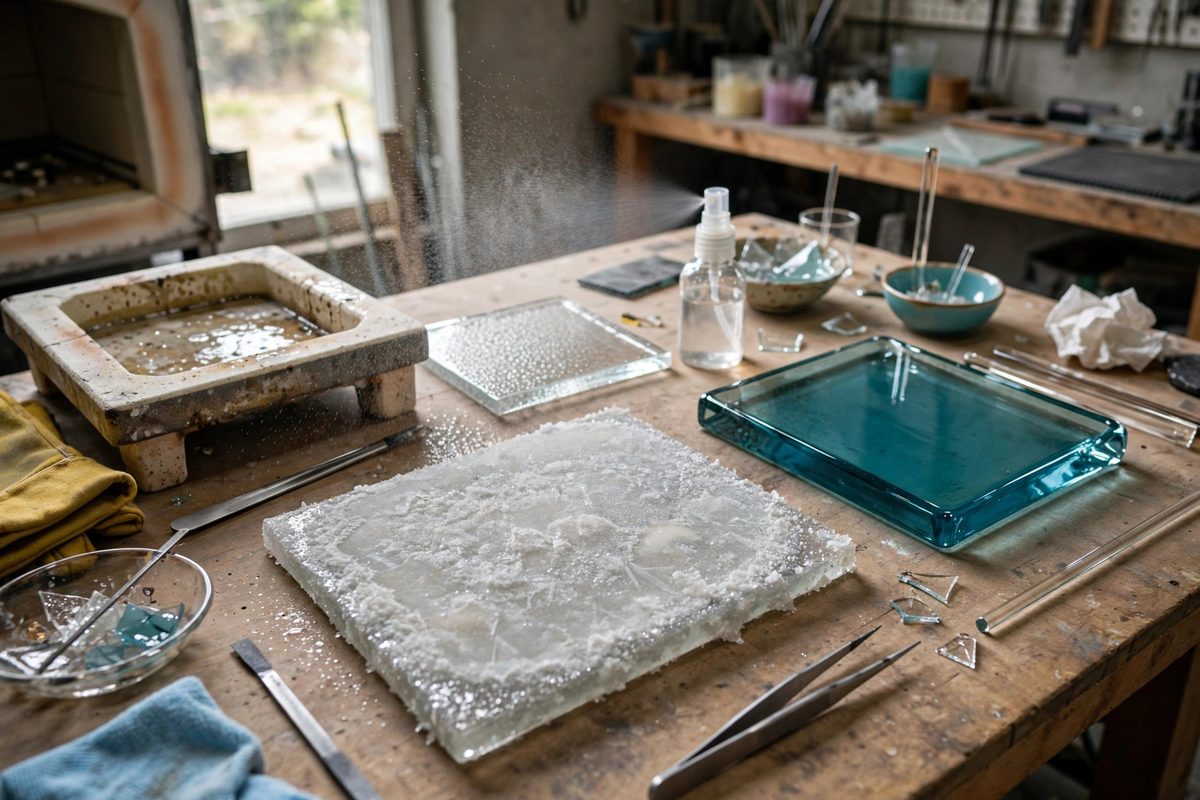
Devitrification is the milky, scummy crystallization that forms on the surface of fused glass when it spends too long in the temperature zone where crystals grow faster than they dissolve. It turns a glossy, jewel-clear surface into something that looks fogged or dusty, and once it forms, it is stubborn to remove. Spray barriers, thin coatings applied before firing that suppress crystal growth on the surface, are the standard defense. They do not change the firing schedule; they change what the surface is allowed to do during it.
What Devitrification Actually Is
Glass is a liquid frozen in place, and at certain temperatures it wants to reorganize into crystals. The devitrification zone sits roughly in the upper-middle of the firing range, where the glass is soft enough for atoms to move but not hot enough to fully melt. Long soaks for tack fusing or slumping hold the glass right in that zone, which is why devit shows up most on pieces with extended mid-range holds.
The surface is where it starts, because the surface has the most nucleation sites: dust, fingerprints, kiln wash particles, even the texture left by a dirty shelf. Crystals grow outward from those seeds. That is why the fix is a surface barrier rather than a schedule change; you cannot always shorten the soak, but you can deny the crystals their starting points.
How Spray Barriers Work
Devit sprays form a microscopically thin glassy film over the piece before firing. The film melts into a smooth, continuous skin at temperature, covering the nucleation sites and presenting the devitrification zone with a surface that has nothing to start from. Think of it as shrink-wrapping the glass in a cleaner version of itself.
Application is straightforward: spray a light, even mist over the clean glass surface, let it dry completely, and fire as usual. The key word is light. A heavy coat can leave its own residue or interfere with the fuse, while a missed patch devitrifies exactly where the spray did not reach. Two light passes from different angles beat one heavy pass.
Surface Prep Before Spraying
The barrier can only cover what is there, and it cannot cover a fingerprint. Clean the glass thoroughly before spraying: wash with a mild glass cleaner or a vinegar solution, rinse, and handle only by the edges afterward. Any oil from your fingers becomes a nucleation site that the spray may not fully mask.
- Clean in a dust-free moment, not right after sweeping the studio.
- Let the glass dry fully after washing; trapped moisture under the spray can cause its own defects.
- Spray in a ventilated area and wear a respirator; the mist is fine particulate and you do not want it in your lungs.
- Keep the spray nozzle clean; a sputtering nozzle lays down an uneven film.
Firing Schedules That Minimize Devit
Spray is a barrier, not a cure-all. Schedules still matter. Move through the devitrification zone as quickly as the piece allows: a fast ramp up to the process temperature gives crystals less time to nucleate. Where the schedule requires a long soak, as in slumping, the spray earns its keep, but keep the soak no longer than the forming requires.
Avoid repeated firings of the same surface when you can. Each trip through the devit zone adds crystal growth, and a piece fired three times is far more likely to scum than one fired once. Plan the firing sequence so each surface sees the minimum number of cycles.
Dealing With Devit That Already Formed
Light devit can sometimes be fire-polished away: a quick trip to a high enough temperature re-melts the surface crystals back into glass. This works for faint haze, not for heavy, well-established crystallization, which may need sandblasting or grinding to remove. Prevention is dramatically cheaper than repair, which is the whole argument for the spray.
If you find yourself fire-polishing repeatedly, look upstream. Recurring devit on the same setup usually means contaminated shelves, dirty kiln wash, or glass stored where airborne dust settles on it. The spray handles the normal case; a dirty studio overwhelms it.
Clean the glass, spray it lightly, and move through the danger zone with purpose. Devitrification is a surface problem with a surface solution, and the barrier spray is the simplest, most reliable version of it.
Related Guides
- Annealing Soak Times for Thick Bullseye Glass: Fused glass looks finished when it comes out of the kiln, but invisible stresses inside can shatter it weeks or months later if the piece was not
- Soak Cycle Scheduling for Slumping Complex Glass Basins: Slumping flat glass into a complex basin mold, with deep curves, tight corners, or asymmetric sections, is a thermal balancing act. The glass must
- Full Fuse Thermal Ramp Rates for Multi-Layer Bullseye: A full fuse melts stacked glass layers into a single smooth tile, and multi-layer Bullseye projects push the kiln schedule harder than simple