
A full fuse melts stacked glass layers into a single smooth tile, and multi-layer Bullseye projects push the kiln schedule harder than simple two-layer work. More layers mean more trapped air, more thermal mass, and more opportunity for thermal shock. The ramp rates, how fast the kiln climbs and cools, are what carry a complex stack through the firing intact.
Why Ramp Rate Matters
Glass expands when heated and contracts when cooled, and thick multi-layer stacks develop temperature differences between their surfaces and their cores. If the kiln ramps faster than heat can equalize through the stack, the outside expands while the inside lags, and the stress cracks the piece. The same happens in reverse on cooling. Slower ramps keep the temperature gradient across the stack small, which keeps the stress below the breaking point. Every extra layer adds thermal mass and slows heat penetration, so the schedule must get more conservative as the stack grows.
The Heating Ramp
Climb slowly through the lower ranges where the glass is rigid and brittle, typically a few hundred degrees per hour for substantial multi-layer work. As the glass approaches its softening range, the ramp can continue steadily; the critical discipline is avoiding sudden jumps. Hold at the bubble squeeze temperature, a soak below the full fuse point, long enough for trapped air between the layers to escape to the edges; rushing past this stage seals bubbles into the finished piece permanently. Then climb to the full fuse target and hold just long enough for the layers to merge and the surface to smooth, since over-soaking at top temperature thins the piece and rounds the edges more than intended.
Annealing: The Non-Negotiable Phase
After the fuse, the glass must cool through the annealing range slowly enough for internal stresses to relax. For multi-layer thicknesses, the annealing soak is long, measured in hours, at the annealing temperature for the glass thickness. Skimp on annealing and the piece may look fine leaving the kiln, only to crack days or weeks later as residual stress finds a flaw. Thicker stacks need longer soaks; there is no shortcut that does not eventually bill you. Follow the anneal with a slow controlled cool to room temperature, because fast cooling after a good anneal can reintroduce the stress you just relieved.
Compatibility and COE
Bullseye glass is formulated for compatibility within its own line, but multi-layer projects still demand discipline: keep the project to tested-compatible glass, and be cautious mixing in unknown scrap no matter how pretty. Incompatible glass fuses fine and then cracks later as the different expansion rates fight during cooling, sometimes weeks after the firing. When in doubt, fire a small test stack through the full schedule before committing the real piece; the test costs one firing and saves the project.
Reading the Fired Piece
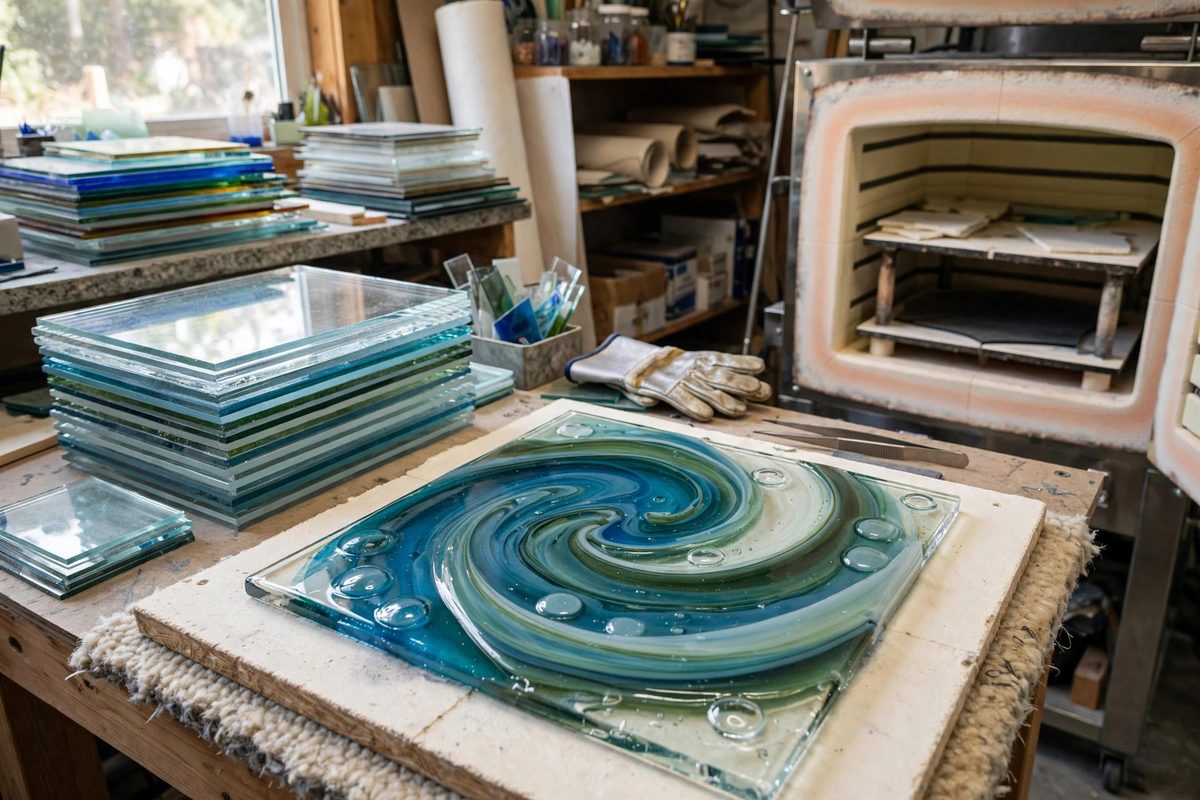
A successful multi-layer full fuse shows smooth merged layers, clear glass without trapped bubbles, and edges that flowed just enough to round without slumping thin. Bubbles trapped mid-stack mean the bubble squeeze was rushed. A piece that cracks in the kiln or shortly after points to ramp or anneal problems. Keep a firing log with the exact schedule, and adjust one variable at a time; kiln work compounds knowledge slowly, and the log is what turns one good firing into repeatable good firings.
Slow ramps for thick stacks, a real bubble squeeze soak, a full annealing hold, compatible glass, and a written log. The multi-layer fuse then comes out of the kiln as one calm piece of glass instead of several stressed ones pretending.
Related Guides
- Annealing Soak Times for Thick Bullseye Glass: Fused glass looks finished when it comes out of the kiln, but invisible stresses inside can shatter it weeks or months later if the piece was not
- Devitrification Spray Barriers for Fused Glass: Devitrification is the milky, scummy crystallization that forms on the surface of fused glass when it spends too long in the temperature zone where
- Soak Cycle Scheduling for Slumping Complex Glass Basins: Slumping flat glass into a complex basin mold, with deep curves, tight corners, or asymmetric sections, is a thermal balancing act. The glass must