
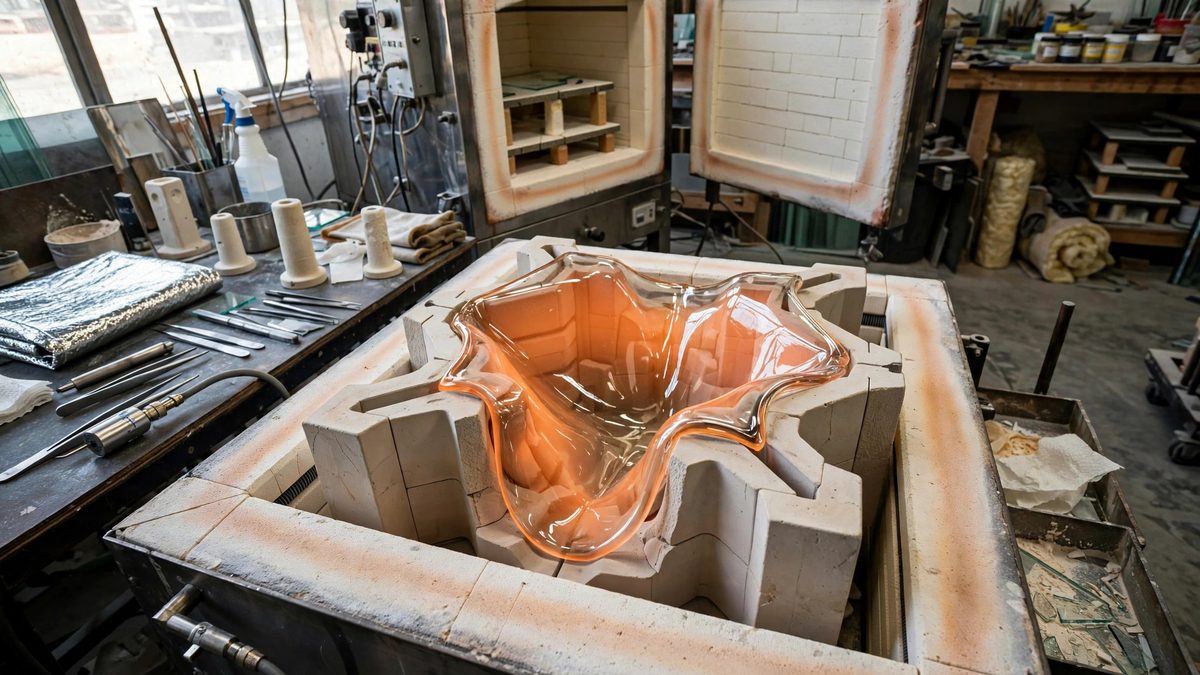
Slumping flat glass into a complex basin mold, with deep curves, tight corners, or asymmetric sections, is a thermal balancing act. The glass must get hot enough to drape into every detail without overheating into distortion, and different thicknesses of the piece reach temperature at different times. The soak cycle, the hold at target temperature, is what evens everything out. Scheduling it correctly is the difference between a crisp basin and a slumped mess.
What the Soak Does
Glass is a poor conductor of heat. When the kiln reaches the slumping temperature, the surface of the glass is there but the interior lags behind, and thick sections lag more than thin ones. The soak holds the kiln at temperature while the heat works through the full thickness and while the glass, now soft, settles into the mold under its own weight. Without an adequate soak, the outside slumps while the inside resists, producing uneven draping, and complex mold details never fill. With too long a soak, the glass overheats: edges thin out, the surface picks up mold texture aggressively, and the piece can stick. The soak is not dead time; it is the working phase of the firing.
Reading the Mold's Demands
Complex basin molds ask for more soak than simple ones. Deep draws need time for the glass to stretch and settle into the bottom; tight inside corners need time for the soft glass to flow into the detail; asymmetric sections need time because the thin areas reach temperature long before the thick ones. Study the mold before programming: identify the deepest draw, the thickest glass section, and the finest detail. The soak must satisfy the most demanding of these. A basin with a deep center and shallow rim, for example, needs enough soak for the center to fully drape, while the rim must not over-slump in the meantime; this tension is resolved by choosing the right target temperature (lower, with longer soak) rather than by blasting heat.
Structuring the Firing Schedule
A typical slump schedule ramps at a controlled rate to avoid thermal shock, soaks at the slumping temperature, then cools through the annealing range with appropriate holds. For complex basins, ramp conservatively through the critical range where the glass softens, since uneven heating during the ramp creates stresses that the soak must then relieve. Set the slump temperature based on the glass type and the mold depth: deeper slumps generally want the lower end of the slumping range with a longer soak, which gives control. Program the soak in segments if the controller allows: an initial soak to equalize temperature, then continued hold while the glass drapes. Watch the first firing of a new mold closely through the peephole; the glass tells you when it has settled.
Judging Soak Length by Observation
The reliable method is to watch and learn. On the first firing with a new mold and glass combination, check the slump's progress at intervals during the soak. The glass surface goes from flat to softly draped to fully settled; fine mold detail appears last. Note the time when the piece looks right, and use that as the baseline soak for subsequent firings, adding a small margin for kiln variability. Keep a firing log with the mold, glass type and thickness, temperatures, ramp rates, and soak times; complex basins are repeatable only with records. If the piece consistently needs a longer soak than expected, the target temperature may be slightly low; if it over-slumps quickly, the temperature is too high. Adjust temperature before adjusting soak time, since temperature dominates the process.
Annealing After the Slump
The soak gets the shape; annealing keeps it from breaking. After slumping, the glass must cool through the annealing range slowly enough to relieve internal stresses, with a hold at the annealing temperature appropriate to the thickest section. Complex basins with varying thickness need annealing scheduled for the thickest part; thin sections simply come along. Skipping or rushing the anneal produces a basin that looks perfect and cracks weeks later, sometimes from a light touch. The annealing soak is as non-negotiable as the slumping soak. Cool to room temperature before opening the kiln fully; thermal shock at the end ruins in minutes what the whole firing built.
Schedule the slump soak for the mold's most demanding feature, favor lower temperature with longer hold for control, observe the first firing to calibrate, log everything, and anneal for the thickest section. Complex basins reward the patient scheduler and punish the hurried one.
Related Guides
- Annealing Soak Times for Thick Bullseye Glass: Fused glass looks finished when it comes out of the kiln, but invisible stresses inside can shatter it weeks or months later if the piece was not
- Devitrification Spray Barriers for Fused Glass: Devitrification is the milky, scummy crystallization that forms on the surface of fused glass when it spends too long in the temperature zone where
- Full Fuse Thermal Ramp Rates for Multi-Layer Bullseye: A full fuse melts stacked glass layers into a single smooth tile, and multi-layer Bullseye projects push the kiln schedule harder than simple