
Stage sound is a battle between clarity and chaos: the performers need to hear each other, the audience needs to hear the performers, and the room's reflections interfere with both. Diffuser panels scatter sound instead of absorbing it, keeping the stage lively without the harsh echoes. The splay angle, the angle of the diffuser's facets, determines how the sound scatters, and getting it right is acoustic design you can build.
What diffusion does on a stage
Absorbers remove sound energy; diffusers redistribute it. A flat reflective wall bounces sound in one predictable direction, creating hot spots and dead zones. A diffuser's angled facets break the reflection into many directions, smoothing the sound field without deadening it. On a stage, this means the performers hear a balanced blend rather than a harsh slap from the back wall, and the audience hears clarity rather than mush. Diffusion preserves energy while taming its direction.
The splay angle's role
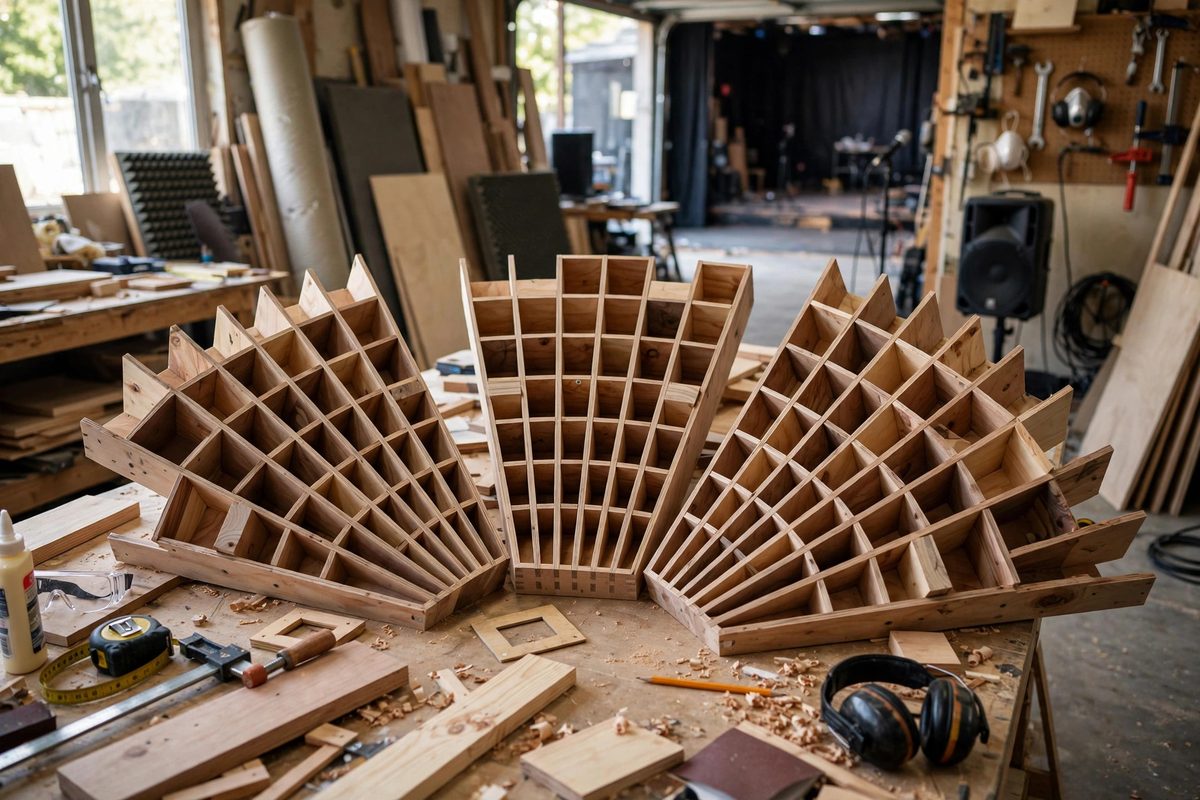
The splay angle is the angle between the diffuser's facets and the wall, or between adjacent facets. Steeper angles scatter sound more widely; shallower angles scatter it more narrowly. The angle also interacts with frequency: a facet of a given depth diffuses frequencies whose wavelengths are comparable to that depth. For stage panels targeting the vocal and instrumental midrange, facet depths of a few inches with splay angles in the moderate range scatter effectively. The design is a compromise across the frequency band that matters most on stage.
Designing the panel layout
A single panel diffuses locally; a stage needs a field of panels working together. Arrange panels to cover the reflective surfaces that cause the worst problems: the wall behind the performers, the side walls at the stage's edges, and any large flat surface facing the audience. Vary the splay angles or facet depths between panels to avoid creating a new periodic pattern; a wall of identical diffusers can develop its own resonances. Think in terms of coverage and variety, not uniformity.
Building the panels
Diffuser panels are straightforward woodworking: a frame holding angled facets, built from plywood or solid stock. Cut the facets accurately; the splay angles are the acoustic design, and sloppy angles scatter unpredictably. The panels must be rigid; a rattling diffuser is worse than none. Mount them securely, because stage panels take abuse from load-ins, and a falling panel is a safety hazard. Build them to survive the road, not just the design review.
Placement and aiming
Placement matters as much as design. Panels behind the performers scatter the sound that would otherwise reflect straight back at them, reducing the harshness in their monitors. Panels at the stage's sides control the lateral reflections that smear stereo imaging for the audience. Aim the diffusion where the problem reflections go; a panel in the wrong place is just decoration. Walk the stage and the house while listening; the ears confirm what the theory predicts.
Testing by ear
The final test is always listening. Have someone speak or play from the stage while you listen in the house, then add or move panels and listen again. The improvement should be audible: less harshness, better clarity, a more even sound across the seating. Acoustic treatment is iterative; no calculation replaces the ear in the room. Document what worked, because the next stage with similar problems will benefit from the record.
Choose splay angles for the frequencies that matter, build the facets accurately and rigidly, cover the problem surfaces with varied panels, and verify by ear. The stage will sound clearer, the performers will hear better, and the room will work with the music instead of against it.
Related Guides
- Acoustic Reflection Baffles for Stage Backdrops: A stage backdrop is usually designed for the eyes, but it is also a giant acoustic surface that shapes what the audience hears. A flat, hard backdrop
- Slotted Helmholtz Resonator Arrays for Studio Panels: Small rooms have big bass problems: low frequencies pile up in corners and between parallel walls, creating boomy spots and dead spots that no amount
- Star Grounding Bus Layouts for High-Gain Stage Preamps: High-gain preamps amplify everything, including the garbage: power supply ripple, heater hum, and the tiny voltage drops that current creates across
- Ground Lift Switch Circuit Isolation for Stage DI Boxes: A ground lift switch is one of the most-used and least-understood controls on a stage DI box. It exists to break ground loops, the humming menace
- Balanced XLR Ground Pin Wiring to Stop Ground Loops: The hum that appears when you connect two pieces of audio gear together, and vanishes when you disconnect them, is almost always a ground loop: an