
A ground lift switch is one of the most-used and least-understood controls on a stage DI box. It exists to break ground loops, the humming menace that appears whenever the instrument rig and the PA system are grounded at different points. Understanding what the switch actually disconnects, and what it leaves connected, keeps you from using it as a magic button and helps you diagnose stage noise in seconds instead of minutes.
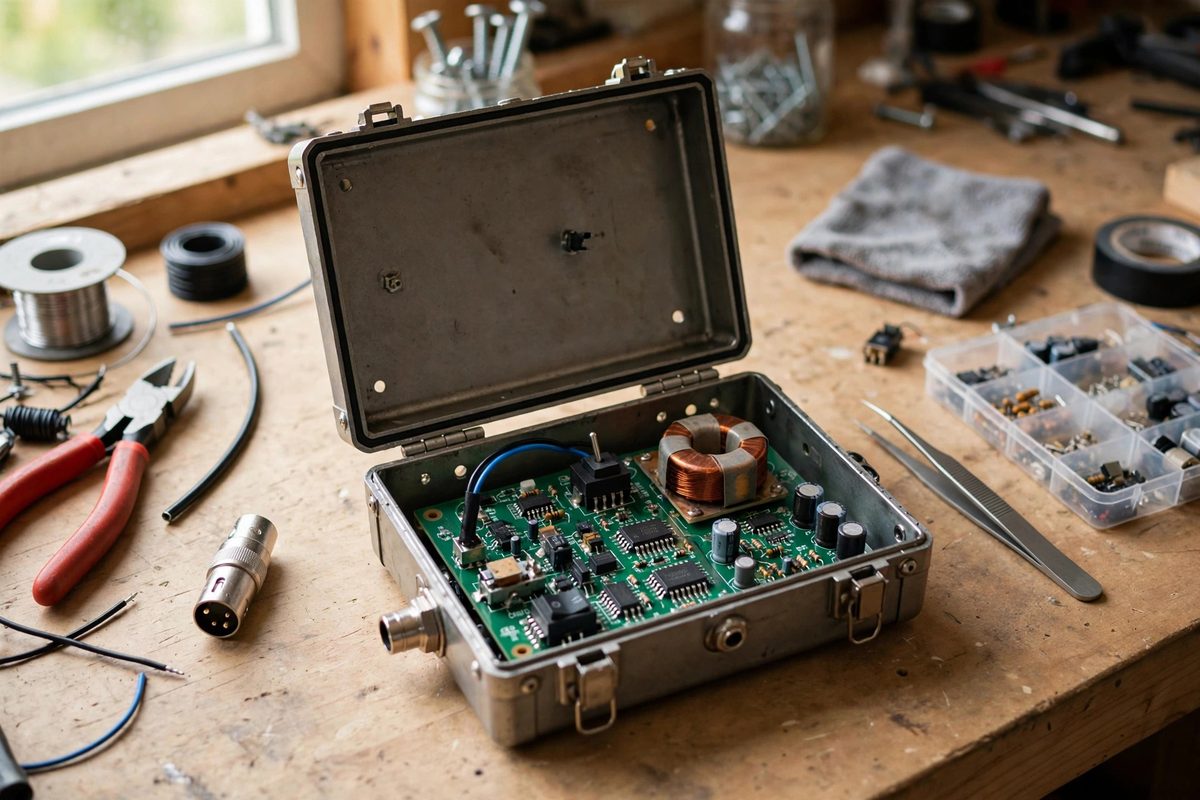
What the Switch Really Disconnects
On most DI boxes, the ground lift switch breaks the connection between pin 1 of the XLR output and the chassis of the DI box, and often also breaks the ground path through to the input jack. The audio signal path itself stays intact. What changes is the shield continuity: with the switch engaged (lifted), the cable shield from the DI to the mixer no longer bonds the two pieces of equipment together. That matters because a ground loop needs a complete loop. The instrument's ground travels through the amp and its power cord to one ground point, while the console grounds through its own power at another point, and the shield of the XLR cable closes the loop. Even a small voltage difference between those two ground points drives current through the shield, and that current becomes hum in the audio. Lifting the shield at one end opens the loop while the signal still travels on pins 2 and 3.
Why the Signal Survives the Lift
The XLR output of a DI box is balanced, so the audio lives as the difference between pins 2 and 3. The shield on pin 1 carries no audio; it exists for RF protection and electrostatic shielding. Because of this, disconnecting the shield at the DI end does not remove any part of the music. The signal arrives at the console just as before, riding the two signal conductors, while the console end of the shield still ties to the mixer's ground for shielding purposes. This is the entire principle behind the lift: shield for noise, disconnect for loop current. If lifting the switch kills or weakens the signal, the DI has a fault, the cable is miswired, or the box is a rare design that grounds through the signal path. In a healthy setup, lift only changes the noise floor.
Isolation Versus Lift
A ground lift and an isolation transformer solve related but different problems. The lift breaks a conductive loop; it does nothing about common-mode voltage that is truly imposed on the line, and it offers no galvanic isolation between stage and console. An isolation transformer, by contrast, passes audio magnetically with no direct electrical connection at all, which stops ground loops, blocks DC offsets, and tolerates large common-mode voltages. Many active DI boxes lift the shield but still share a ground reference through the electronics; a transformer-isolated DI fully separates the two sides. For most stage work, the lift switch is enough. When you are feeding long cable runs in a venue with notoriously dirty power, or interfacing with equipment whose ground you do not trust, a transformer-isolated DI is the stronger medicine. Knowing which tool you own changes your troubleshooting order.
The Correct Troubleshooting Sequence
When hum appears, work in this order. First, make sure the DI and the backline share a power source if possible, since a common ground point prevents the loop from forming. Second, engage the ground lift on the DI. Third, if hum persists, try the lift on other DI boxes or devices in the chain one at a time, because the loop can close through any shield in the system. Fourth, check for dimmers, fluorescent fixtures, and phone chargers near the cable runs, since the lift fixes ground loops but not magnetic or RF pickup. A useful rule: if the hum changes pitch or level when you touch the strings or the chassis, you are probably dealing with a ground reference issue rather than a loop, and the lift may not be the answer. Fix one variable at a time so you know what actually solved it.
When Lifting Is the Wrong Move
The ground lift is a diagnostic tool, not a permanent safety measure. Never lift a ground to silence a shock hazard; if you feel tingling from a mic or guitar, stop and fix the faulty equipment. The chassis ground exists partly to give fault current a path, and some older or modified gear depends on the shield for safety grounding. Also, lifting every DI on a big stage can leave shields floating in ways that invite RF interference, especially near lighting rigs. The convention is to lift at the source (the DI) and keep the console end grounded, and to lift only the channels that actually need it. Label the lifted channels mentally or on tape so the next soundcheck does not inherit a mystery.
The ground lift switch works because balanced audio does not need its shield to carry signal. Break the loop, keep the music, and treat the switch as one step in an orderly noise hunt rather than the whole solution. That mindset clears up most stage hum before the band finishes tuning.
Related Guides
- Isolating Ground Loops With Optical Line Level DI Boxes: Ground loop hum is the fifty or sixty hertz drone that appears when two pieces of gear share more than one path to ground. It is the most common
- Balanced XLR Ground Pin Wiring to Stop Ground Loops: The hum that appears when you connect two pieces of audio gear together, and vanishes when you disconnect them, is almost always a ground loop: an
- Diffuser Splay Angles for Acoustic Stage Panels: Stage sound is a battle between clarity and chaos: the performers need to hear each other, the audience needs to hear the performers, and the room's
- Acoustic Reflection Baffles for Stage Backdrops: A stage backdrop is usually designed for the eyes, but it is also a giant acoustic surface that shapes what the audience hears. A flat, hard backdrop
- Star Grounding Bus Layouts for High-Gain Stage Preamps: High-gain preamps amplify everything, including the garbage: power supply ripple, heater hum, and the tiny voltage drops that current creates across