
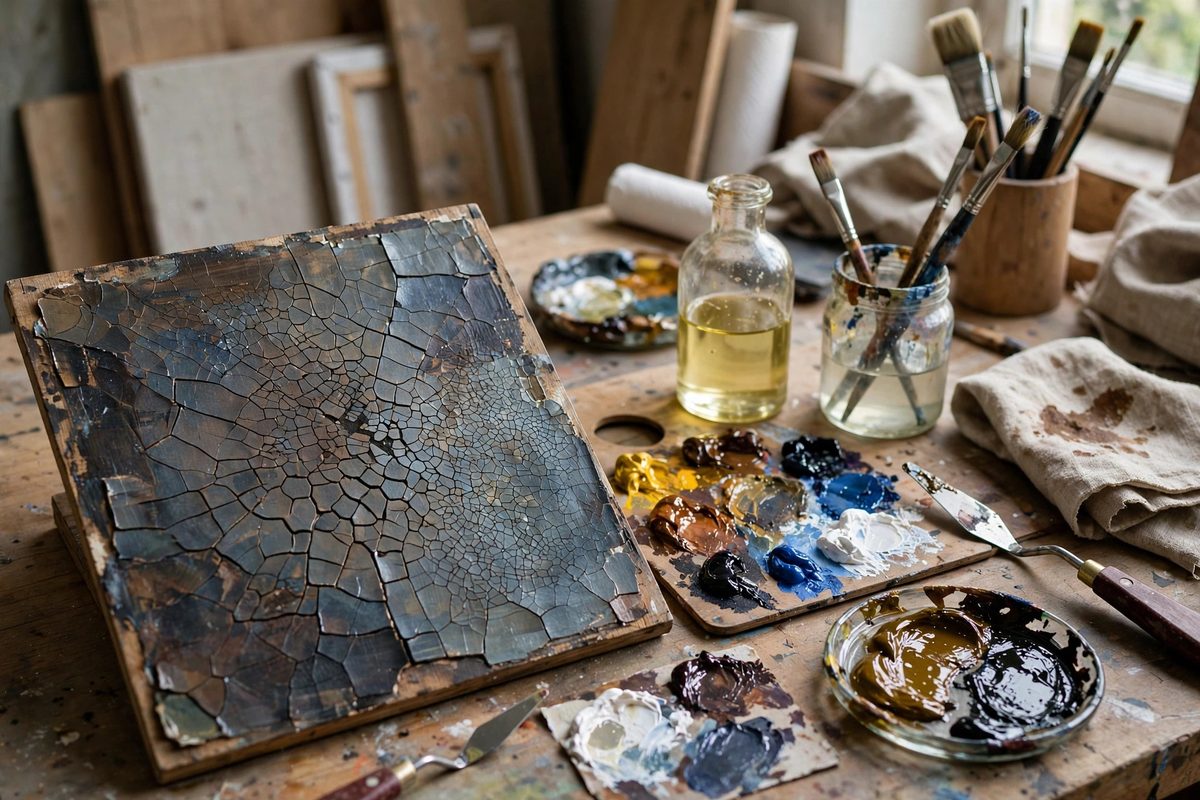
Crazing, the network of fine cracks that can appear in an oil painting months after it looked perfect, is almost always a layering error. The rule that prevents it is three words: fat over lean. Each successive layer must contain at least as much oil, as much "fat," as the layer beneath it. Break the rule with a lean layer over a fat one, and the top layer shrinks and sets while the layer underneath is still moving. The result is cracks. The rule is simple to state and surprisingly easy to violate by accident, because "fat" and "lean" describe the whole painting medium, not just the paint.
What Fat and Lean Mean
In oil painting, "fat" means oil-rich and slow-drying; "lean" means oil-poor and fast-drying. The fat content comes from the painting medium, the liquid you mix with the paint, not just from the tube paint itself. A layer thinned with turpentine or mineral spirits is lean: the solvent evaporates quickly, leaving a thin, matte, fast-setting film. A layer mixed with linseed oil, stand oil, or an oil-heavy medium is fat: it stays mobile longer, levels to a glossier surface, and cures slowly as the oil oxidizes. As oil paint cures, the film shrinks slightly and keeps moving for weeks. A lean layer on top dries rigid quickly and cannot accommodate the movement of the fat layer below, so it cracks to relieve the stress.
Building a Painting Fat-Over-Lean
The standard working sequence follows the rule naturally. The underpainting goes down lean: paint thinned with solvent, sometimes to a wash, establishing the drawing and values. It dries within hours, forming a stable, matte foundation. Middle layers use paint straight from the tube or with a touch of oil, moderately fat. Final layers, glazes and details, carry the most oil and are the fattest. Each step increases the oil content, so each layer dries more slowly and remains more flexible than the one beneath it, and the whole stack cures as a compatible system. Reversing any step causes failure: glazing with a lean mixture over an oily passage, or touching up fat paint with a quick lean stroke. Those fixes look fine for weeks, then craze exactly where the rule was broken.
Mediums and Their Place in the Sequence
Commercial painting mediums complicate the picture because their fat content is not obvious from the bottle. Solvent-based mediums, often labeled for underpainting or fast drying, are lean. Oil-based mediums, alkyds, and anything containing stand oil are fat. Note that alkyds dry fast but are still oil-rich, so they count as fat despite their speed. The safe approach is to pick one medium family and use it consistently through the painting, increasing the proportion slightly in upper layers. Mixing lean and fat mediums in the same layer is the most common accidental violation; the layer's overall fat content becomes unpredictable, and the layer above or below it may end up on the wrong side of the rule.
Recognizing Crazing vs. Other Cracks
Not every crack in an oil painting is a fat-over-lean failure, and the pattern tells the story. Crazing from reversed layering appears as a fine, alligator-like network confined to the upper layer, often following the exact shape of the offending brushstroke: you can see where the lean glaze was applied because the cracks stop at its edge. Cracks from an inflexible ground look different, usually wider and following the panel structure; cracks from excessive impasto are about thickness, not layering order. Only fat-over-lean crazing is preventable at the easel; the others are material or support problems. If you see the fine network appearing a few months after finishing, confined to glazed or detailed passages, the layering sequence is the first suspect.
Repairing a Crazed Passage
A mildly crazed passage, where the cracks are fine and the paint is still attached, can often be stabilized rather than repainted. The standard approach is to let the painting cure fully, which takes months, then apply a thin, fat-compatible varnish or a lean isolation layer followed by careful inpainting with a fat medium. The key principle of the repair mirrors the original rule: whatever goes on top must be at least as flexible as what is beneath.
Working Wet-Into-Wet and Alla Prima
Paintings done in a single session sidestep the rule almost entirely, because all the layers cure together as one film rather than as a stack of separately drying layers. When wet paint mixes with wet paint, the fat content averages out and there is no rigid-over-flexible interface to crack. The rule bites in multi-session work, where each layer dries before the next is applied. If you work in sessions, the discipline is simple: start each new session slightly fatter than the last, even if only by adding a touch more oil to the medium. Keep "oiling out," refreshing a sunken area with a thin wipe of oil, honest: it adds fat to the surface, which is correct as long as the new paint is equally fat or fatter.
Fat over lean is the load-bearing rule of oil painting technique. Build lean to fat, keep your mediums consistent, and never let a quick lean fix sit on top of fat paint. The painting will still be crack-free when the varnish goes on, and decades after.
Related Guides
- Stand Oil Viscosity Control for Wet-on-Wet Blends: Wet-on-wet oil painting, laying fresh paint into fresh paint and blending on the canvas, is a viscosity performance. The paint must be fluid enough
- Solvent Ratios in Linseed Oil Underpainting Coats: The underpainting is the foundation of an oil painting, establishing values and composition in thin paint before the real color work begins. Linseed
- Stand Oil Dilution Curves for Glazed Oil Shadows: Shadow glazes in oil painting need to be dark, transparent, and level, and stand oil is the medium that makes all three possible at once. Stand oil