
Shadow glazes in oil painting need to be dark, transparent, and level, and stand oil is the medium that makes all three possible at once. Stand oil is linseed oil that has been heat-bodied: thickened by heating without air, which gives it a honey-like viscosity, a pale color, and a tendency to level out brush marks as it dries. Diluted correctly, it carries pigment in thin films that dry to a smooth enamel-like surface, which is exactly what a shadow glaze wants to be.
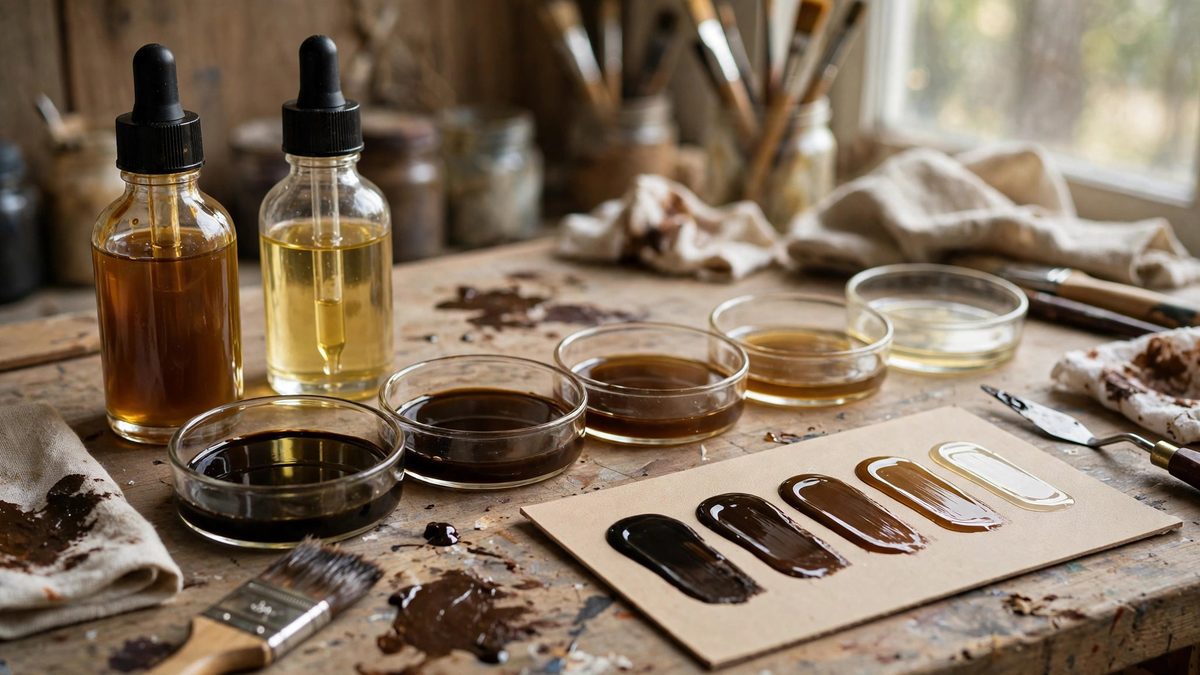
Why stand oil suits shadow glazing
A shadow glaze has to do two contradictory things: darken the passage and remain transparent enough that the underpainting shows through. Raw linseed oil yellows and stays soft; alkyd mediums dry fast but can look plasticky in thin films; stand oil dries to a tough, level film with minimal yellowing, and its viscosity keeps the pigment suspended evenly so the glaze goes on uniformly.
The leveling is the key property. Shadow areas are often large and need to read as one continuous tone. A medium that holds brush marks breaks that tone into stripes; stand oil's self-leveling lets the glaze settle into a single unbroken film. This is why the old masters' shadows look poured on even though they were brushed.
The dilution curve: from paste to veil
Think of dilution as a curve with distinct working zones. At paint straight from the tube with a touch of stand oil, you get a translucent scumble: it modifies the underpainting but does not fully glaze it, useful for the first pass over a shadow where you want to keep some of the underpainting's texture. At roughly equal parts paint and stand oil, the mixture becomes a true glaze, transparent enough to let the underpainting do the drawing while the pigment supplies the color and depth.
Push further, to one part paint in three or more parts stand oil, and you reach the veil zone: barely-there films for unifying large shadow masses or deepening a glaze that dried slightly light. Beyond this the film gets so lean in pigment that you are mostly adding oil, which extends drying time without adding color. There is rarely a reason to go further.
Cut the stand oil with a little solvent (turpentine or mineral spirits) when you need the glaze to flow out thin. The solvent evaporates and leaves the oil film behind; it does not weaken the film the way over-thinning with oil alone can. A common working mixture is stand oil thinned with just enough solvent to make it brushable, then pigment added to taste.
Fat over lean in the glaze stack
Every oil painter learns fat over lean, and glazing is where violations show up first. Each successive glaze must contain at least as much oil as the one beneath it, or the upper layer will dry faster, shrink, and crack over the slower-drying layer below. Since shadow glazes are usually built up over several sessions, keep notes on your mixtures or, simpler, make each new glaze slightly fatter than the last as a matter of habit.
This rule also governs the underpainting. Glazing over an underpainting that is still soft is asking for the glaze to sink in unevenly and for adhesion problems later. Let the underpainting dry to the touch and then some before the first glaze goes on; for thick underpainting, that means waiting days, not hours.
Drying times and studio reality
Stand oil dries slowly. A glaze rich in stand oil can stay tacky for days and take a week or more to dry fully, depending on the pigment (earth pigments dry faster, organics slower), the thickness of the film, and the studio's temperature and airflow. Plan the painting schedule around this: shadow glazes are a toward-the-end operation, not something to rush between sessions.
Do not try to force the drying with heat or by adding driers unless you know exactly what you are doing. Cobalt and manganese driers speed surface drying but leave the under-film soft, which creates wrinkling and long-term brittleness. A slow, even dry in a dust-free spot beats a forced one every time.
Safety notes
Oil-soaked rags can spontaneously combust as the oil oxidizes; this is not a theoretical risk. Spread used rags flat outdoors or store them in a sealed metal container with water, and never pile them in a trash can. Work with solvents in ventilation, and keep stand oil and solvent containers closed when not in use.
Dilute along the curve, respect fat over lean, and give the glazes the drying time they demand. Shadow passages built this way have a depth that reads as atmosphere rather than paint, which is the entire point of glazing them.
Related Guides
- Stand Oil Viscosity Control for Wet-on-Wet Blends: Wet-on-wet oil painting, laying fresh paint into fresh paint and blending on the canvas, is a viscosity performance. The paint must be fluid enough
- Solvent Ratios in Linseed Oil Underpainting Coats: The underpainting is the foundation of an oil painting, establishing values and composition in thin paint before the real color work begins. Linseed
- Fat Over Lean Paint Layering to Prevent Crazing: Crazing, the network of fine cracks that can appear in an oil painting months after it looked perfect, is almost always a layering error. The rule