
Neoprene is a tempting base for wearable electronics: it is soft, stretchy, water-resistant, and easy to cut and glue. But embedding circuits in a material that stretches means the electronics must survive the stretching, and the failure mode is specific and repeatable. Conductive traces crack, solder joints fatigue, and components pop off, all because the substrate moves and the circuit does not move with it. Understanding flex strain, how much the neoprene stretches and where the circuit feels it, is what separates e-textile prototypes that survive a fitting from ones that die the first time the wearer bends an elbow.
How Neoprene Moves
Neoprene stretches in all directions, but not equally and not uniformly. A typical sheet elongates substantially along its length and width under tension, then recovers, though repeated cycling gradually degrades the recovery. The strain concentrates where the garment bends: elbows, knees, shoulders, wrists. A circuit trace crossing an elbow sees the full local stretch, which can be tens of percent, while a trace on the back panel sees almost none. The other subtlety is that neoprene stretches in plane but is relatively incompressible through its thickness, so surface-mounted components experience shear as the substrate stretches beneath them. Design for the worst-case location, not the average: a trace that survives on the torso may fail in a week across a joint.
Why Rigid Circuits Fail on Stretch
The fundamental mismatch is modulus: copper, solder, and component packages are orders of magnitude stiffer than neoprene. When the substrate stretches 20% and the copper trace cannot, something has to give, and it is always the brittle element. Solder joints fail first because solder is both stiff and fatigue-prone; a joint that survives a hundred flex cycles cracks on the hundred-and-first, and the crack grows with every subsequent bend. Straight copper traces fail next, cracking across the trace where the strain concentrates, often at the edge of a component pad where the stiffness changes abruptly. Components themselves usually survive, but they detach as their joints fail. The lesson is not that electronics cannot live on neoprene, but that rigid construction techniques borrowed from PCBs do not transfer.
Strain Relief by Geometry
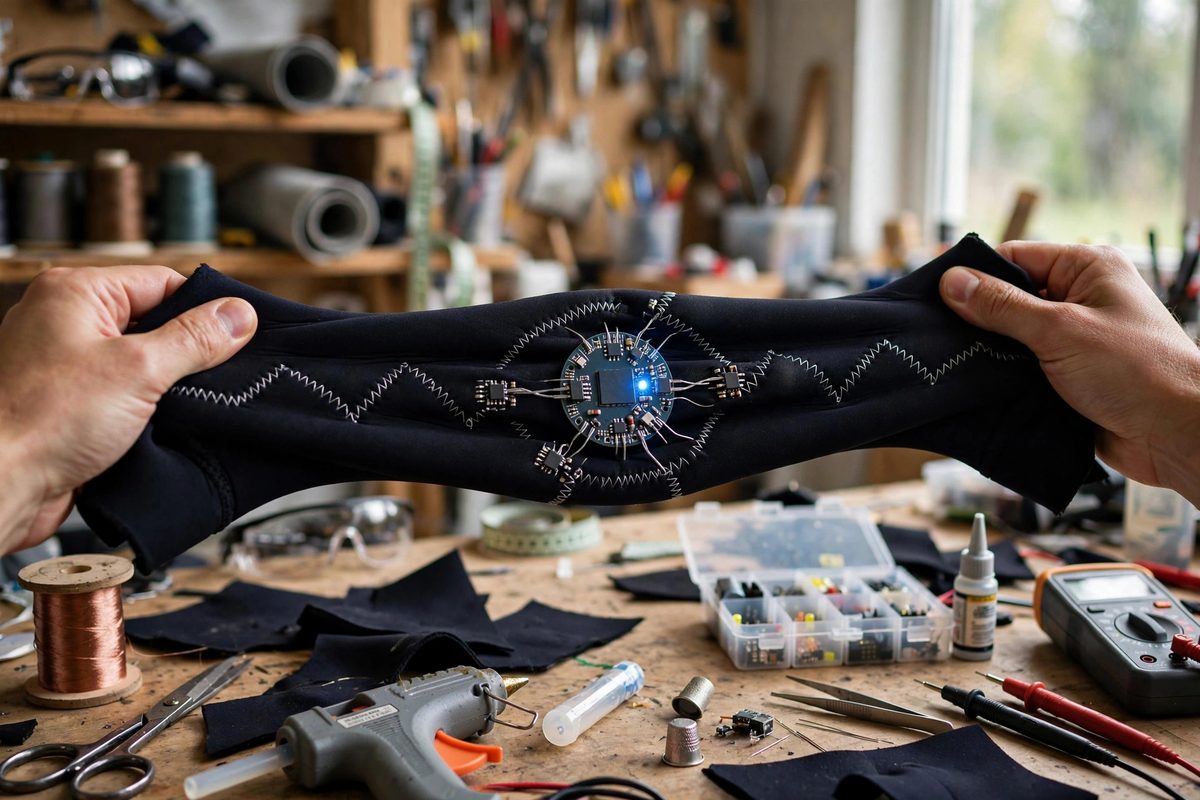
The classic solution is to give the conductors slack in the plane of stretch: serpentine or zigzag traces that unfold as the substrate stretches, like a coiled telephone cord. A serpentine trace converts stretching into bending, and thin conductors tolerate bending far better than stretching. The geometry matters: generous curve radii, since sharp corners concentrate stress; amplitude matched to the expected strain, so the serpentine can fully extend without the conductor itself elongating; and gradual transitions where the trace meets a component pad, because the pad is a rigid island and the trace-to-pad junction is the highest-stress point in the whole circuit. Conductive thread sewn in wavy or zigzag stitch patterns achieves the same effect naturally, which is one reason e-textile practice favors stitching over rigid traces.
Islanding: Protecting Components
Components cannot stretch, so the strategy is to keep them off the stretch zones. Mount components on small rigid islands, tiny PCB fragments or stiffened patches, bonded to the neoprene, and route only flexible serpentine conductors across the gaps between islands. The islands themselves should sit on low-strain areas of the garment, away from joints, and the conductors between them absorb all the movement. Bond the islands with flexible adhesive, not rigid epoxy: a rigid bond creates a hard edge where the neoprene flexes against the island boundary, concentrating strain exactly where the conductors leave the island. A flexible bond spreads the transition over a gradient. Keep islands small: a large rigid patch on a stretchy garment fights the garment's movement and either delaminates or restricts the wearer, both failures.
Encapsulation and Washability
Once the circuit works mechanically, it needs protection. Flexible encapsulants, silicone conformal coatings or thin silicone potting over the islands and joints, keep sweat and moisture out while remaining pliable enough to move with the assembly. Rigid potting compounds defeat the purpose: they create a hard lump that concentrates strain at its edges. Design for washing from the start if the garment will be laundered: connectors should detach, or the electronics should tolerate gentle cycles. Test washability early with a sacrificial prototype, because water, detergent, and agitation together find every weakness that dry flex testing missed. Strain-relieve every wire exit from the encapsulant: a wire leaving a potted island is a flex point, and an unrelieved one breaks at the potting boundary.
E-textiles on neoprene fail at the stiffness transitions, and every design decision should soften those transitions. Serpentine conductors, small islands on low-strain areas, flexible bonds and coatings, and testing that includes real joint movement. Build for the stretch and the circuit survives it.
Related Guides
- Strain Relief Stitching for Wearable Flex Sensors: Flex sensors fail at the connection point, almost always. The sensor itself is a robust strip designed to bend thousands of times, but where its
- Conductive Thread Trace Routing Protocols: Conductive thread lets you sew circuits directly into fabric, but thread is a terrible wire by electronics standards: high resistance, fragile
- Washable Surface Mount Solder Bonds on Stretch Yarn: Wearable electronics live at the intersection of textiles and circuitry, and nowhere is that collision more demanding than in solder joints on
- Insulating Stainless Steel Thread Traces in Washables: Conductive stainless steel thread lets you sew circuits directly into washable garments, but bare conductive traces in a garment that goes through