
Wearable electronics live at the intersection of textiles and circuitry, and nowhere is that collision more demanding than in solder joints on stretch fabrics. Conductive stretch yarn, the elastic thread that carries signals through garments, moves, stretches, and goes through the washing machine; surface mount components soldered to it must survive all three. A conventional rigid solder bond cracks under the first good stretch. Washable, stretch-tolerant bonds require rethinking the joint as a flexible mechanical system, not just an electrical connection.
Why Ordinary Solder Joints Fail on Stretch
Solder is a rigid metal alloy. Stretch yarn is an elastic textile. When the fabric stretches, the yarn elongates but the solder blob does not; the strain concentrates at the boundary between the rigid joint and the flexible conductor, and the solder cracks, usually right at the interface. Each stretch cycle grows the crack until the connection opens. Washing adds mechanical agitation, water ingress, and thermal cycling, accelerating every failure mode.
The fundamental problem is modulus mismatch: hard material bonded to soft material, flexed repeatedly. The solution is never to make the solder flexible (it cannot be); it is to manage where the flexing happens, keeping strain away from the rigid joint and in the elastic yarn where it belongs.
Strain Relief by Design
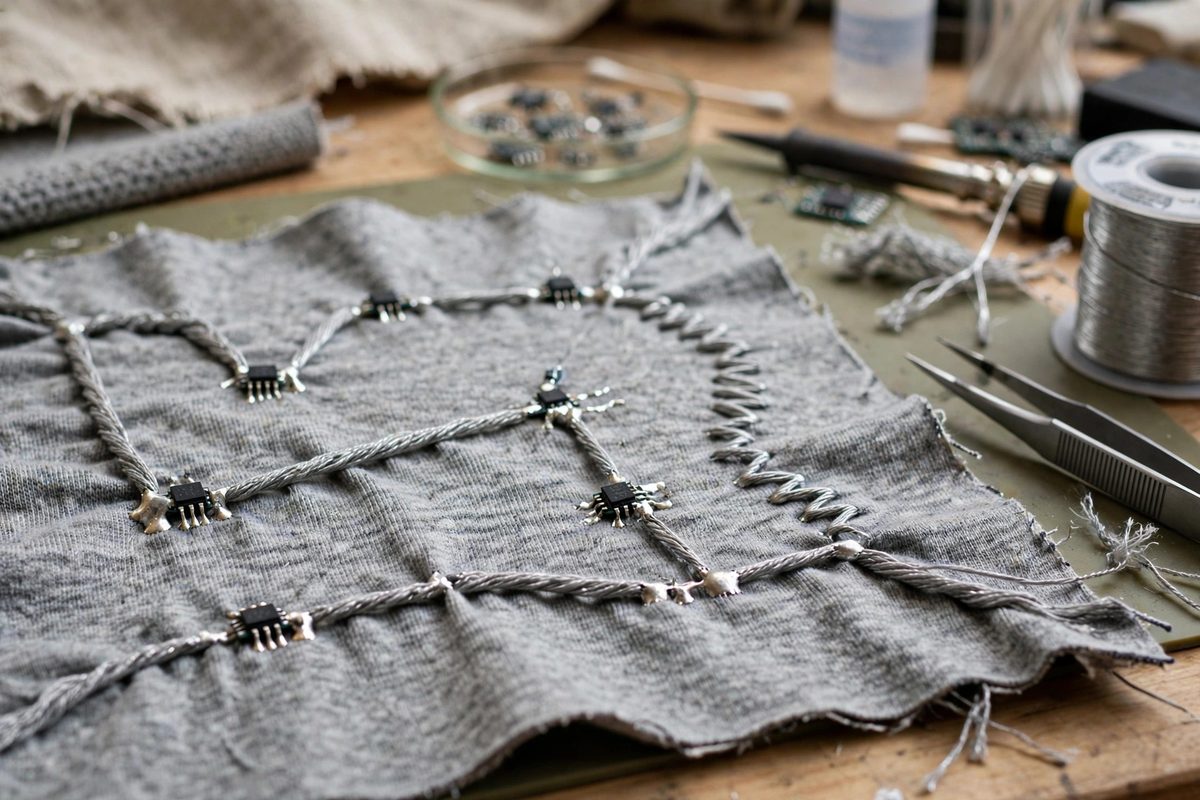
The key technique is strain relief: transitioning from the rigid component to the stretch yarn through a gradient of flexibility. Anchor the component to a small rigid or semi-rigid island, a tiny PCB or a stiffened fabric patch, solder the yarn to the island's pads with generous fillets, and then let the yarn leave the island with slack: a service loop, a zigzag stitch pattern, or a curved routing that gives the yarn room to stretch without pulling on the joint.
Encapsulation helps enormously. Covering the joint and the transition zone with a flexible encapsulant, silicone or flexible polyurethane, distributes strain over a larger area instead of concentrating it at the solder boundary. The encapsulant moves with the yarn and holds the joint, turning a hard boundary into a graduated transition.
Soldering Technique for Textiles
Use low-temperature solder and work quickly; prolonged heat damages the yarn's elastic core and melts synthetic fibers. Pre-tin both the component pad and the yarn end separately, then join them with a brief reflow: the goal is a small, smooth fillet, not a large blob. Excess solder adds rigidity exactly where you need compliance, so keep the joint minimal.
- Choose solder with some mechanical forgiveness; avoid brittle high-tin formulations where possible.
- Keep iron temperature as low as the solder allows; scorching the yarn weakens it permanently.
- Support the work so nothing moves during soldering; a joint formed under tension starts pre-stressed.
- Inspect under magnification; textile solder joints hide bridges and cold joints in the fibers.
Designing for the Washing Machine
Washability is a system property, not a joint property. The whole assembly must survive water, detergent, agitation, and spin cycles: components should be inherently washable or conformally coated, the textile base must tolerate washing, and the interconnects must handle the mechanical violence of the machine. Design for gentle cycles and advise the wearer accordingly, but engineer for the worst case, because someone will machine-wash it on heavy duty.
Water ingress at the joint is the specific enemy: moisture wicks along the yarn into the solder interface, corroding it from the inside. The flexible encapsulant doubles as a moisture barrier; ensure it fully seals the joint and extends onto the yarn in both directions, leaving no wicking path. Test by soaking, not just by wearing.
Testing Before Deployment
Test the assembly the way it will live: stretch cycles (hundreds, not dozens), wash cycles (multiple, with detergent), and flexing at the joint specifically. Monitor resistance across the joint during testing; a rising resistance precedes open-circuit failure and reveals joints that look fine but are cracking internally. A joint that survives fifty wash cycles with stable resistance is a joint you can trust.
Build test coupons, simple component-to-yarn joints on fabric scraps, and abuse them deliberately. The coupon that fails teaches more than the garment that succeeds; every failure mode you find on the bench is one your wearer never experiences.
Island the component, loop the yarn, encapsulate the transition, solder cool and quick, and test like a washing machine. Stretch-tolerant solder bonds are mechanical engineering in textile form, and the joints that survive are the ones designed for motion from the start.
Related Guides
- Conductive Thread Trace Routing Protocols: Conductive thread lets you sew circuits directly into fabric, but thread is a terrible wire by electronics standards: high resistance, fragile
- Neoprene Substrate Flex Strain in E-Textiles: Neoprene is a tempting base for wearable electronics: it is soft, stretchy, water-resistant, and easy to cut and glue. But embedding circuits in a
- Insulating Stainless Steel Thread Traces in Washables: Conductive stainless steel thread lets you sew circuits directly into washable garments, but bare conductive traces in a garment that goes through
- Strain Relief Stitching for Wearable Flex Sensors: Flex sensors fail at the connection point, almost always. The sensor itself is a robust strip designed to bend thousands of times, but where its