
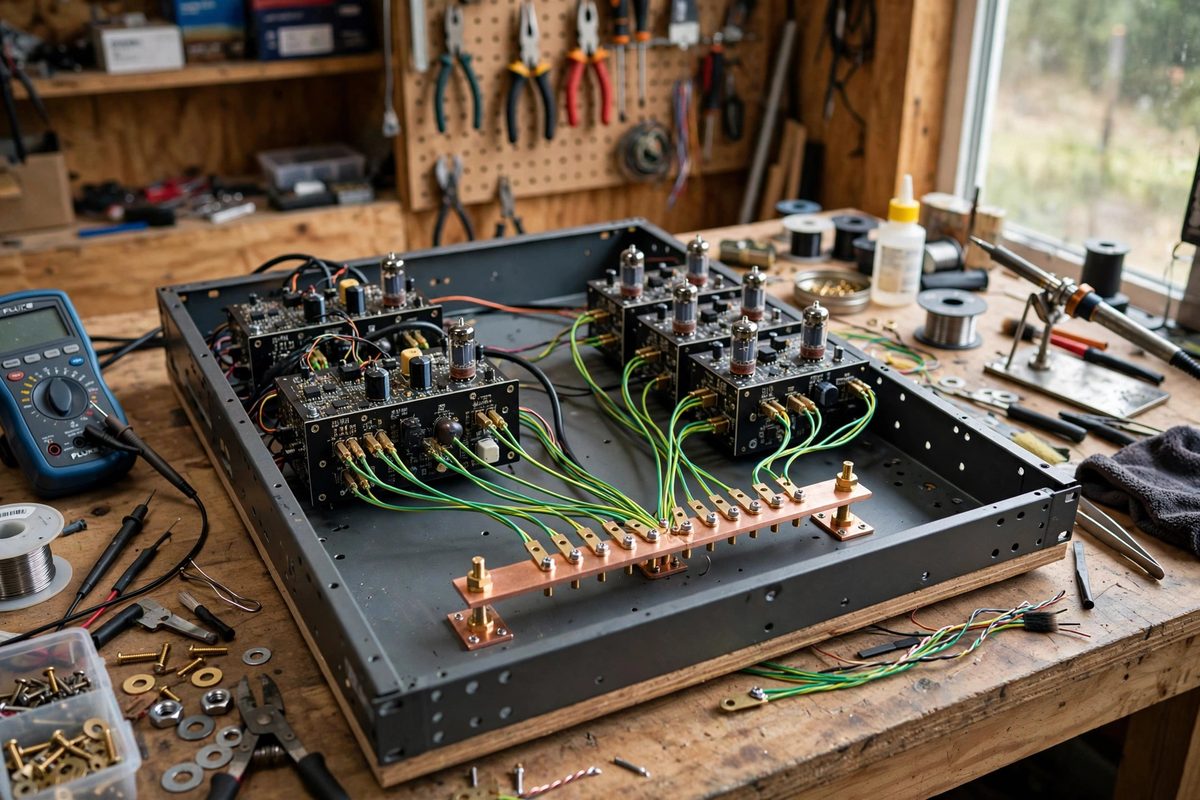
High-gain preamps amplify everything, including the tiny voltage differences between ground points in the chassis. When grounds connect in a daisy chain, the current from one stage flows through the shared ground wire and appears as noise at the next stage's input; at high gain, that noise becomes audible hum and buzz. Star grounding fixes it by giving every stage its own dedicated path to a single ground point. In a rack of high-gain preamps, it is the difference between silence and a 60-cycle headache.
Why daisy-chained grounds hum
Every wire has resistance, small but real. When the output stage's return current flows through a ground wire shared with the input stage, Ohm's law puts a small voltage across that wire's resistance, and the input stage sees that voltage as signal. At unity gain it is negligible; at 60 dB of gain it is hum. Ground loops make it worse: multiple ground paths between equipment create loops that act as antennas for mains-frequency magnetic fields. The star topology eliminates both problems at the source by ensuring no stage's current flows through another stage's ground reference.
Building the star
Choose one physical point as the star center, typically a heavy copper bus bar or a solid lug near the power supply's ground. Run a separate ground wire from each circuit stage, each input jack's ground, and each output jack's ground directly to that point; no stage grounds to another stage, ever. Size the bus generously; it carries the sum of all return currents and must have negligible resistance. Keep the ground wires short and route them away from AC mains wiring and power transformers, since even a star ground picks up noise if its wires run alongside the mains.
Chassis, safety earth, and signal ground
The star point connects to the chassis at exactly one place, and the chassis connects to mains safety earth at exactly one place. This single-point connection is critical: multiple chassis-to-earth connections create the ground loops the star was built to prevent. The distinction between safety earth (which protects humans) and signal ground (which references the audio) must be maintained; they meet at one defined point and nowhere else. In a rack with multiple preamp modules, each module gets its own star, and the module stars tie to the rack star at one point each.
Rack-level grounding
A rack of preamps multiplies the grounding challenge: each unit has its own internal grounding, and the rack rails, patch cables, and power distribution create additional paths. Rack-mount the units with attention to isolation; use isolated jack washers where the design calls for them, and do not assume the rack rails are a valid ground path (they are intermittent and noisy). Power all units in the rack from the same mains distribution so their safety earths share one path. If hum persists, lift cable shields at one end only, never both, and never lift the safety earth; the earth keeps the equipment safe, and defeating it to fix hum trades noise for electrocution risk.
Verifying the result
Test with the gains all the way up and no input connected: the residual noise should be low and should not change when you touch the chassis or move cables around. Touch-sensitivity indicates a grounding or shielding problem, not a star problem per se, but the star makes such problems diagnosable instead of mysterious. Document the grounding scheme for the rack; the next person to modify it needs to know where the star points are before adding a ground wire that creates a loop.
One point, separate wires, single chassis connection. Star grounding is simple, absolute, and the foundation every quiet high-gain rack stands on.
Related Guides
- Star Grounding Bus Layouts for High-Gain Stage Preamps: High-gain preamps amplify everything, including the garbage: power supply ripple, heater hum, and the tiny voltage drops that current creates across
- Balanced XLR Ground Pin Wiring to Stop Ground Loops: The hum that appears when you connect two pieces of audio gear together, and vanishes when you disconnect them, is almost always a ground loop: an
- Acoustic Reflection Baffles for Stage Backdrops: A stage backdrop is usually designed for the eyes, but it is also a giant acoustic surface that shapes what the audience hears. A flat, hard backdrop
- Diffuser Splay Angles for Acoustic Stage Panels: Stage sound is a battle between clarity and chaos: the performers need to hear each other, the audience needs to hear the performers, and the room's
- Ground Lift Switch Circuit Isolation for Stage DI Boxes: A ground lift switch is one of the most-used and least-understood controls on a stage DI box. It exists to break ground loops, the humming menace