
CoreXY printers are fast because both motors work together to move the toolhead, but that same coupled motion makes them resonance-prone: the long belts and the moving gantry form a springy system that rings at certain speeds, and the ringing shows up on prints as ghosting, rippled walls next to sharp features. Stepper motor damping, taming the vibration at its source, is one of the most effective fixes. It works because most CoreXY ringing is not a frame problem; it is the motors exciting the belts at their natural frequencies.
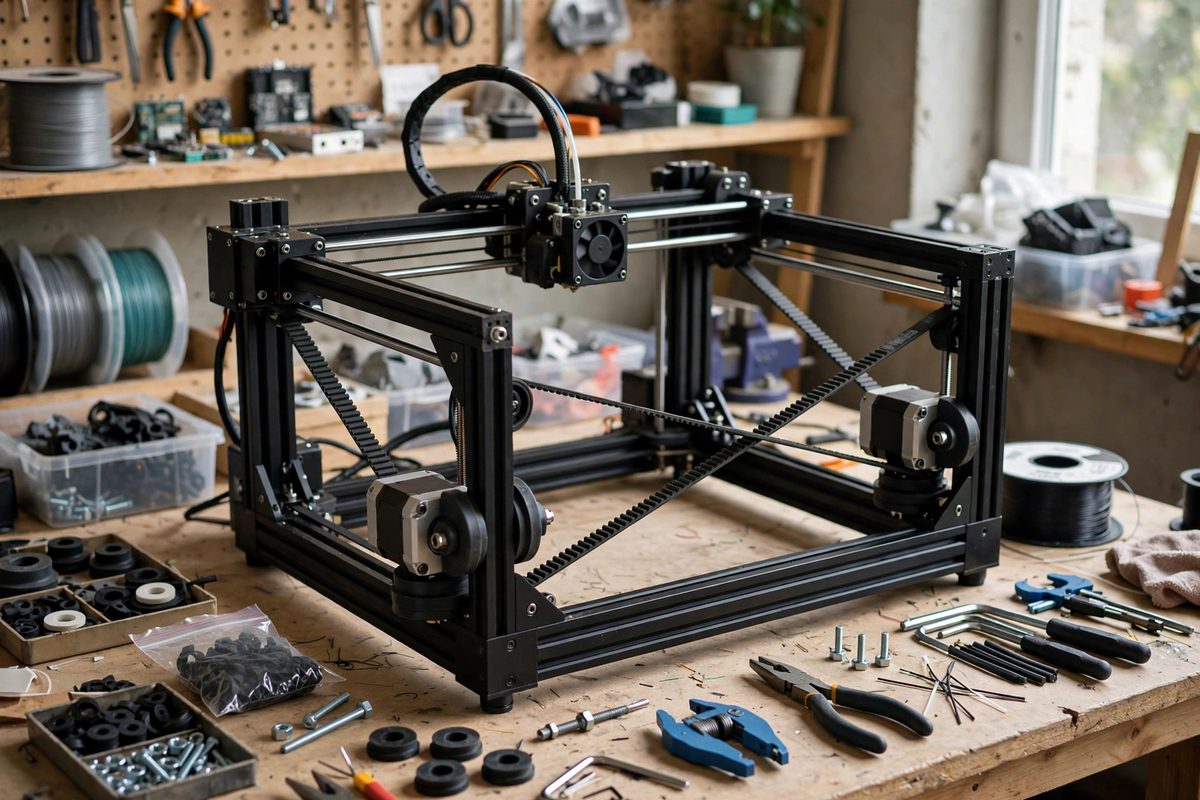
Where the Resonance Comes From
A stepper motor moves in discrete steps, and each step is a small impulse: the rotor snaps to the next position and overshoots slightly before settling. At certain step rates, those impulses land in rhythm with the mechanical resonance of the belt-and-gantry system, and each impulse adds energy to the oscillation instead of canceling it. This is resonance: a small periodic input building a large periodic response. In CoreXY machines the effect is pronounced because the belts are long, the gantry is light, and the two motors' motions combine, so resonances in the 30 to 80 Hz range are common. The print artifact is unmistakable: faint echoes of sharp corners and text, rippling outward along the wall. The ringing frequency is a property of the mechanics; the excitation is a property of the motors. Damping attacks the excitation.
Microstepping as First-Line Damping
The cheapest and most effective damping is already in your controller: microstepping. A motor driven at full steps delivers 200 hard impulses per revolution; at 16x microstepping it delivers 3,200 much smaller ones, and the impulse energy per step drops dramatically. Higher microstepping smooths the motor's torque delivery and pushes the excitation energy into smaller, less resonant nudges. Most modern drivers run 16x with interpolation to 256x, which is a good baseline. The reason this matters for CoreXY specifically is that the belt system is most sensitive to the low-frequency thump of coarse stepping; smoothing the steps starves the resonance of its favorite food. If your printer is running an older driver at low microstepping, upgrading the driver or enabling interpolation is often the single biggest ringing improvement available, before touching anything mechanical.
Driver Damping Features
Modern stepper drivers include active damping features that go beyond microstepping. StealthChop-style modes modulate the drive waveform to reduce noise and vibration, effectively smoothing the current delivered to the motor coils. SpreadCycle-style modes prioritize torque at speed with a different chopping behavior. The practical approach is empirical: print a ringing test tower, a standard model with sharp features at increasing speeds, in each driver mode and compare. Some machines ring less in the quiet mode at moderate speeds but lose torque at high speeds, which causes skipped steps; others do better with the torque-prioritized mode throughout. There is no universal winner because the resonance profile depends on your specific belts, gantry mass, and frame. Also check driver current: a motor run far below its rated current has less holding authority and can resonate more, while excessive current overheats the motor and the driver without further benefit. Set current to the motor's comfortable operating range and verify by touch that motors run warm, not hot.
Mechanical Damping at the Motor
When electrical damping is not enough, mechanical damping at the motor mounts helps. The principle is to absorb vibration before it reaches the frame and belts. Flexible motor mounts, silicone or rubber isolation pads between the motor and its bracket, decouple the motor's vibration from the structure. They work, but with a tradeoff: a motor that can flex on its mount loses a tiny amount of positioning rigidity, which can show as a different artifact if overdone. Keep the isolation modest and the mounting screws snug. Belt tension is the other mechanical lever: a slack belt is a floppy spring with low, easily excited resonances, while a properly tensioned belt raises the resonant frequency and reduces amplitude. Tension both CoreXY belts evenly; uneven tension makes the gantry behave asymmetrically and can introduce skew on top of ringing. Pluck the belts: they should produce a similar, fairly high tone on both sides.
Input Shaping as the Complement
Motor damping reduces the excitation; input shaping, available in modern firmware, cancels the remaining resonance by modifying the motion commands. It works by splitting each motion into two smaller motions timed so their vibrations cancel. Input shaping is powerful, but it works best on a machine whose resonances are already damped and consistent: shaping a wildly ringing machine requires aggressive compensation that slows printing and can introduce its own artifacts. Think of damping as lowering the mountain and input shaping as tunneling through what remains. Measure your resonances with an accelerometer if your firmware supports it, apply the recommended shaper, and then re-test. The combination of well-damped motors and tuned input shaping is what produces the clean, ghost-free walls that CoreXY machines are capable of.
CoreXY ringing is a motor excitation problem wearing a mechanical disguise. Smooth the steps with microstepping and driver features, set current correctly, tension the belts evenly, isolate the motors modestly, and let input shaping finish the job. Each layer of damping multiplies the others.
Related Guides
- CoreXY Belt Tension Tuning for Print Speed: On a CoreXY printer, the belts do more than move the print head. They are the motion system. Two belts working together position the toolhead on
- Dual Gear Extruder Tension Tuning for Flex TPU: Flexible TPU filament is the 3D printing material that behaves like a wet noodle: it buckles, binds, and jams in extruders designed for rigid
- Tuning Input Shaper Frequencies via Accelerometer: Input shaping cancels the vibrations that cause ringing and ghosting on 3D prints, but it only works when the shaper is tuned to the printer's actual
- Input Shaping Accelerometer Mounting on Toolheads: Input shaping cancels the vibrations that cause ringing and ghosting in 3D prints, but it can only cancel what it can measure. The accelerometer that