
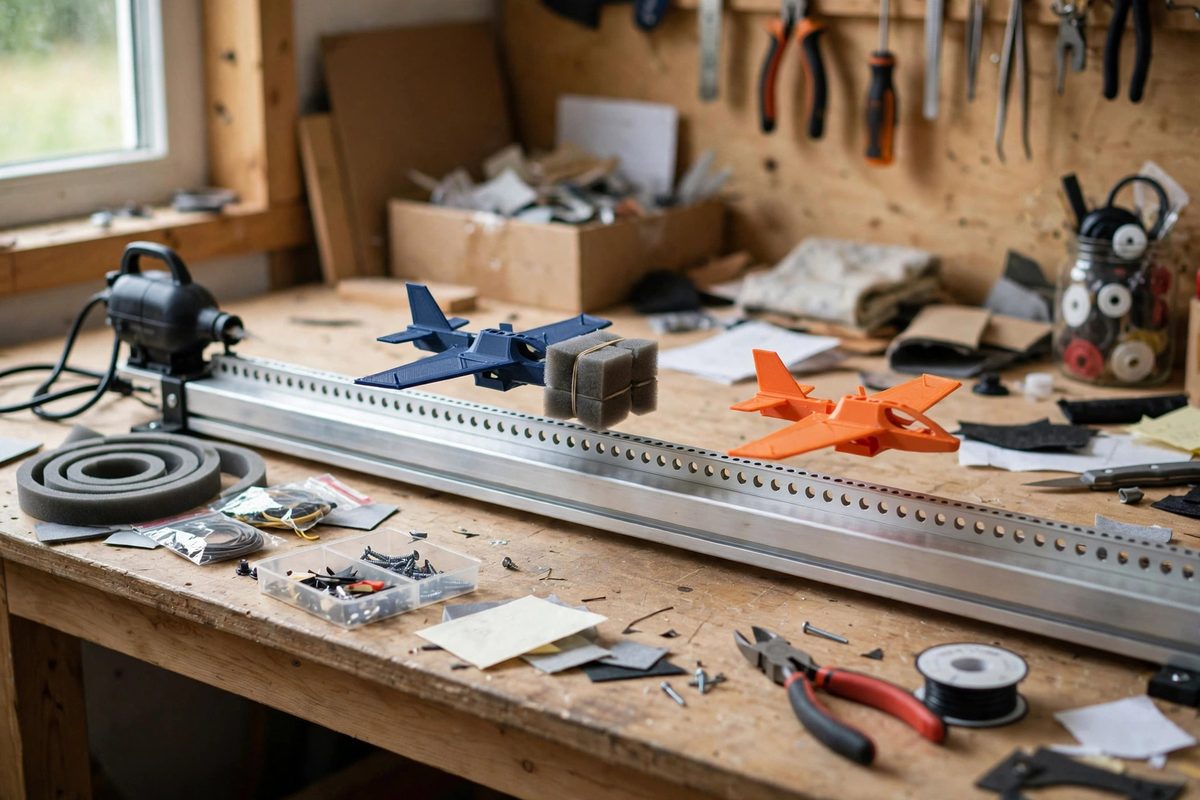
The air track is the classic physics demonstration of conservation of momentum: gliders floating on a cushion of air collide with near-zero friction, and the before-and-after velocities tell the story. But "near-zero" is doing quiet work in that sentence. Real air tracks have residual damping, air resistance, track imperfections, and bumper losses, that make collisions slightly inelastic, and if the demo ignores the damping, the measured momentum appears not to conserve, confusing exactly the students the demo is meant to enlighten. Understanding and accounting for the damping turns a puzzling discrepancy into a deeper lesson.
Where the Damping Comes From
Several small effects combine into the track's residual damping. Air resistance on the glider grows with velocity, so fast gliders lose speed measurably between the launcher and the collision point. The air cushion itself is not perfectly frictionless: the glider's skirt drags slightly, and any tilt or imperfection in the track makes the glider rub. The bumpers, springs or elastic bands at the collision interface, are not perfectly elastic: they return most of the energy but dissipate some as heat and vibration with each impact. Even the track's level matters: a track tilted by a fraction of a degree accelerates gliders downhill, which looks like negative damping in one direction and extra damping in the other. Each effect is small, but the demo's claim is precision: momentum conservation is exact, so even small unaccounted losses show up as apparent violations.
Measuring the Damping
Before the collision demo, characterize the track's damping with a simple measurement: launch a single glider and record its velocity at multiple points along the track using photogates or a motion sensor. The velocity decay with distance quantifies the damping directly, and repeating at different launch speeds reveals whether the damping is mostly velocity-proportional (air resistance) or roughly constant (dry friction). This measurement is itself a valuable lab exercise: students discover that the "frictionless" track has measurable friction, which motivates the entire discussion of idealization in physics. Record the damping as a matter of routine before each demo session, because it changes: dust in the air holes, a shifted track, or a tired bumper all alter the numbers. A track characterized today is not necessarily the track of last month.
Correcting Collision Data
With the damping measured, the collision analysis can correct for it. The cleanest approach is to measure each glider's velocity immediately before and immediately after the collision, as close to the impact point as the sensors allow, minimizing the distance over which damping acts. Then apply the measured damping correction for the residual travel: adjust the velocities to what they would have been at the instant of collision. An alternative used in many labs is to verify momentum conservation in a way that cancels the damping: comparing the system's momentum at symmetric points, or using the damping measurement to show that the "missing" momentum matches the damping loss quantitatively. The pedagogical payoff is significant: instead of hand-waving the discrepancy, the demo shows that momentum is conserved once all effects are accounted for, which is a more honest and more impressive lesson than a fudged perfect result.
Minimizing Damping in the Apparatus
Reduce the damping at its sources for cleaner demos. Level the track carefully with its adjustment screws, checking with a glider's drift in both directions: a truly level track shows no systematic drift. Clean the air holes regularly; clogged holes starve sections of the cushion and the glider drags. Use the air supply at the correct pressure: too little and the gliders ride low and drag, too much and turbulence adds resistance. Choose bumpers for elasticity and inspect them: hardened or cracked elastic bumpers dissipate far more energy than fresh ones, and they are a consumable. Keep gliders clean and undamaged: a bent skirt or a rough edge adds drag that no amount of air pressure fixes. These maintenance habits are the difference between a track that demonstrates physics and one that demonstrates frustration.
Teaching the Idealization Honestly
The deepest value of the damping discussion is philosophical: physics works with idealizations, frictionless surfaces, perfectly elastic collisions, that never exist, and the skill is knowing how to handle the gap between ideal and real. The air track demo, done with damping measured and corrected, teaches this explicitly: here is the ideal law, here is our imperfect apparatus, here is how we account for the imperfection, and the law survives the accounting. Students who learn this lesson stop being disturbed by experimental error and start being curious about it, which is the transition from following lab instructions to doing science. The alternative, presenting uncorrected data and asking students to see conservation that is not quite there, teaches that physics is a matter of squinting, which is the opposite of the truth.
Air track damping is small, measurable, and correctable: characterize it before the demo, minimize it with maintenance, correct the collision data for what remains, and teach the idealization gap explicitly. The momentum conserves, the students see it conserve, and they learn something about how science handles imperfection along the way.
Related Guides
- Balancing Compound Pendulum Weights for Dynamic Demos: A compound pendulum, a rigid body swinging about a pivot that is not at its center of mass, is one of the best dynamic demonstrations in physics: it
- Rotational Inertia Damping in Flywheel Demonstration Kits: A flywheel demonstration kit is supposed to make rotational inertia visible: spin it up, feel the resistance to changes in motion, watch it keep
- Build a Popsicle Stick Catapult: Launch Into Physics! A popsicle stick catapult is the perfect introduction to physics, engineering, and hands-on problem-solving. Kids (and adults!)
- Calibrating Pendulum Escapements for Physics Labs: A pendulum escapement, the mechanism that lets a clock's gear train advance in controlled steps while giving the pendulum tiny sustaining pushes, is
- Rotational Moment of Inertia in Compound Pendulums: A compound pendulum, any rigid body swinging about a fixed pivot that is not its center of mass, is one of the richest simple systems in mechanics