
A pendulum escapement, the mechanism that lets a clock's gear train advance in controlled steps while giving the pendulum tiny sustaining pushes, is a physics lab in miniature: harmonic motion, energy transfer, friction, and feedback all visible in brass and steel. Calibrating one, getting it to tick evenly and keep time, teaches more about oscillators than any simulation. The calibration sequence is methodical and deeply satisfying when the beat locks in, and every step maps directly onto concepts students meet in the physics curriculum.
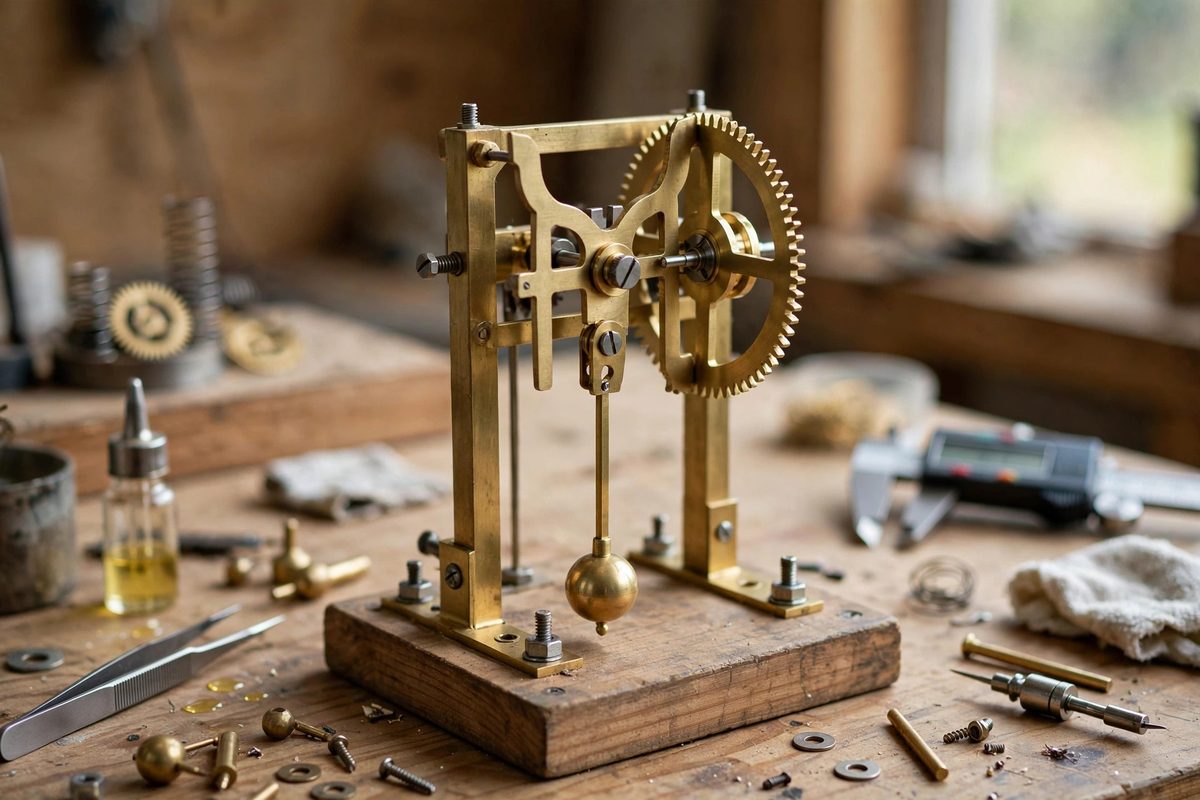
How the escapement sustains the pendulum
A free pendulum decays as friction and air resistance steal energy. The escapement replaces that energy with a small impulse each swing while using the pendulum's regularity to gate the gear train's advance. The anchor or deadbeat pallets alternately catch and release the escape wheel teeth, and the geometry of the pallets determines how much energy is delivered and how evenly the ticks fall.
Calibration means adjusting the mechanism so the energy delivered exactly balances the losses, the pendulum swings at its natural amplitude, and the tick-tock intervals are equal. Each adjustment interacts with the others, which is why calibration follows a sequence rather than random tweaking.
Leveling and beat setting
Start by leveling the movement: the escapement must sit so the pendulum hangs at the center of its swing relative to the pallets. An unlevel clock ticks unevenly, tick longer than tock or vice versa, because the pendulum meets the pallets asymmetrically. Adjust the leveling screws or shims until the beat is even to the ear, then verify by timing consecutive half-periods.
Beat setting is the foundation everything else builds on. No amount of pallet adjustment fixes an unlevel movement; the asymmetry overwhelms everything. Get the beat audibly even before touching anything else, and re-check it after every subsequent adjustment, since moving pallets can disturb the geometry.
Pallet depth and lock
The pallets must engage the escape wheel teeth deeply enough to lock securely but shallowly enough to release cleanly with minimal friction. Too deep and the escapement drags, robbing energy and possibly stalling; too shallow and teeth can slip past, causing the train to race. Adjust pallet depth in tiny increments, observing the lock through a loupe: you want to see the tooth land solidly on the locking face with a small, consistent amount of engagement.
Check both pallets symmetrically. Uneven pallet depth produces uneven impulse, which shows up as beat inequality that leveling cannot fix. The two sides of the escapement should mirror each other in engagement depth and release behavior.
Amplitude and energy balance
With beat and lock set, observe the pendulum's amplitude: it should build to a steady value and hold it. Amplitude that keeps growing indicates over-impulse, too much energy per swing, which wastes power and stresses the suspension; amplitude that decays to a stall indicates under-impulse or excess friction. Adjust the impulse by small changes to pallet geometry or by regulating the driving weight or spring power.
Friction is the usual thief. Clean and lightly oil the pivot holes, check that the crutch does not bind, and verify the suspension spring is straight and undamaged. A surprising amount of "escapement trouble" is really pivot friction or a kinked suspension, and no pallet adjustment compensates for a dirty pivot.
Rating: setting the timekeeping
Once the escapement runs steadily, rate it: compare against a time reference over at least a full day and adjust the pendulum's effective length. Raising the rating nut shortens the pendulum and speeds the clock; lowering it lengthens and slows. Move in small increments and allow the rate to settle between adjustments, since temperature and fresh oil both drift during the first days of running.
Record the daily rate over a week. A well-calibrated escapement holds a consistent rate; a rate that wanders points at remaining issues, usually temperature sensitivity, unstable beat, or variable friction. The logbook is the final calibration instrument: it reveals what the ear and eye miss. Have students plot the daily rates on a graph; the visual trend makes the concept of systematic versus random error concrete in a way numbers alone rarely do.
Escapement calibration is a sequence: level for beat, set pallet depth for clean lock, balance energy for steady amplitude, eliminate friction, then rate for timekeeping. Each step enables the next. When the ticks fall evenly and the days agree with the reference, the mechanism is teaching physics exactly as designed.
Related Guides
- Balancing Compound Pendulum Weights for Dynamic Demos: A compound pendulum, a rigid body swinging about a pivot that is not at its center of mass, is one of the best dynamic demonstrations in physics: it
- Build a Popsicle Stick Catapult: Launch Into Physics! A popsicle stick catapult is the perfect introduction to physics, engineering, and hands-on problem-solving. Kids (and adults!)
- Air Track Glider Damping in Elastic Collision Demos: The air track is the classic physics demonstration of conservation of momentum: gliders floating on a cushion of air collide with near-zero friction
- Rotational Inertia Damping in Flywheel Demonstration Kits: A flywheel demonstration kit is supposed to make rotational inertia visible: spin it up, feel the resistance to changes in motion, watch it keep
- Rotational Moment of Inertia in Compound Pendulums: A compound pendulum, any rigid body swinging about a fixed pivot that is not its center of mass, is one of the richest simple systems in mechanics