
A compound pendulum, a rigid body swinging about a pivot that is not at its center of mass, is one of the best dynamic demonstrations in physics: it shows rotational inertia, center of mass, and period in one swinging object. But a demo pendulum that wobbles, twists, or swings erratically teaches confusion instead of physics. Getting the weights balanced so the pendulum swings cleanly in a single plane is the difference between a demo that lands and one that flops.
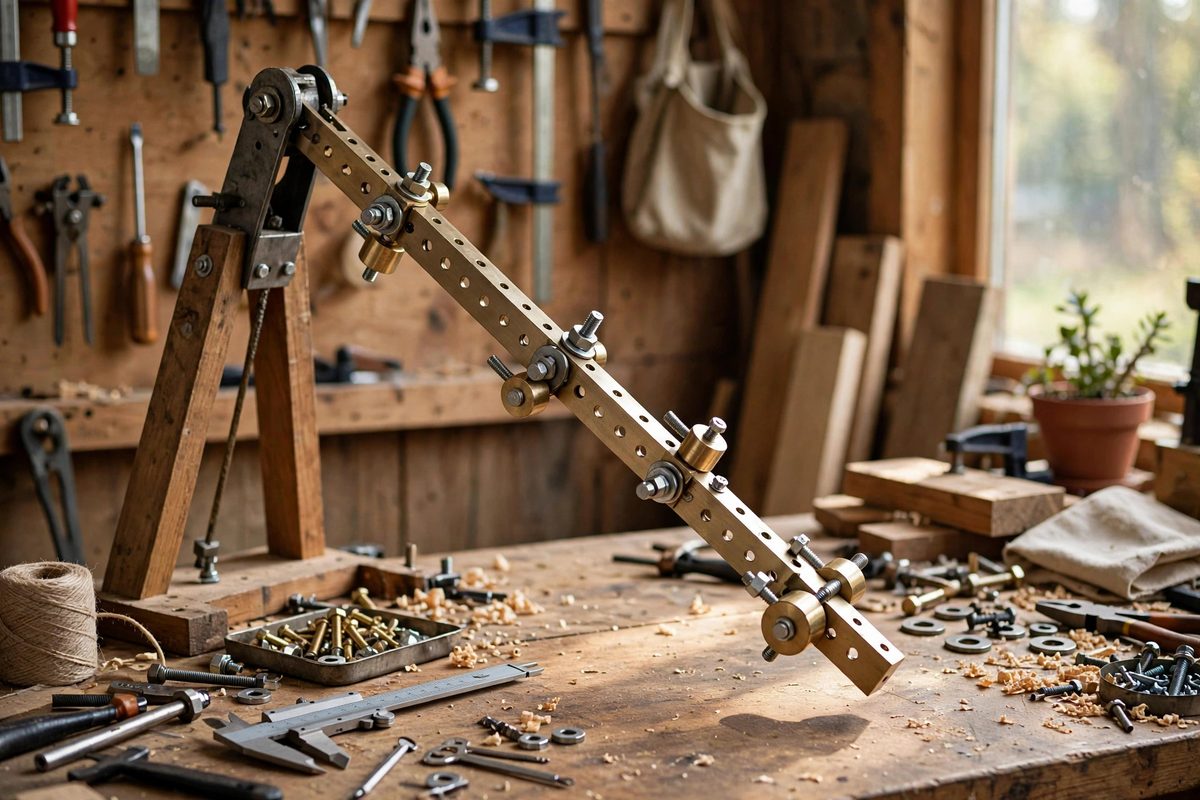
What Makes a Pendulum Swing True
A clean swing needs the center of mass to lie in the plane of motion and on the line through the pivot perpendicular to the swing plane. If the mass distribution is asymmetric, say a weight mounted slightly off to one side, gravity pulls the pendulum not just along the swing plane but sideways, and the motion becomes an ellipse or a wobble instead of a straight swing. Bearing friction and air resistance also matter, but asymmetry is the dominant problem in most demo builds because it is easy to introduce accidentally: a bolt head here, a slightly off-center weight there, and the pendulum has a preferred twist. The fix is deliberate balancing, not tighter bearings.
Designing the Weight Layout
Start with symmetry as a design rule. If the pendulum needs adjustable weights, mount them in pairs on opposite sides of the central bar, or on a single centered threaded rod where the weight's own symmetry guarantees balance. Keep the weights' centers on the pendulum's central axis: a weight that hangs below the bar on a bracket is fine as long as the bracket is centered, but a weight clamped to one face of the bar introduces a sideways offset. When the demo calls for moving weights to change the period, design the adjustment to preserve symmetry: sliding a single weight along the central axis changes the center of mass position without introducing sideways imbalance, which is exactly what you want students to observe.
Static Balancing Procedure
Before the pendulum ever swings, balance it statically. Support the pendulum horizontally on a knife edge or a round rod placed at the intended pivot axis, and see which way it tips. Add small trim weights, washers, modeling clay, or small magnets work well, to the light side until the pendulum sits level. Then rotate the pendulum 90 degrees about its long axis and check again: balance in both orientations confirms the center of mass is on the axis, not just level in one plane. This static check catches the gross asymmetries in minutes, and it is a great classroom activity in itself: students can feel the balance change as they add trim weights.
Dynamic Tuning for a Clean Swing
Static balance gets you close; dynamic testing finishes the job. Hang the pendulum and give it a small initial displacement purely in the intended plane, then watch. A well-balanced pendulum swings in that plane with the amplitude decaying smoothly; a poorly balanced one develops an elliptical or twisting motion within a few swings. If twist appears, the pivot itself may be the problem: the pivot axis must be perpendicular to the swing plane and free to rotate with minimal friction. A knife-edge or a good ball bearing pivot beats a loose bolt through a hole. Also check that the support structure is rigid: a wobbly stand injects its own motion into the pendulum and mimics imbalance.
Tuning the Period for the Demo
Once the swing is clean, set the period for the lesson. Moving the main weight toward the pivot shortens the period; moving it away lengthens it, and the relationship is not linear, which is itself a teachable moment. For classroom visibility, aim for a period students can easily time with a stopwatch: very fast pendulums are hard to count, very slow ones lose the audience. Mark weight positions with a scale on the bar so settings are repeatable, because a demo you cannot reproduce is a demo you cannot build a lesson around. Record the period at each marked position once, and you have a calibration the whole class can use.
Keeping the Demo Reliable
Demo equipment gets handled roughly. Check the balance periodically, because trim weights migrate and pivot bearings wear. Keep a small kit with the pendulum: spare trim weights, the tools to adjust them, and the calibration notes. And store the pendulum hanging or supported so nothing bends: a bent bar is a permanently unbalanced pendulum. A few minutes of maintenance before each use keeps the demo crisp.
Balance the weights symmetrically, verify statically, tune dynamically, and calibrate the period. A compound pendulum that swings true is physics you can see, and it earns its place in the demo cabinet by working every single time.
Related Guides
- Calibrating Pendulum Escapements for Physics Labs: A pendulum escapement, the mechanism that lets a clock's gear train advance in controlled steps while giving the pendulum tiny sustaining pushes, is
- Air Track Glider Damping in Elastic Collision Demos: The air track is the classic physics demonstration of conservation of momentum: gliders floating on a cushion of air collide with near-zero friction
- Rotational Moment of Inertia in Compound Pendulums: A compound pendulum, any rigid body swinging about a fixed pivot that is not its center of mass, is one of the richest simple systems in mechanics
- Build a Popsicle Stick Catapult: Launch Into Physics! A popsicle stick catapult is the perfect introduction to physics, engineering, and hands-on problem-solving. Kids (and adults!)
- Rotational Inertia Damping in Flywheel Demonstration Kits: A flywheel demonstration kit is supposed to make rotational inertia visible: spin it up, feel the resistance to changes in motion, watch it keep