
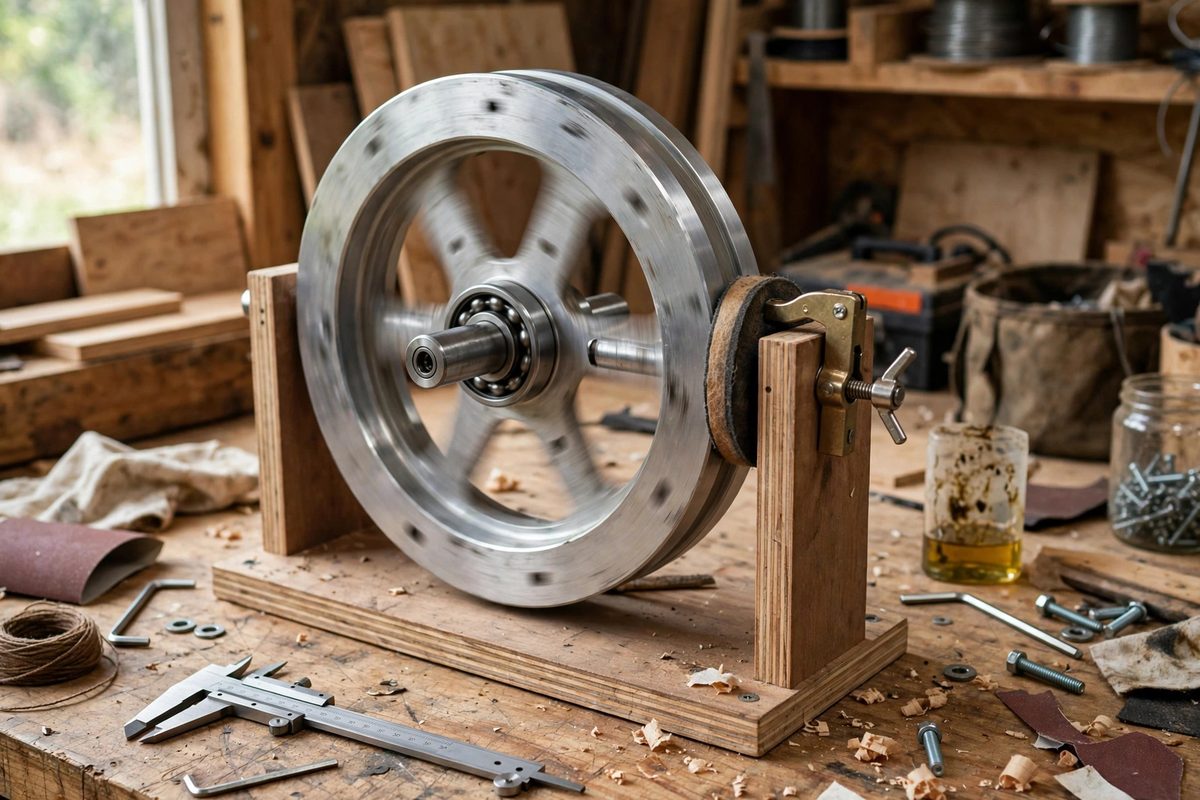
A flywheel demonstration kit is supposed to make rotational inertia visible: spin it up, feel the resistance to changes in motion, watch it keep turning. But a poorly designed kit fights its own lesson, with friction and wobble masking the physics. Damping the unwanted motion while preserving the inertia effect is the design problem that makes or breaks the kit.
What students should feel
The lesson of a flywheel demo is that mass in rotation resists changes to its rotation: it is hard to start, hard to stop, and it resists tilting. For that lesson to land, the unwanted motions have to be small compared to the flywheel effect. If the bearings are gritty, students feel friction, not inertia. If the wheel wobbles, they see imbalance, not gyroscopic stability. The kit's job is to isolate the variable being taught, which means damping or eliminating everything else.
Bearing choice sets the baseline
The axle bearings determine how much of the wheel's behavior is inertia and how much is friction. Smooth ball bearings or good bronze bushings let a well-made wheel spin for a long time on one push, which is the visceral demonstration of stored rotational energy. Avoid bearings with seals that drag unless the kit's scale demands them; the drag of a sealed bearing can dominate a small wheel. Mount the bearings in alignment, because a misaligned axle binds and the binding masquerades as damping. Spin the bare axle before the wheel goes on; it should turn with almost no resistance.
Damping wobble without killing spin
Wobble is the enemy, and it comes from imbalance or a bent axle. Balance the wheel the way you would any flywheel: spin it, find the heavy spot, remove material or add a counterweight. A balanced wheel on a straight axle in good bearings needs no damping of its spin at all; it will run true. Where kits add damping, it should target the unwanted degrees of freedom: a slightly compliant mount that absorbs vibration without constraining rotation, or a gimbal arrangement that lets the wheel's axis move freely so students can feel the gyroscopic resistance. Damp the noise, never the signal.
Adjustable inertia for the lesson
The best kits let students change the inertia and feel the difference. Removable rim weights, or a wheel that accepts bolt-on mass at different radii, turn one demo into an experiment: same push, different coast time; same wheel, mass moved inward versus outward. This is where the radius-squared relationship becomes something felt in the hands rather than read in a textbook. Design the weight attachment to be tool-light and secure; weights that fly off mid-spin end the lesson abruptly and dangerously.
Demonstration choreography
The kit needs a script, not just parts. A good sequence: spin the light configuration and time the coast, add rim weight and repeat, then demonstrate the resistance to tilting by trying to change the spinning wheel's axis. Each step isolates one idea. Provide a stopwatch and a simple data sheet; students who time the coast and record the weight positions are doing physics, not just playing with a spinner. The kit is the apparatus; the choreography is the lesson.
Safety in a spinning-mass demo
Spinning mass stores energy, and students are endlessly inventive about finding the unsafe way to interact with it. Guard any pinch points between the wheel and the frame, keep fingers out of the plane of rotation, and set a maximum spin speed appropriate to the wheel's construction. A wheel built from a cast or 3D-printed part should be spun well below any speed that stresses it. The demonstration of inertia should never become a demonstration of shrapnel.
Build the kit around clean bearings, a balanced wheel, and adjustable rim mass; damp the wobble and the vibration, never the spin; and script the demo so each idea lands. The students will remember what inertia feels like long after they forget the formula.
Related Guides
- Rotational Moment of Inertia in Compound Pendulums: A compound pendulum, any rigid body swinging about a fixed pivot that is not its center of mass, is one of the richest simple systems in mechanics
- Air Track Glider Damping in Elastic Collision Demos: The air track is the classic physics demonstration of conservation of momentum: gliders floating on a cushion of air collide with near-zero friction
- Build a Popsicle Stick Catapult: Launch Into Physics! A popsicle stick catapult is the perfect introduction to physics, engineering, and hands-on problem-solving. Kids (and adults!)
- Calibrating Pendulum Escapements for Physics Labs: A pendulum escapement, the mechanism that lets a clock's gear train advance in controlled steps while giving the pendulum tiny sustaining pushes, is
- Balancing Compound Pendulum Weights for Dynamic Demos: A compound pendulum, a rigid body swinging about a pivot that is not at its center of mass, is one of the best dynamic demonstrations in physics: it