
A textile wall hanging that sags between its mounting points looks tired and homemade in the wrong way. The fabric stretches, the weight pulls, and gravity wins wherever the support is sparse. Anchor cleat spacing, how far apart the hanging's support points are, is the structural decision that keeps a textile hanging flat and proud.
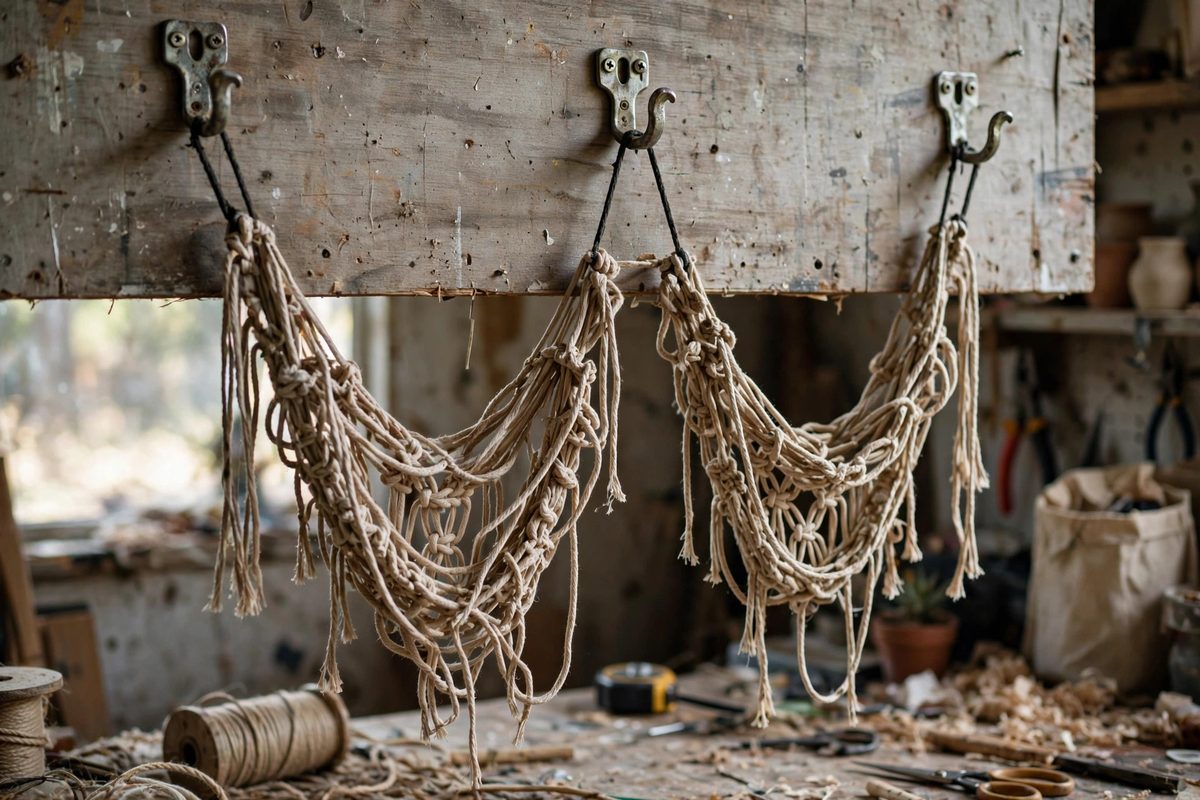
Why textiles sag
Textile hangings are heavy, flexible, and stretchy, a difficult combination. Between any two support points, the textile spans like a tiny suspension bridge, and the span sags under its own weight. The sag grows with the square of the span: double the distance between supports and the sag roughly quadruples. Knotted and woven textiles also creep over time, stretching permanently under sustained load. The support spacing has to account for both the immediate sag and the slow creep.
The spacing rule
As a working rule, support a textile hanging at intervals no wider than about a quarter of its total width, and closer for heavy or stretchy pieces. A three-foot-wide hanging wants supports every nine inches or so; a heavy macrame piece with wooden beads wants them closer. These are starting points to verify by hanging the piece and observing it over days, not engineering constants. The right spacing is the widest spacing at which the hanging stays flat, found by testing.
Cleat types and mounting
A cleat is a support ledge the hanging rests on or attaches to. For textile hangings, the cleat often takes the form of a dowel or rod through a sleeve, supported by brackets, or a series of hooks or nails along the top edge. Whatever the form, each support point must be anchored to the wall properly: into studs where possible, with appropriate wall anchors where not. A cleat that pulls out of drywall is worse than no cleat; the hanging's weight is real, and the mounting must be too.
Distributing the load along the top
The top edge of the hanging carries the whole weight, so it needs to distribute that weight to the supports without stretching. A sleeve sewn or knotted along the top, carrying a rod, spreads the load beautifully. Hanging from isolated points, like corner loops only, concentrates the stress and guarantees sag between them. If the design has only corner attachments, add a hidden support cord or sleeve along the top; the viewer never sees it, but the hanging's flatness depends on it.
Accounting for creep over time
Even a well-supported hanging will creep. Check it after the first month and again seasonally; if sag develops, add intermediate supports or tighten the mounting. Some fibers creep more than others: wool relaxes significantly, cotton less so, synthetics least. Knowing the fiber's character lets you anticipate: a wool hanging gets closer supports from the start. Design for the textile the hanging will become, not just the one fresh off the loom.
Level and alignment
Supports at uneven heights create their own sag, as the textile slides toward the low side. Level every support point with a real level, not by eye, and recheck after the hanging has been up for a week, because wall anchors can settle. A hanging that is level and evenly supported looks intentional; one that tilts looks neglected, regardless of the quality of the textile work.
Space the supports close enough, anchor each one properly, distribute the top-edge load, and check for creep. The hanging stays flat, the textile gets the presentation its maker intended, and gravity is kept politely at bay.
Related Guides
- Hanging Cleat Weight Ratings for Large Textile Drops: Large macrame wall hangings are deceptively heavy. A piece that looks like airy knotted cotton can weigh fifteen or twenty pounds once the dowel, the
- Mounting Dowel Deflection Limits in Wide Macrame: A wide macrame wall hanging puts a real structural demand on its mounting dowel: the full weight of cords and knots pulls down along its length, and
- Calculating Branch Deflection in Driftwood Wall Art: Driftwood wall hangings balance rustic beauty against quiet structural risk. A handsome branch mounted horizontally, hung with macrame, beads, or
- Hanging Dowel Bending Stress Calculations for Weaves: A macrame wall hanging starts with a dowel: the horizontal bar from which every cord hangs and around which the whole piece is built. It looks like a