
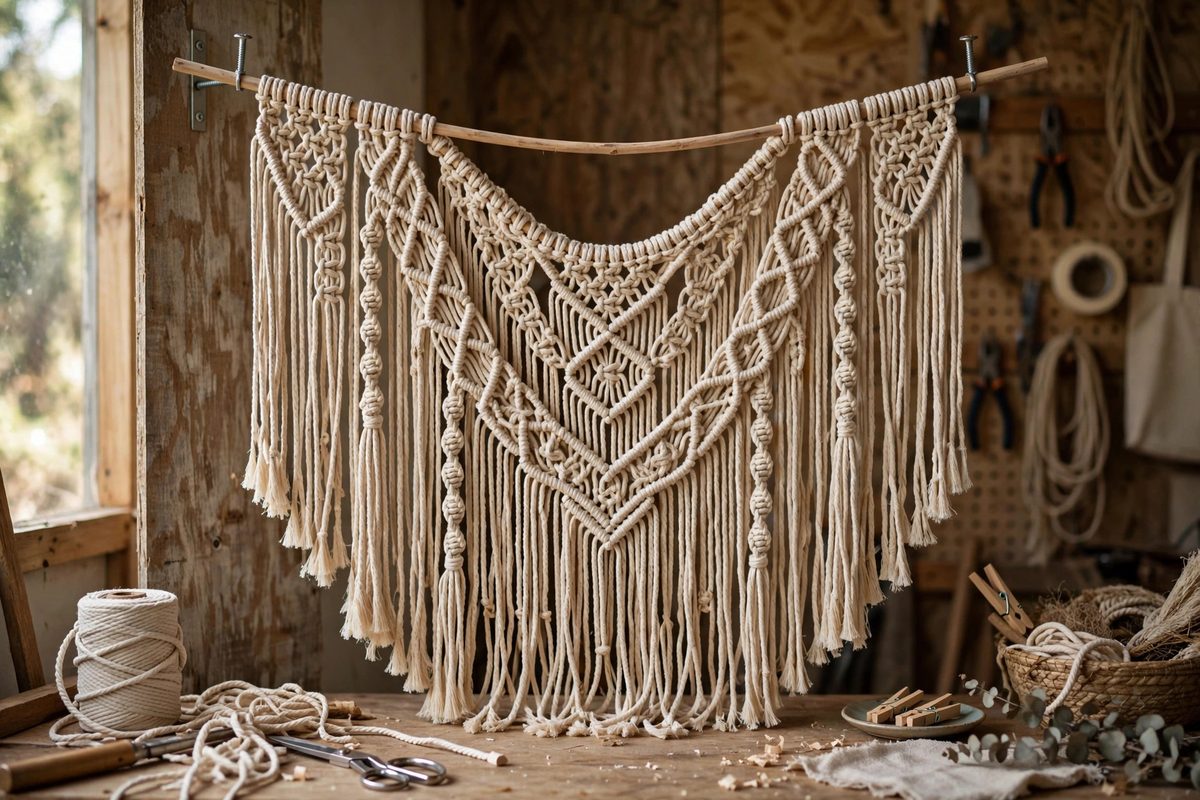
A wide macrame wall hanging puts a real structural demand on its mounting dowel: the full weight of cords and knots pulls down along its length, and a dowel that is too slender bows visibly under the load, ruining the hanging's lines and stressing the mounting cords unevenly. Sizing the dowel against deflection, not just against breaking, is the engineering that keeps wide pieces hanging straight. It is a small calculation that pays off every time you look at the finished piece.
Why deflection governs, not strength
A wooden dowel strong enough to hold a wall hanging without breaking can still sag enough to look wrong. The eye notices a bowed dowel immediately: the hanging's top edge curves, the fringe hangs unevenly, and the whole piece reads as saggy rather than crafted. Deflection limits for display pieces are aesthetic, which makes them stricter than structural limits; a dowel at half its breaking load can already be unacceptably bowed.
Deflection grows with the cube of the span and inversely with the fourth power of the diameter, which means small diameter increases buy large stiffness gains, and span is brutally punishing. Doubling the hanging's width demands roughly eight times the stiffness for the same sag, a relationship that surprises everyone the first time.
Estimating the load
Weigh the finished knotting or estimate from cord weight: a dense wide hanging can weigh several pounds, all of it suspended from the dowel as a roughly distributed load. Add the dowel's own weight, which matters for long spans. The distributed load case, weight spread along the length, deflects less than the same weight concentrated at the center, so estimate honestly rather than worst-casing; but include everything, including fringe and beads.
Remember the hanging also loads the dowel dynamically when handled, taken down for dusting, adjusted on the wall. Size with margin for real life, not just static display. A dowel that is merely adequate on day one will look tired after a year of seasonal humidity cycles, which soften wood and increase sag; build in headroom for that aging.
Sizing the dowel
For a given span and load, increase diameter until the predicted sag is visually negligible, a fraction of the dowel's own diameter over the full span. In practice, wide hangings, three feet and up, need dowels substantially thicker than craft-store defaults: stepping from a half-inch to a three-quarter-inch dowel roughly quintuples stiffness, which usually solves the problem outright.
Wood species matters at the margin: dense hardwoods are stiffer than soft pine dowels of the same diameter. But diameter dominates species; a thicker softwood dowel outperforms a thin hardwood one. Choose diameter first, species second. Consider a metal rod sleeved in wood or wrapped in cord for very wide pieces, where no reasonable wooden dowel stays straight.
Support strategies for wide spans
When the span defeats any reasonable dowel, add support: a center hanger from the wall or ceiling that carries the dowel's midpoint converts one long span into two short ones, cutting deflection dramatically. Alternatively, mount the hanging from two points on a wall-mounted board or rail rather than a single suspended dowel, eliminating the span problem entirely.
Design the support into the piece from the start. A center support added as an afterthought shows; one integrated into the knotting pattern, perhaps as a decorative element, disappears. Plan wide hangings around their support strategy, not around the hope that the dowel will suffice.
Mounting cords and balance
The cords suspending the dowel must share the load evenly, or the dowel twists and the hanging tilts. Attach suspension cords symmetrically, verify balance before finalizing, and use cord rated well above the total weight. Wall anchors must suit the wall and the load; a heavy wide hanging needs studs or proper anchors, not hope and small nails.
Check the hanging after a week: cords stretch, knots settle, and dowels take a set. Re-level and adjust as needed; the piece finds its final shape in the first days on the wall, and a quick tune-up then keeps it straight for years.
Dowel sizing is deflection engineering with an aesthetic limit: estimate the distributed load, size diameter for negligible sag, step up decisively for wide spans, add center support when physics demands it, and hang from real anchors. The top edge stays straight, and the craftsmanship shows instead of the sag.
Related Guides
- Hanging Dowel Bending Stress Calculations for Weaves: A macrame wall hanging starts with a dowel: the horizontal bar from which every cord hangs and around which the whole piece is built. It looks like a
- Calculating Branch Deflection in Driftwood Wall Art: Driftwood wall hangings balance rustic beauty against quiet structural risk. A handsome branch mounted horizontally, hung with macrame, beads, or
- Hanging Cleat Weight Ratings for Large Textile Drops: Large macrame wall hangings are deceptively heavy. A piece that looks like airy knotted cotton can weigh fifteen or twenty pounds once the dowel, the
- Anchor Cleat Spacing to Stop Sagging in Textile Hangings: A textile wall hanging that sags between its mounting points looks tired and homemade in the wrong way. The fabric stretches, the weight pulls, and