
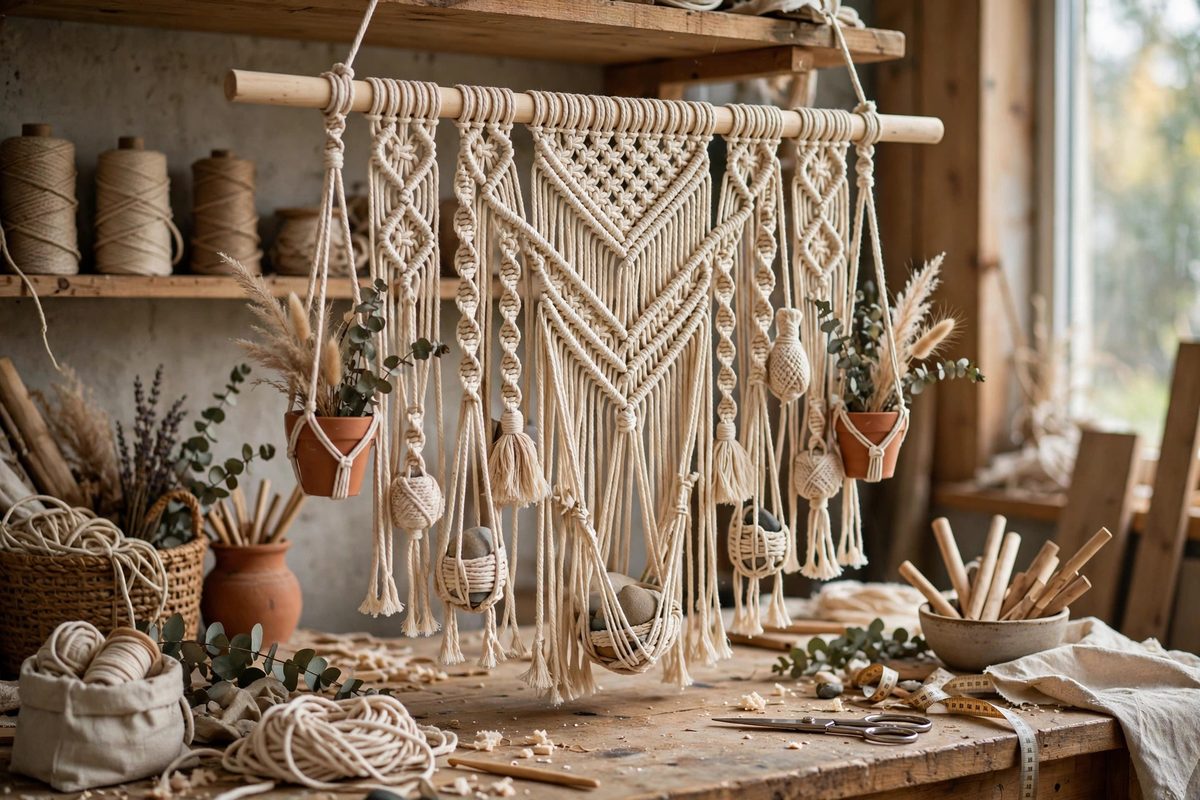
A macrame wall hanging starts with a dowel: the horizontal bar from which every cord hangs and around which the whole piece is built. It looks like a simple stick, but structurally it is a beam carrying a distributed load, and for large hangings that load is significant. A dowel that is too thin for its span sags visibly, stresses the mounting, and in the worst case snaps. A little beam math, kept practical, keeps your hangings straight and safe.
The Dowel as a Beam
Think of the dowel as a beam supported at its two ends (where it hangs from the wall mounts or cords) with the weight of the macrame distributed along its length. This is the classic uniformly loaded beam, and its behavior is well understood: it deflects most at the center, and the bending stress is highest at the center too, on the top and bottom fibers of the dowel. The deflection grows with the cube of the span: double the distance between supports and the sag increases roughly eightfold for the same load. This cubic relationship is why a dowel that works fine at two feet fails dramatically at four: span is the dominant variable.
Estimating the Load
Add up what the dowel carries: the total weight of cord in the piece, any beads or embellishments, and a margin for the dynamic loads of handling and hanging. A kitchen scale makes this easy — weigh a sample length of cord and multiply. Cord weight surprises people: a large wall hanging can contain hundreds of yards of cord, and that adds up to real pounds. Weigh a sample length of your cord and multiply by the total length used, or weigh the finished piece on a scale if it is already made. Be honest about embellishments: wooden beads, metal rings, and driftwood additions concentrate weight that the dowel must carry. When in doubt, overestimate: the calculation is only as good as the load number.
Why Diameter Matters More Than Species
A dowel's resistance to bending comes from its cross-section, and the stiffness of a round dowel grows with the fourth power of its diameter: a small increase in thickness produces a large increase in rigidity. This means choosing a slightly thicker dowel beats choosing a stronger wood species almost every time. Doubling the diameter increases stiffness roughly sixteenfold; switching from pine to oak might double it. So when a hanging needs more support, reach for a thicker dowel first. The practical rule: for wide hangings, err toward dowels that look almost too chunky. The visual weight of a substantial dowel suits a large textile piece, and the structural margin keeps it straight.
Quick-Reference: Span vs. Diameter
For typical macrame loads (a few pounds of cord plus embellishments), these minimums keep sag negligible. Buy your dowels as hardwood dowel rods rather than softwood when you can:
- Up to 24" span: 3/4" diameter is fine for light pieces; go 1" for anything beaded or dense
- 24" to 36" span: 1" diameter minimum; 1-1/4" for heavy pieces
- 36" to 48" span: 1-1/4" to 1-1/2" diameter, or add a center support
- Over 48" span: add intermediate supports regardless of diameter, or expect visible sag
These assume softwood dowels (pine, poplar). Hardwood buys you roughly one step down in diameter, but as the section above explains, thickness beats species.
The Math, for the Curious (Optional)
You do not need this section to pick a dowel. The table above is enough. But since this article promises calculations, here is the real one.
A dowel supported at both ends with weight spread along its length is a uniformly loaded simply supported beam. Its maximum sag at center is:
deflection = 5 x load x span^4 / (384 x E x I)
Where load is total weight in pounds, span is in inches, E is the wood's stiffness (about 1,500,000 psi for pine, 1,800,000 for oak), and I for a round dowel is 3.1416 x diameter^4 / 64.
A worked example shows why diameter dominates. Take a 36-inch span carrying 5 pounds of macrame on a pine dowel:
- 1" dowel: sags about 1.5 inches at center. Worse, the bending stress approaches 8,000 psi, which is near pine's breaking point. This dowel is in trouble.
- 1-1/4" dowel: sags about 0.6 inches. Safe.
- 1-1/2" dowel: sags about 0.3 inches. Very safe.
Going from 1 inch to 1-1/2 inches cut the sag fivefold. That is the fourth power at work, and it is why the table above leans chunky.
Support Placement and Span Reduction
If the dowel must span a wide distance, consider intermediate supports: a third hanging point at the center cuts the effective span in half, which reduces deflection by roughly a factor of eight. Center supports change the design, the hanging cords must accommodate them, but for very large pieces they are the difference between possible and impossible. Alternatively, hang the dowel from cords attached at multiple points along its length rather than just the ends: each attachment shares the support. Whatever the arrangement, make sure the supports themselves are adequate: the total load now concentrates at the mounting points, which must hold it.
Checking for Sag Before It Is Permanent
Wood creeps under sustained load: a dowel that looks straight on hanging day may develop a permanent sag over months. Test before committing: support the dowel as planned, hang the full weight (or an equivalent test load) for several days, and check for deflection with a straightedge. If it sags under test, it will sag worse over time: upsize the dowel or add supports. Also consider the dowel's own weight on long spans: a heavy hardwood dowel contributes meaningful load by itself. And store dowels horizontally and supported when not in use: a dowel leaning in a corner for a year arrives pre-bent.
Mounting Safety
The wall mounting carries everything the dowel carries, concentrated at two (or three) points. Use wall anchors rated for the total weight with margin, installed into structure wherever possible: a large textile hanging is heavier than it looks, and drywall anchors have limits. Check mounts periodically, especially in the first weeks as the hanging settles. A wall hanging that falls is not just a damaged artwork; a heavy dowel falling from height is a genuine hazard.
Conclusion
The dowel is a beam: estimate the load, respect the cubic power of span, choose diameter generously, support wisely, test for sag, and mount securely. A little structural thinking at the start keeps the wall hanging straight, safe, and beautiful for its whole life. When in doubt, go one size thicker. Nobody ever regretted a dowel that was slightly too sturdy.
Related Guides
- Mounting Dowel Deflection Limits in Wide Macrame: A wide macrame wall hanging puts a real structural demand on its mounting dowel: the full weight of cords and knots pulls down along its length, and this guide works through the deflection limits that tell you when a span needs a thicker dowel or an extra support.
- Hanging Cleat Weight Ratings for Large Textile Drops: Large macrame wall hangings are deceptively heavy. A piece that looks like airy knotted cotton can weigh fifteen or twenty pounds once the dowel, the knots, and the embellishments add up, so the hanging cleat needs a real weight rating with margin.
- Anchor Cleat Spacing to Stop Sagging in Textile Hangings: A textile wall hanging that sags between its mounting points looks tired and homemade in the wrong way. The fabric stretches, the weight pulls, and the right anchor cleat spacing is what keeps the whole piece hanging straight.
- Calculating Branch Deflection in Driftwood Wall Art: Driftwood wall hangings balance rustic beauty against quiet structural risk. A handsome branch mounted horizontally, hung with macrame or beads, carries the same beam-loading problem as a dowel, with the added complication of irregular cross-sections.
As an Amazon Associate I earn from qualifying purchases.