
Anyone who has run a rotary tool for an hour knows the feeling: the buzz travels up through your fingers, into your wrist, and by the end of the session your hand is tingling. Rotary tools spin fast, and fast-spinning accessories are never perfectly balanced, so every session is a low-grade vibration workout for your hand. Adding a counterweight to the grip is a simple modification that cancels a surprising amount of that buzz, and it is worth understanding why it works before you start bolting weights onto your tool.
Where the Vibration Comes From
Vibration in a rotary tool comes from imbalance: the spinning accessory, collet, and bit assembly has its center of mass slightly off the axis of rotation, so every revolution throws a tiny sideways force into the housing. At thousands of RPM, those tiny forces add up to a constant buzz. Accessories make it worse: a grinding stone that is slightly out of round, a burr with uneven teeth, or a cutting wheel mounted slightly off-center all increase the imbalance. The tool body then transmits that vibration straight into your grip, and your hand and forearm absorb it for the duration of the work.
Why Counterweights Help
A counterweight works by shifting the tool's center of mass and changing how it responds to the vibration forces. Added mass at the right spot resists being shaken: the same sideways force that rattles a light tool barely moves a heavier one, because acceleration drops as mass rises. Placed opposite the worst imbalance, a counterweight can also partially cancel the oscillating force directly. The practical result is less vibration reaching your hand, which means less fatigue, better control for detail work, and less of the numbness that comes from long sessions. It does not fix a badly out-of-balance accessory, but it takes the edge off the vibration that even good accessories produce.
Designing the Counterweight
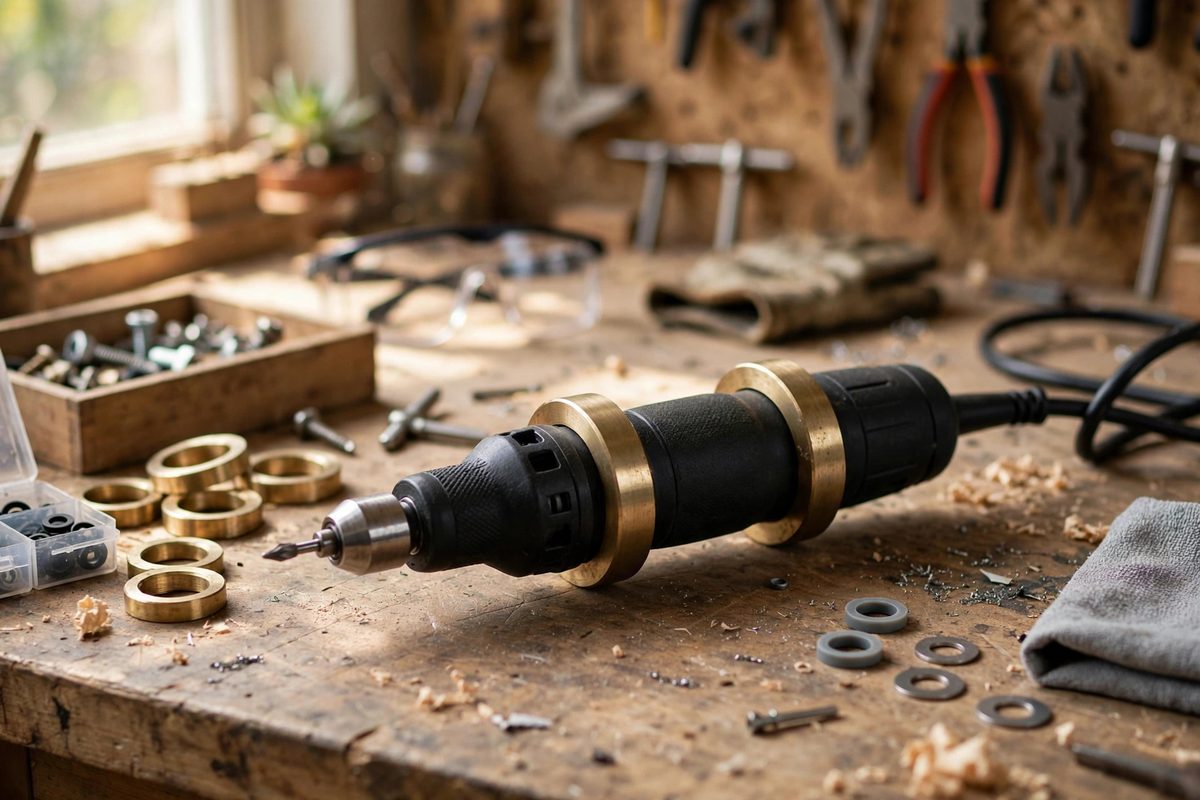
The most effective counterweight sits as close to the vibration source as practical, which usually means near the front of the tool around the collet end, and it should be symmetric around the tool body so it does not introduce its own imbalance. A ring or collar of dense metal (steel or brass) around the nose of the tool is the classic form: it adds mass exactly where the shaking enters the housing, and because it is a ring, it stays balanced itself. Start modest: add weight in small increments and test the feel, because there is a point of diminishing returns where extra mass just makes the tool tiring to hold. A few ounces in the right place beats a pound in the wrong place.
Attachment Methods That Stay Put
A counterweight that shifts or spins loose is worse than no counterweight, because a loose weight adds its own rattling imbalance. Attachment needs to be solid and concentric. Options include a split collar clamped with screws, a threaded adapter that screws onto the tool's existing nose threads, or a friction-fit sleeve secured with set screws. Whatever method you choose, check that it does not block cooling vents: rotary tools run hot, and covering the air intake will cook the motor. Also confirm the added weight does not interfere with the collet nut or the shaft lock, since you still need to change accessories freely.
Balancing the Whole Setup
The counterweight is only half the equation; the other half is reducing vibration at the source. Inspect accessories before mounting: spin grinding stones and cutting wheels by hand and reject any that wobble visibly. Seat accessories fully in the collet and tighten properly, because a bit that is not fully seated runs eccentric. Replace collets that are worn or sprung, since a sloppy collet lets every accessory run off-center. And dress grinding stones that have worn unevenly. Each of these steps reduces the imbalance the counterweight has to fight, and together they can transform a buzzy tool into a smooth one.
Ergonomics Beyond the Weight
While you are modifying the grip, consider the grip itself. A slightly larger-diameter grip with a soft, high-friction covering reduces the squeeze force your hand needs, and less squeeze means less transmitted vibration and less fatigue. Take breaks during long sessions: no modification eliminates vibration entirely, and periodic rest is the proven way to protect your hands. If you ever experience persistent numbness or tingling that does not fade after the work stops, take it seriously and talk to a doctor, because vibration exposure is a cumulative thing.
A well-placed counterweight is one of the highest-value modifications you can make to a rotary tool: a little dense metal, mounted solidly near the nose, takes the harsh edge off the buzz and leaves you with steadier hands for detail work. Pair it with balanced accessories and sensible breaks, and long carving or grinding sessions get a lot more comfortable.
Related Guides
- Vibration Dampening Grips for Angle Grinders: Angle grinders are among the highest-vibration tools in the shop, and the vibration goes straight into the operator's hands through the side handle
- Elastomeric Palm Grips for Orbital Sander Vibration: Orbital sanders vibrate by design: the pad orbits thousands of times per minute, and that motion couples into the user's hand as high-frequency
- Elastomeric Handle Bushings for Heavy Rotary Hammers: A heavy rotary hammer delivers punishment in both directions: the bit hammers the concrete, and the concrete hammers back through the handles into
- Adjusting Trigger Pull Weight on Heavy Nailers: Driving hundreds of nails with a heavy framing nailer is a forearm workout, and a stiff trigger multiplies the effort on every single shot. Adjusting