
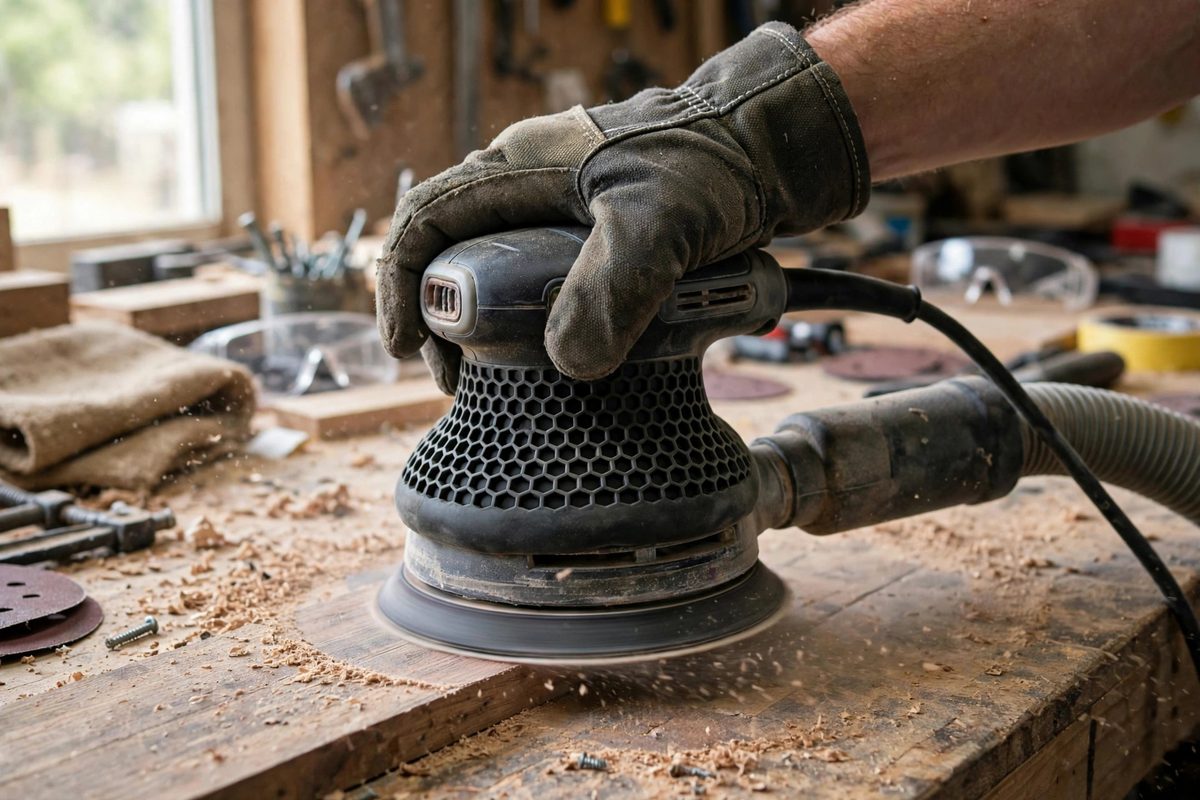
Orbital sanders vibrate by design: the pad orbits thousands of times per minute, and that motion couples into the user's hand as high-frequency vibration. Over a long sanding session, the vibration causes fatigue, numbness, and with enough exposure over years, hand-arm vibration issues that are genuinely debilitating. Elastomeric palm grips, soft rubber-like sleeves fitted over the sander's body, damp that vibration before it reaches the hand. They are a simple modification with real ergonomic physics behind them, and they make the difference between dreading the sanding stage and getting through it comfortably.
How Vibration Reaches the Hand
The sander's motor and eccentric mechanism generate vibration at the orbit frequency and its harmonics. That vibration travels through the tool's rigid housing directly into the palm and fingers gripping it. The hand's tissues absorb the energy: at high frequencies the energy dissipates as heat and micro-trauma in the soft tissues, blood vessels, and nerves. The damage mechanism is cumulative and frequency-dependent: the frequencies orbital sanders produce sit squarely in the range most associated with hand-arm vibration syndrome, the numbness, whitening, and loss of dexterity that afflicts long-term power tool users. Reducing the vibration transmitted to the hand, even modestly, disproportionately reduces the cumulative dose, because the dose accumulates with the square of the acceleration. A grip that cuts transmitted vibration meaningfully is not comfort; it is prevention.
How Elastomers Damp Vibration
Elastomeric materials, silicones, thermoplastic elastomers, soft polyurethanes, damp vibration through hysteresis: as the material deforms with each vibration cycle, internal friction converts some of the mechanical energy into heat instead of passing it through. A grip sleeve works as a compliant layer between the vibrating housing and the hand: the housing moves, the elastomer shears and compresses, and the hand experiences a smoothed, reduced version of the motion. The damping effectiveness depends on the material's loss factor, its thickness, and its hardness relative to the grip pressure. Too hard and it transmits like the housing; too soft and it bottoms out under grip pressure, transmitting directly. The sweet spot is a medium-soft elastomer thick enough to deform through the vibration amplitude without collapsing: a few millimeters of the right material outperforms a thick layer of the wrong one.
Fitting Grips to the Sander
The grip must fit the sander's body snugly without adhesive in most cases: a sleeve slightly undersized that stretches over the housing stays put through friction and can be removed for cleaning or replacement. Measure the housing circumference at the grip zones, palm rest and any secondary handle, and size the sleeve to stretch roughly 10 to 20 percent over the housing. The sleeve should cover the primary contact areas fully: the palm rest where most pressure lands, and the front knob or handle if the sander has one. Avoid covering ventilation slots or the dust port: blocking cooling airflow overheats the motor, and a grip that migrates over the vents during use is worse than none. Trim the sleeve cleanly rather than stretching it over obstructions; a grip fighting the tool's shape bunches up and creates pressure points that defeat the ergonomic purpose.
Material Selection
Not all soft materials damp equally. Closed-cell foam grips are cheap and comfortable initially but compress permanently over time, losing both cushioning and damping; they are a short-term fix. Thermoplastic elastomer sleeves hold their properties far longer and resist the oils, sweat, and dust of shop use. Silicone offers excellent damping and temperature stability but can feel slippery, especially with dusty hands; textured silicone mitigates this. Whatever the material, it must tolerate the shop environment: UV from windows, ozone, sawdust abrasion, and occasional solvent splash. A grip that degrades into a sticky mess within months gets removed, and the sander goes back to bare housing. Buy or make grips from materials rated for the environment, and inspect them periodically: a cracked or hardened grip damps nothing.
Complementary Vibration Reduction
Grips are one layer of a vibration strategy, not the whole thing. Reduce the source vibration where possible: keep the sander's pad and counterweight clean and balanced, because an imbalanced pad vibrates far more than a true one, and replace worn pads promptly. Use sharp, quality abrasives: dull paper forces the user to press harder, increasing both the coupling force and the session duration, a double penalty. Take breaks on long sanding sessions: the vibration dose accumulates with time, so pacing the work is as effective as any hardware. Alternate hands or tasks where practical. And consider the sander itself: some designs isolate the handles from the motor housing far better than others, and when buying, the vibration specification, where published, is worth comparing. The grip upgrade helps any sander; starting from a low-vibration design helps more.
Elastomeric palm grips are cheap, simple, and grounded in real damping physics: a compliant layer that eats vibration before the hand does. Fit them snugly, choose durable materials, keep the tool balanced and the abrasives sharp, and pace the work. Your hands have to last longer than any project.
Related Guides
- Vibration Dampening Grips for Angle Grinders: Angle grinders are among the highest-vibration tools in the shop, and the vibration goes straight into the operator's hands through the side handle
- Anti-Vibration Counterweights for Rotary Tool Grips: Anyone who has run a rotary tool for an hour knows the feeling: the buzz travels up through your fingers, into your wrist, and by the end of the
- Elastomeric Handle Bushings for Heavy Rotary Hammers: A heavy rotary hammer delivers punishment in both directions: the bit hammers the concrete, and the concrete hammers back through the handles into
- Adjusting Trigger Pull Weight on Heavy Nailers: Driving hundreds of nails with a heavy framing nailer is a forearm workout, and a stiff trigger multiplies the effort on every single shot. Adjusting