
A heavy rotary hammer delivers punishment in both directions: the bit hammers the concrete, and the concrete hammers back through the handles into your hands and arms. Over a day of overhead or horizontal drilling, that vibration accumulates into fatigue, numbness, and the kind of joint ache that lingers into the next morning. Elastomeric handle bushings, rubber or polyurethane isolators fitted between the handle and the tool body, are one of the most effective ergonomic mods for these tools. They do not change the tool's power. They change how much of the tool's violence reaches you.
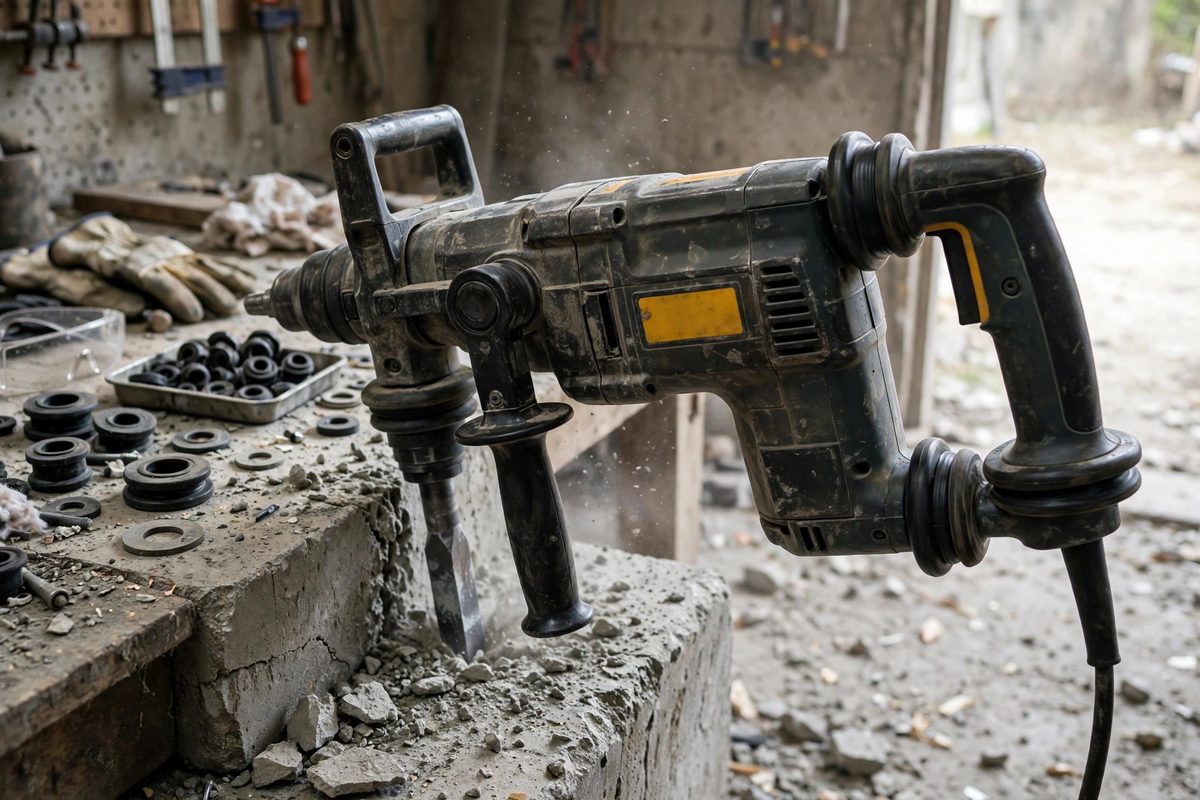
How vibration reaches the operator
A rotary hammer generates vibration at the bit from two sources: the hammering mechanism's reciprocating impacts and the rotary cutting action. That vibration travels through the metal tool body directly into the rigid handles, and from there into the hands. Human hands and arms are most sensitive to vibration in a frequency band that unfortunately overlaps the operating frequencies of these tools, which is why the fatigue feels disproportionate to the visible shaking. Prolonged exposure is not just uncomfortable; it is the mechanism behind hand-arm vibration syndrome, a genuine occupational condition. Reducing the vibration that reaches the handles is therefore both a comfort upgrade and a health measure, especially for anyone who runs these tools regularly.
What elastomeric bushings do
An elastomeric bushing is a sleeve or mount of rubber-like material placed in the load path between the vibrating tool body and the handle. It works as a spring and damper in series with your hands: the stiffness of the elastomer sets how much vibration transmits at each frequency, and its internal damping converts some of the vibrational energy to heat. The key design principle is tuning the bushing's stiffness so its natural frequency sits well below the tool's dominant vibration frequencies. Above that natural frequency, the bushing isolates; near it, the bushing can actually amplify. This is why a bushing that is too stiff barely helps and one that is too soft makes the handle feel vague and uncontrolled. The material choice, natural rubber, neoprene, or polyurethane, sets the stiffness, damping, and durability tradeoff.
Selecting and fitting bushings
Start by identifying the handle mounting points on your tool: most rotary hammers have a side handle threading into the gear case and a rear handle integrated with the body. Aftermarket isolation handles exist for common mounting patterns, and they are worth considering before fabricating, since their bushings are already tuned for the application. If you are making your own, choose a bushing with enough stiffness to keep the handle feeling connected under drilling thrust; the handle must still transmit your feed force accurately, or drilling becomes vague and bits wander. Size the bushing so it carries the static load of your grip and feed pressure without bottoming out, and capture it mechanically so it cannot walk out of its seat under vibration. A bushing that migrates mid-job is worse than none, because it changes the tool's feel unpredictably.
Installation and tuning
Install bushings with the tool's fasteners torqued to spec, since clamping force affects the bushing's effective stiffness. After installation, test the tool under real drilling load, not just free-running, because the vibration character changes dramatically when the bit is cutting. The handle should feel noticeably deader, with the sharp impacts rounded off, while still giving enough feedback to feel the bit's progress. If the handle feels mushy or the tool seems harder to control, the bushings are too soft for the feed forces involved; step up in stiffness. If the improvement is marginal, check that vibration is not bypassing the bushings through another rigid path, such as a depth stop rod or an auxiliary attachment bolted directly to the body. Isolation only works on the paths you actually isolate.
Durability and inspection
Elastomers age. Heat, ozone, UV, and oil exposure harden rubber over time, and a hardened bushing gradually stops isolating. Inspect the bushings periodically for cracking, permanent deformation, and hardening; a bushing that has taken a set or shows surface crazing is due for replacement. Polyurethane generally outlasts natural rubber in oily, harsh environments but can be less forgiving in its damping character. Keep spares on hand, since bushing replacement is a minutes-long job and running with a failed bushing means running with no isolation while thinking you have it. Log the installation date; time, not just visible wear, retires elastomers.
Safety boundaries for tool mods
Never modify the tool in ways that compromise its structural integrity or safety systems. Bushings belong in the handle path only; do not alter the gear case, the chuck, or any guard. Ensure the modified handle cannot separate from the tool under load, because a handle coming off mid-drill with a spinning bit is a serious hazard. Verify that the modification does not interfere with the tool's clutch or safety shutoffs. And respect the underlying message of the vibration: if a job requires hours of rotary hammering, isolation bushings help, but work rotation, sharp bits that cut instead of pounding, and the right tool for the scale of the job help more.
Elastomeric handle bushings turn a rigid vibration path into a tuned isolation mount, cutting the punishment that reaches your hands without dulling the tool's feedback. Size them stiff enough to drill accurately, soft enough to isolate, inspect them as they age, and never compromise the tool's structure to fit them. Your hands will notice the difference by lunchtime.
Related Guides
- Elastomeric Palm Grips for Orbital Sander Vibration: Orbital sanders vibrate by design: the pad orbits thousands of times per minute, and that motion couples into the user's hand as high-frequency
- Anti-Vibration Counterweights for Rotary Tool Grips: Anyone who has run a rotary tool for an hour knows the feeling: the buzz travels up through your fingers, into your wrist, and by the end of the
- Adjusting Trigger Pull Weight on Heavy Nailers: Driving hundreds of nails with a heavy framing nailer is a forearm workout, and a stiff trigger multiplies the effort on every single shot. Adjusting
- Vibration Dampening Grips for Angle Grinders: Angle grinders are among the highest-vibration tools in the shop, and the vibration goes straight into the operator's hands through the side handle