
Clear coat is where a paint job is won or lost, and atomization is where clear coat is won or lost. The spray gun's job is to break the liquid into droplets fine enough to flow together into glass, and the air pressure driving that breakup is the primary control. Too little pressure and the droplets are coarse, landing as orange peel that never quite levels. Too much pressure and the droplets are so fine they dry before landing, or bounce off the surface as overspray, leaving a dry, sandy texture. Calibrating atomization pressure for HVLP equipment is a short procedure that pays off in every coat.
What atomization does to the finish
A liquid coating levels because surface tension pulls the deposited droplets together into a continuous film, but surface tension can only bridge small gaps. Fine, uniform droplets land close together, merge readily, and flow out flat before the coating sets. Coarse droplets land as distinct bumps with valleys between them that surface tension cannot fully close, which is orange peel in its classic form. Over-atomized material has the opposite problem: the droplets lose so much solvent in flight that they arrive nearly dry and cannot merge at all, producing a rough, matte texture that no amount of flow will fix. The target is the middle ground where droplets are fine enough to merge but wet enough to flow, and pressure is the knob that moves you along that spectrum.
Understanding HVLP pressure readings
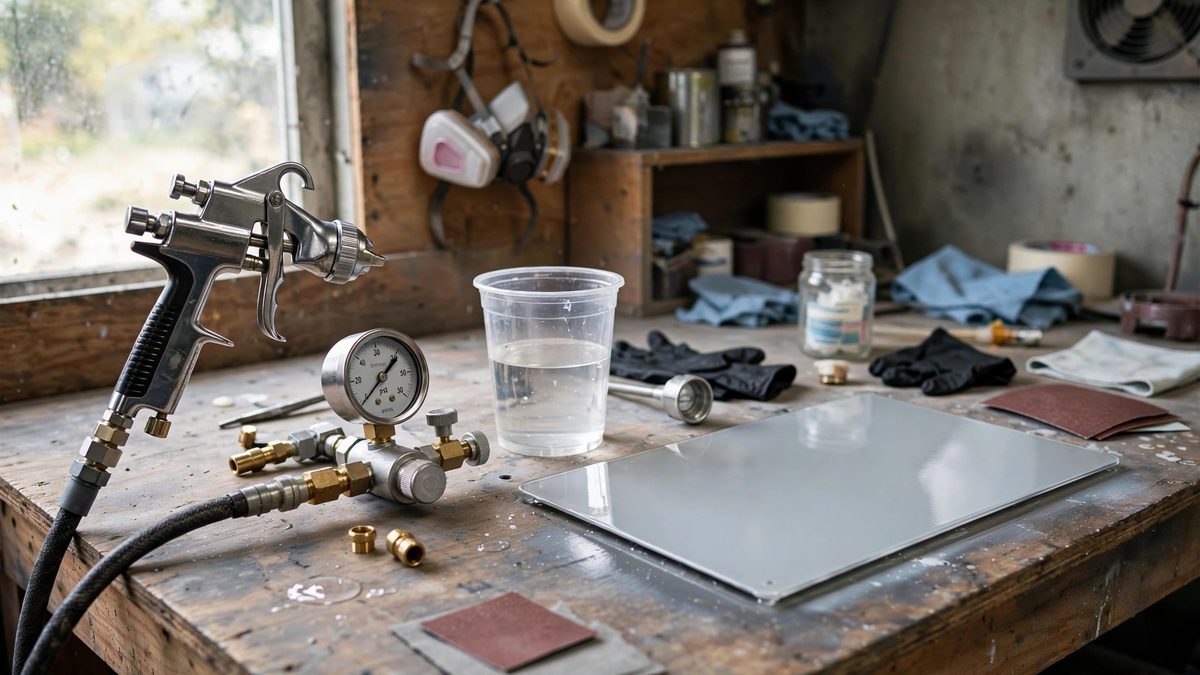
HVLP guns are rated by pressure at the air cap, not at the wall regulator, and the two differ because air loses pressure traveling through the hose, fittings, and the gun body. A gun designed to run at around ten PSI at the cap might need several times that at the regulator to deliver it. The reliable way to know the cap pressure is a gauge that mounts at the gun inlet or on the air cap itself; regulator readings alone are guesses. Set up with the trigger pulled and air flowing, because static pressure with no flow reads higher than the working pressure and will mislead you. Once you know the real cap pressure, you can calibrate deliberately instead of chasing texture problems with random knob turns.
The spray-out calibration procedure
Calibrate on test panels, not on the work. Hang a test panel vertically at the same distance you will spray, and shoot a series of passes at stepped pressure settings, keeping gun speed, distance, and overlap constant so pressure is the only variable. Let the panel flash and then read the texture under a strong raking light. The low-pressure passes will show orange peel; the high-pressure passes will show dry spray and excessive overspray fog. The correct pressure is the lowest setting that produces a wet, merged film without peel, because running more pressure than necessary wastes material as overspray and increases the dry-spray risk. Write the setting down with the material, temperature, and humidity, since all of those shift the ideal point.
Fluid delivery and fan pattern interplay
Pressure does not act alone. The fluid needle setting controls how much material flows, and the fan pattern control shapes the spray; all three must agree. A common error is cranking pressure to fix a starved, stripey pattern that is actually caused by too little fluid delivery or a fan opened wider than the fluid can support. Before touching pressure, verify the fan pattern on a test spray: it should be an even oval, wet in the middle and feathering at the edges, with no heavy center stripe or dry horns. Adjust fluid and fan first, then calibrate pressure for the resulting setup. Changing any one of the three invalidates the calibration of the others, so work them in order and recheck the pattern after every change.
Environmental factors
Temperature and humidity move the calibration point. Warm conditions thin the material's effective viscosity and speed solvent flash, which can push a good pressure setting toward dry spray; cool conditions do the reverse, making orange peel more likely at a setting that was perfect last week. Rather than fighting this with pressure alone, adjust the material to the conditions with the appropriate reducer speed for the temperature, then fine-tune pressure around that. Keep a log of what worked at what temperature. Over a season of spraying, that log becomes a calibration chart that gets you to the right neighborhood before the first test panel.
Safety with atomized coatings
Fine atomization means fine airborne material, which is exactly what respirators and ventilation are for. Wear a properly fitted respirator with cartridges rated for the coating's solvents and particulates, not a paper dust mask. Ventilate the spray area and eliminate ignition sources, since atomized solvent is far more flammable than the liquid in the cup. Cover skin and eyes; isocyanate-containing clears in particular demand full protection and respect. Calibration sprays on test panels generate the same hazards as production spraying, so gear up for the test as you would for the job.
Calibrate atomization pressure at the gun, on test panels, with fluid and fan set first: find the lowest cap pressure that lays a wet, merging film, and log it with the conditions. Respect what temperature does to the setting, and protect your lungs while you spray. The mirror finish is just properly atomized droplets given time to flow.
Related Guides
- Airless Spray Tip Orifice Sizing for Latex: An airless sprayer turns tip selection into paint engineering: the tip's orifice size and fan width determine how much paint flows, how finely it
- Wet Film Gauge Thickness Audits for Acrylic Enamels: Acrylic enamel, the workhorse coating for trim, doors, and cabinetry, delivers its hardness, washability, and durability only at the specified dry
- Straining Latex Paint to Eliminate Gun Clogging: A spray gun that sputters, spits, or clogs mid-coat turns a fast job into a slow one. Most of those clogs are not gun problems; they are paint
- Cleaning Airless Spray Packings to Eliminate Pulsing: Your airless sprayer used to lay down a smooth, even fan, and now it pulses: the pattern surges and fades with every pump stroke, leaving stripes on