
Acrylic enamel, the workhorse coating for trim, doors, and cabinetry, delivers its hardness, washability, and durability only at the specified dry film thickness. Applied too thin, it never fully cures to its designed properties; too thick, it sags, cracks, or stays soft underneath a skinned surface. The wet film gauge, a simple notched comb, is how painters verify thickness during application, and auditing with it separates professional results from paint that looks fine for a month and then disappoints. The audit takes seconds; the failures it prevents take days to fix.
Why Enamel Thickness Matters More Than It Looks
Acrylic enamels cure by coalescence: the polymer particles fuse as water evaporates, forming a continuous film. That fusion needs sufficient film mass: below the minimum dry thickness, the film is discontinuous at a microscopic level, leaving a coating that scuffs easily, washes poorly, and chalks early. Above the maximum, the surface skins while the interior remains wet; the trapped moisture eventually escapes, causing blistering, or the thick film's cure stresses crack it. Enamels are less forgiving than flat wall paints here because their higher solids and harder cure amplify both failure modes. The manufacturer's specified thickness range, usually expressed as dry film thickness with a corresponding wet film target, is the window where the chemistry performs. Brushing or rolling "a good coat" by feel routinely lands outside that window, which is why the gauge exists.
Using the Wet Film Gauge
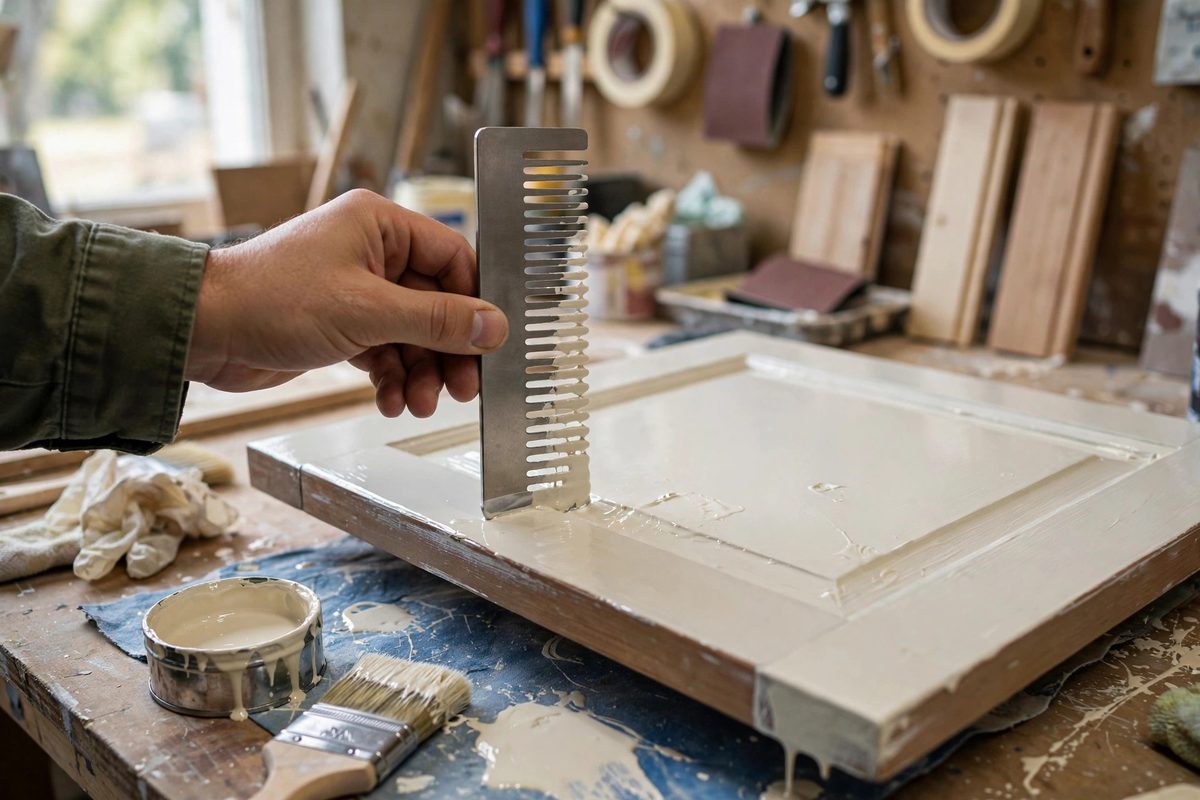
Press the gauge's notched edge firmly into the freshly applied wet paint, perpendicular to the surface, then withdraw it and read the highest numbered notch that shows paint. That number is the wet film thickness in mils or microns. Take readings on a test area or an inconspicuous spot, because the gauge disturbs the finish; on trim work, gauge the back of a door or inside a cabinet. The reading converts to dry film thickness through the paint's volume solids: a paint at 40% volume solids applied at 4 mils wet dries to about 1.6 mils. Know your product's solids and target before you start, and write the wet-film target on the can lid: in the middle of painting, nobody remembers the datasheet. Gauge early in the job to calibrate your application, then spot-check periodically; application thickness drifts as arms tire and rollers load differently.
Auditing Brush and Roller Application
Brush application thickness varies with technique: a fully loaded brush laid on generously deposits far more than a brush worked until it drags. The audit often reveals that the first coats go on heavy, as the painter loads confidently, and later coats go on thin, as fatigue sets in and the painter stretches the paint. Neither extreme is acceptable for enamel: heavy coats sag on vertical trim and cure soft, thin coats underbuild the film. Calibrate by gauging a brushed section and adjusting loading and working until the gauge reads consistently in range. Roller application has its own pattern: the film is thickest where the roller first lands and thinnest at the end of each stroke, so maintain a wet edge and consistent pressure, and gauge across a rolled section to see the variation. Back-brushing a rolled enamel, common on trim for a brushed look, redistributes the film and should be gauged after the back-brushing, not before.
Spray Application Audits
Spraying deposits film fast, which makes auditing more critical, not less: a sprayer can apply three coats' worth of thickness in one pass without realizing it. Gauge sprayed sections immediately, adjusting fluid flow, gun speed, and overlap until the wet film lands in range. The common spray error is excessive overlap on trim details: the broad surfaces gauge correctly while the profiles and edges, where the sprayer slows down, build double thickness and sag. Gauge the details specifically, not just the easy flat areas. Multiple thin sprayed coats, each gauged, produce the enamel's best finish: full film build without runs, with each coat curing properly before the next. The temptation to build the full thickness in one heavy sprayed coat is the fastest route to a finish that looks perfect on day one and cracks by month three.
Correcting Out-of-Spec Films
An audit that finds thin film is good news: apply another coat, gauged, to bring the total build into range. An audit that finds excessive thickness requires judgment: if the paint is still wet, it can sometimes be brushed out or the excess removed, but once an enamel skins, the thick film must cure fully before any correction, and correction may mean sanding back and recoating. This asymmetry is the argument for auditing early and often: catching a thin first coat costs one more coat, while discovering a too-thick finish after cure costs a sanding and recoat cycle. Keep a simple log on larger jobs: product, target wet film, readings per area. The log turns the audit from a nagging chore into quality documentation, and it settles the inevitable debate about whether the second coat was really necessary.
The wet film gauge is the cheapest quality instrument in painting. Know the target from the volume solids, gauge during application, correct thin films with another coat, and never trust "looks like enough." The enamel will cure into the durable finish it was formulated to be, because it was applied at the thickness the formulation assumed.
Related Guides
- Airless Spray Tip Orifice Sizing for Latex: An airless sprayer turns tip selection into paint engineering: the tip's orifice size and fan width determine how much paint flows, how finely it
- Straining Latex Paint to Eliminate Gun Clogging: A spray gun that sputters, spits, or clogs mid-coat turns a fast job into a slow one. Most of those clogs are not gun problems; they are paint
- Atomization Pressure Calibration for HVLP Clear Coats: Clear coat is where a paint job is won or lost, and atomization is where clear coat is won or lost. The spray gun's job is to break the liquid into
- Cleaning Airless Spray Packings to Eliminate Pulsing: Your airless sprayer used to lay down a smooth, even fan, and now it pulses: the pattern surges and fades with every pump stroke, leaving stripes on