
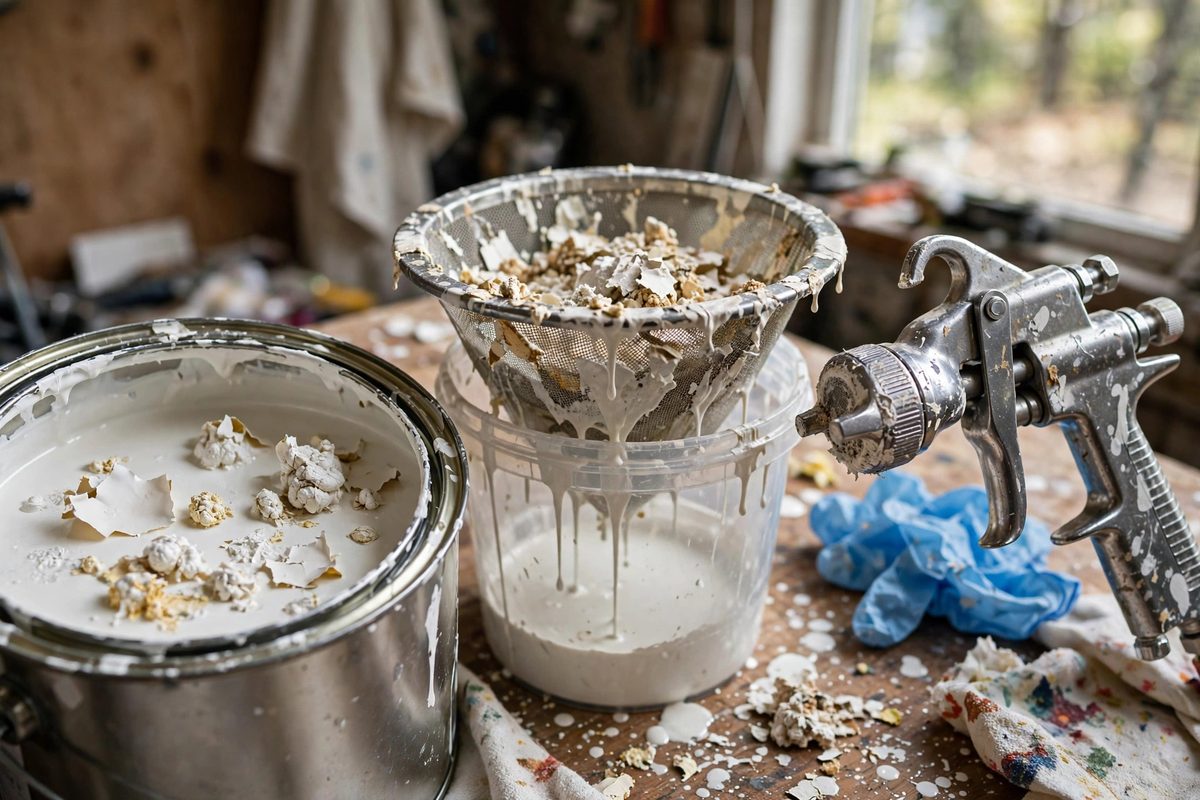
A spray gun that sputters, spits, or clogs mid-coat turns a fast job into a slow one. Most of those clogs are not gun problems; they are paint problems, caused by skins, dried bits, and coagulated lumps that formed in the can. Straining every gallon before it goes in the gun is the cheapest insurance in spray painting.
What clogs a gun
Latex paint forms a skin on its surface whenever air reaches it, and that skin breaks into flakes when you stir. Older cans develop dried paint around the rim and lid that falls in as chunks. Pigment and binder can also coagulate into soft lumps if the paint froze or sat too long. The gun's filter and tip orifice are small enough that any of these lodge in them, and once flow is interrupted the gun sprays unevenly or stops. Straining catches all of it before the gun ever sees it.
Choosing the right strainer
Paint strainers come in mesh ratings. For spray work, a fine mesh that matches the tip size you are using is the right call; the general guidance is that the strainer mesh should be at least as fine as the gun's own filter. Paper cone strainers that fit a bucket are the classic choice and cheap enough to use fresh each time. Nylon mesh bags work too and are washable for reuse. Use a fresh or clean strainer for every pour; a strainer that already holds a load of trapped skins lets the next gallon's debris ride through on top of the old layer.
The straining technique
Set the strainer over a clean bucket, not directly over the gun cup or hopper, so you can see what it catches. Pour slowly and steadily; dumping the paint through in a rush forces debris past the mesh and collapses the cone. Stir the can thoroughly first, scraping the bottom and sides, because straining only catches what gets poured out. What the strainer catches tells you about the paint: a few flakes are normal, a handful of lumps means that can needs extra attention or replacement.
Straining at the gun
Straining the gallon is step one; the gun's own filters are step two. Keep the gun's manifold or cup filter clean, and check the tip for buildup during long spray sessions. Some painters add a disposable in-line filter at the gun for extra protection on long hoses. If a tip clogs despite straining, check whether the tip is worn: an enlarged orifice from a worn tip sprays a ragged pattern that looks like a clog and tempts you to over-thin the paint.
Thinning versus straining
Do not thin paint to fix a clogging problem caused by debris. Thinning changes the paint's film build and hiding power; it does nothing about the chunk stuck in the tip. Strain first, and only thin when the paint genuinely needs viscosity adjustment for the gun and tip combination, following the paint maker's guidance. Most modern latex sprays fine through a properly sized tip without thinning once it is clean.
Storing paint to reduce debris
You can reduce what needs straining at the source. Wipe the rim before resealing, press the lid down fully, and store cans upside down for a short period so the skin forms on the bottom instead of the top, or simply avoid storing half cans for months. Pour from the can into the strainer bucket rather than working from the can itself, which keeps the rim debris out of the working supply. Clean habits at the can mean clean paint at the gun.
Strain every gallon through a fresh, fine strainer, keep the gun filters clean, and stop blaming the gun for paint debris. A strained gallon sprays smooth from the first trigger pull to the last.
Related Guides
- Airless Spray Tip Orifice Sizing for Latex: An airless sprayer turns tip selection into paint engineering: the tip's orifice size and fan width determine how much paint flows, how finely it
- Cleaning Airless Spray Packings to Eliminate Pulsing: Your airless sprayer used to lay down a smooth, even fan, and now it pulses: the pattern surges and fades with every pump stroke, leaving stripes on
- Wet Film Gauge Thickness Audits for Acrylic Enamels: Acrylic enamel, the workhorse coating for trim, doors, and cabinetry, delivers its hardness, washability, and durability only at the specified dry
- Atomization Pressure Calibration for HVLP Clear Coats: Clear coat is where a paint job is won or lost, and atomization is where clear coat is won or lost. The spray gun's job is to break the liquid into