
Irrigation zones on a slope have a drainage problem that flat zones do not. When the zone shuts off, the water in the downhill lateral lines keeps moving, draining out through the lowest heads. The result is soggy low spots, wasted water, and heads that sputter air on the next start. Check valves at the heads or in the line stop that drain-down, but only if they are sized and placed for the actual elevation change they are holding back.
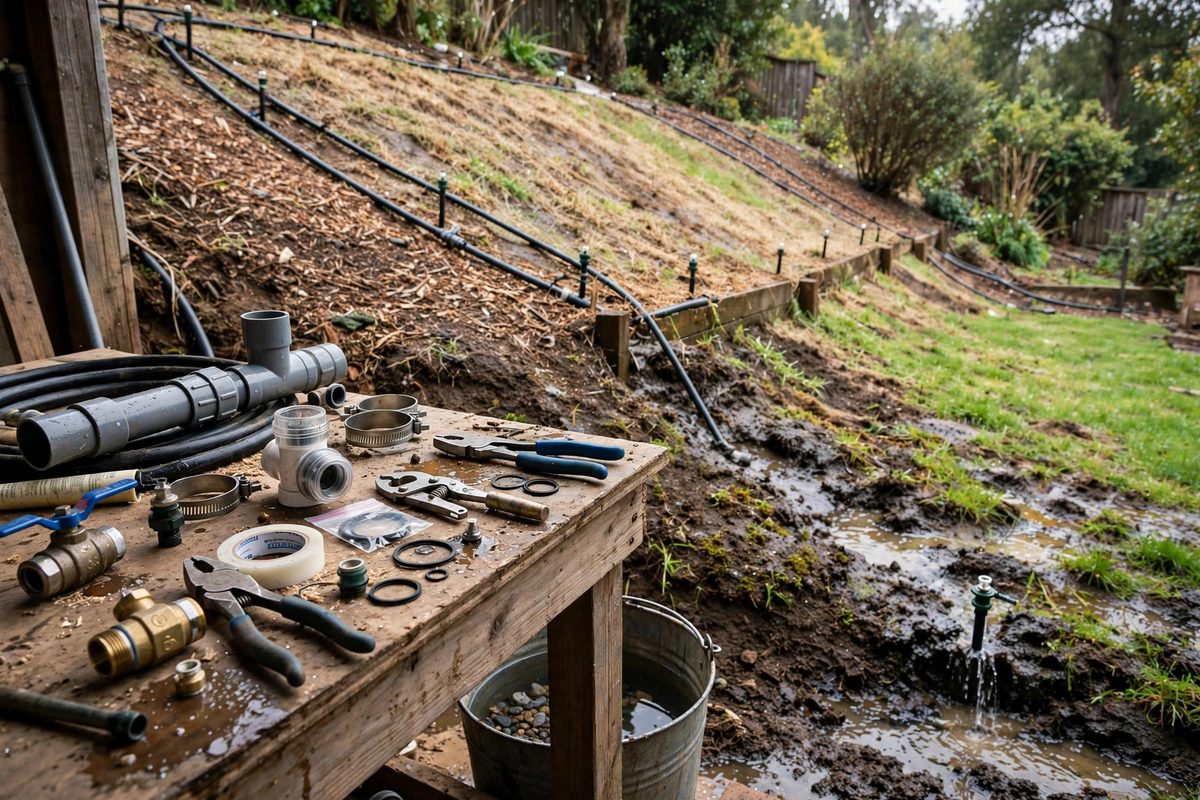
What the check valve is holding
A check valve at a sprinkler head holds back the column of water above it in the lateral line. The pressure from that column is about 0.43 psi per foot of elevation. A head sitting six feet below the zone valve is holding back roughly 2.6 psi when the system is off. That sounds small, but over hours it is enough to push gallons through a head with no check valve, or through one whose cracking pressure is too low for the height it is holding.
Cracking pressure and elevation
Check valves have a cracking pressure, the minimum pressure needed to open them, and a holding rating, the pressure they seal against when closed. For slope zones, the holding side is what matters. Add up the elevation drop from the highest point the lateral serves down to the head. Multiply by 0.43 psi per foot. Your check valve needs to hold comfortably above that number. A valve rated to hold 5 psi covers about 11 feet of elevation. Beyond that, you need a higher-rated valve or check valves at multiple points up the slope.
Sizing the valve to the line
Match the valve body to the lateral pipe size. A 1-inch valve on a 1-inch lateral keeps flow unrestricted when the zone runs. Downsizing the valve to save money creates a choke point that costs pressure during operation, which shows up as weak throw on the downhill heads. The valve goes on the head itself for most residential rotors and sprays, which many manufacturers offer with built-in check valves, or inline on the lateral for drip zones and remote heads.
Placement on the slope
- Heads at the bottom of the slope always get check valves. That is where the drain-down exits.
- On long or steep slopes, add check valves at intervals up the hill so no single valve holds more than its rating.
- The zone valve itself does not stop lateral drainage. It stops supply pressure, but the water already in the downhill pipe still drains.
- At the top of the slope, check valves are usually unnecessary. There is no water column above them to drain.
Signs your check valves are wrong
Mushy ground around the lowest heads a day after watering means water is still migrating downhill. Heads that cough air for several seconds at zone start mean the lateral drained and is refilling. Both point to missing or under-rated check valves. If the low heads perform fine but the high heads on the same zone have weak throw, suspect a valve that is too restrictive or partially stuck, choking flow to everything uphill of it.
Maintenance
Check valves have springs and seals that wear. Grit in the water is the usual killer. If a zone that used to hold starts draining again, the valve seals are the first thing to inspect. Flush the lateral before replacing the valve, or the new one inherits the same grit. On systems with dirty water, a filter upstream of the zone valve extends check valve life noticeably.
The bottom line: figure the elevation drop, multiply by 0.43, and put check valves rated above that number on the downhill heads. It is a small part that fixes a problem most people blame on their timer.
Related Guides
- Solenoid Valve Air Bleed Procedures on Drip Systems: You start a drip zone and instead of a quiet, even seep you get sputtering, hammering, and half the emitters barely dripping. Trapped air is the
- Sub-Surface Lateral Drip Line Purging Valve Setups: Sub-surface drip irrigation is wonderfully efficient and quietly vulnerable. Buried emitters deliver water straight to the root zone with almost no
- Friction Head Loss in Drip Line Lateral Runs: A drip irrigation lateral that starts strong and dribbles at the far end is showing friction head loss: the pressure the water spends fighting the
- Mainline Pressure Regulators for Zone Drip Lines: Drip emitters are designed for low pressure, and house water pressure is not low pressure. Hook drip zones straight to the main and you get misting