
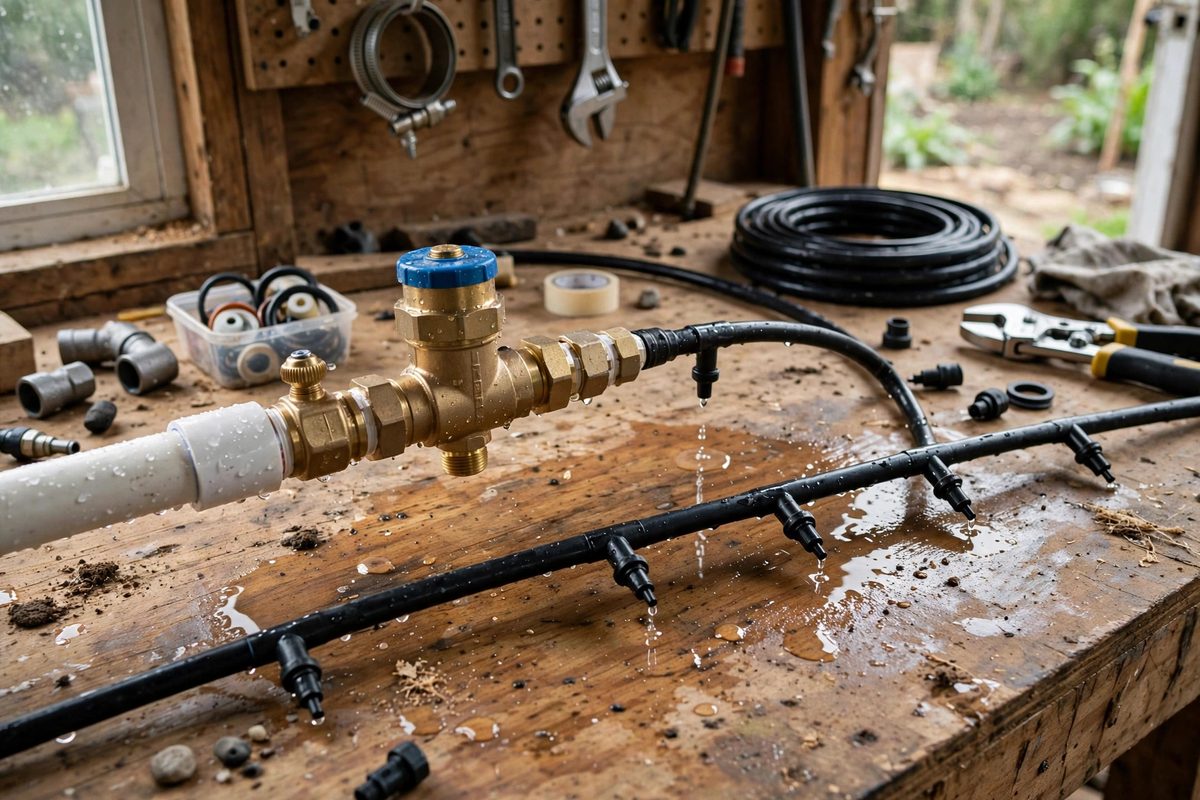
Drip emitters are designed for low pressure, and house water pressure is not low pressure. Hook drip zones straight to the main and you get misting emitters, popped connections, and wildly uneven watering. A pressure regulator at the right point in the system turns a punishing mainline into the gentle, consistent flow that drip was designed for.
What drip zones actually need
Most drip emitters, tubing, and micro-sprayers are happiest around 20 to 30 pounds of pressure. Above that range, emitters flow more than their rated gallons per hour, thin-walled drip tubing balloons and weakens, and push-fit or barbed connections that hold fine at low pressure start letting go. Household mains commonly run 60 to 80 pounds. The gap between those two numbers is exactly what the regulator exists to close.
Where the regulator goes
The regulator belongs at the head of each drip zone, after the zone valve and filter, so every emitter downstream sees the reduced pressure. Putting a single regulator on the whole irrigation main is tempting but wrong: spray zones need their full pressure, and a shared regulator starves them. Zone-by-zone regulation also lets you run different pressures for different drip layouts, such as a low-pressure emitter grid near the house and a slightly higher setting for long tubing runs. Sequence it as valve, then filter, then regulator, then tubing.
Choosing preset versus adjustable
Preset regulators, factory set to a fixed outlet pressure, are simple, cheap, and hard to misadjust, which makes them ideal for most residential drip zones. Adjustable regulators let you dial in the pressure for unusual layouts or long runs with meaningful friction loss. The tradeoff is that adjustable ones can be fiddled with, by you in a hurry or by a helpful neighbor, so mark the setting clearly once it is right. For a standard garden bed zone, a preset regulator is the set-and-forget choice.
Sizing for the zone's flow
Regulators need a minimum flow to regulate accurately and a maximum flow they can pass. A tiny zone with a handful of emitters may flow so little that a big-bodied regulator never really engages, while an oversized zone maxes the regulator out and drops pressure anyway. Check the regulator's flow range against the zone's total emitter output, which you know if you counted emitters when designing the zone. If the numbers do not overlap, resize the zone or split it. Guessing here shows up as emitters that never quite look right.
Friction loss in long runs
Long drip tubing runs lose pressure to friction, so the far end sees less than the regulator outlet. For typical short residential runs this is negligible, but a couple hundred feet of half-inch tubing on a slope is a different story. Keep runs within the tubing manufacturer's length guidance, or upsize the tubing, rather than cranking the regulator up to compensate. Raising the regulated pressure to fix a long-run problem just over-pressurizes the near emitters. Fix the run, not the setting.
Maintenance and failure signs
Regulators are reliable but not immortal. A zone that suddenly waters unevenly, emitters that start misting, or connections popping off all point to a regulator that has failed open. Regulators can also clog at their inlet, so keep the upstream filter clean and check the filter screen on a schedule. Replacement is usually a quick threaded swap; buy a spare and keep it with the irrigation parts so a failure is a ten-minute fix, not a week of hand-watering.
Put the right regulator after the valve and filter on every drip zone, size it for the zone's flow, and leave the pressure alone once it is set. The emitters get the pressure they were designed for, the tubing lasts, and the garden gets even water.
Related Guides
- Friction Head Loss in Drip Line Lateral Runs: A drip irrigation lateral that starts strong and dribbles at the far end is showing friction head loss: the pressure the water spends fighting the
- Solenoid Valve Air Bleed Procedures on Drip Systems: You start a drip zone and instead of a quiet, even seep you get sputtering, hammering, and half the emitters barely dripping. Trapped air is the
- Sub-Surface Lateral Drip Line Purging Valve Setups: Sub-surface drip irrigation is wonderfully efficient and quietly vulnerable. Buried emitters deliver water straight to the root zone with almost no
- Backflow Prevention Check Valve Sizing on Slope Zones: Irrigation zones on a slope have a drainage problem that flat zones do not. When the zone shuts off, the water in the downhill lateral lines keeps