
Silk quilts demand the best of every technique: the fabric is unforgiving of puckering, the sheen shows every irregularity, and the fine threads involved leave no margin for tension errors. Some quilters approach silk with a floating bobbin technique, using fine bobbin thread and a delicately balanced tension that lets the lightweight sandwich move freely without distortion. Balancing that tension is a study in subtlety: the forces involved are tiny, the symptoms of imbalance are subtle, and the corrections are correspondingly fine. This guide covers the principles and the procedure for tension balance worthy of silk.
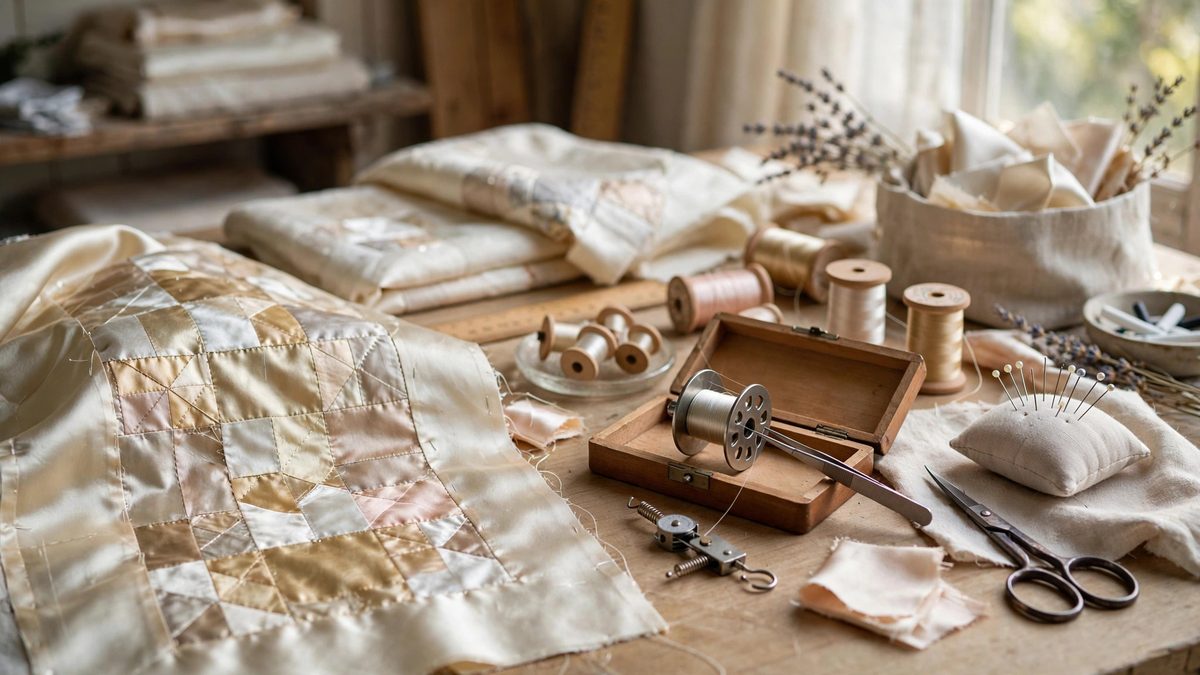
Why silk punishes tension errors
Silk's properties conspire against the quilter. The fabric has little body to absorb stitch distortion, so any tension imbalance puckers visibly. Its smooth surface shows needle holes and thread paths that a matte cotton would hide. Fine silk threads have less tensile strength than their cotton equivalents, so excessive tension breaks them rather than merely distorting the fabric. And the quilt sandwich in a fine silk quilt is typically thin, giving the stitch formation little material to work with; the interlock of top and bobbin threads must sit precisely in the thin sandwich or it shows on one face. These factors multiply: each makes tension balance more critical, and together they make silk the ultimate test of a quilter's tension control.
The floating bobbin concept
The floating bobbin approach uses a very fine bobbin thread, often a lightweight silk or fine polyester, tensioned delicately so it offers minimal resistance to the top thread. The name describes the feel: the bobbin thread seems to float, contributing almost no drag to the stitch formation. This suits silk because the top thread, also fine, can then form the stitch without fighting the bobbin, and the thin sandwich is not distorted by heavy thread or aggressive tension. The tradeoff is sensitivity: with so little tension in the system, small changes, lint, humidity, thread variation, have proportionally large effects. The floating bobbin is a precision instrument, not a set-and-forget configuration, and it asks for attention throughout the quilting session.
Establishing the bobbin baseline
Begin with a clean bobbin case and the fine bobbin thread wound smoothly and evenly; lumpy winding is a tension variation wound into the system. Set the bobbin tension lighter than for standard quilting, testing the pull by hand: the thread should draw with a gentle, consistent resistance, noticeably lighter than a cotton-quilt baseline but not free-spooling. If using a tension gauge, record the reading as your silk baseline for future sessions. The key quality is consistency through the bobbin: wind bobbins carefully and check that the tension does not change as the bobbin empties, since some cases behave differently full versus nearly empty. Prepare several identically wound bobbins before starting, so bobbin changes mid-quilt do not introduce variation.
Balancing the top thread
With the delicate bobbin baseline set, bring the top tension down to match. Test on a scrap sandwich identical to the quilt: same silk, same batting, same backing. The balanced stitch on silk shows as an even, flat seam with the interlock buried in the thin sandwich; examine both faces under good light, looking for any puckering along the stitch line, any thread showing where it should not, and any distortion of the silk's sheen. Adjust the top tension in the smallest increments the machine allows, testing after each change. Silk reveals the truth quickly: a setting that looks fine on cotton scrap will show its flaws on silk immediately, which is why the test sandwich must be the real materials. Record the final settings; silk quilts are rare enough that you will not remember the numbers next time.
Quilting technique for delicate balance
Maintain the balance through technique. Quilt at a moderate, steady speed; rushing introduces tension spikes that the delicate system cannot absorb. Support the quilt's weight fully so gravity does not add drag that mimics tension problems. Keep the work area humid enough that static does not make the fine threads misbehave; dry air and silk thread are a troublesome combination. Take breaks before fatigue degrades your handling, since tired hands move the quilt unevenly and the silk records every inconsistency. And resist the urge to tug the quilt to correct small wanders; the delicate tension balance punishes manhandling visibly.
Troubleshooting the subtle symptoms
Silk's tension symptoms are quiet. Slight puckering along the stitch line means the top tension is marginally tight; ease it a fraction. Tiny loops on the underside mean the top is marginally loose. A stitch line that looks perfect but feels slightly ridged to the fingertip indicates the interlock is riding high or low in the sandwich; adjust the balance until the line feels flat. If the symptoms change through the session, suspect lint in the bobbin case or the top tension discs, humidity changes, or a bobbin running low; the floating bobbin's sensitivity makes it an early warning system for all of these. Clean, check, and continue. The discipline of maintaining the balance is part of the craft of the silk quilt.
Balance fine silk quilting from a delicate, consistent bobbin baseline, match the top tension on true test sandwiches, quilt with steady supported technique, and read the subtle symptoms early. The floating bobbin asks for attention and repays it with stitching worthy of the silk.
Related Guides
- Quarter Inch Seam Allowance Trueing for Scant Patchwork: Patchwork accuracy lives or dies on the seam allowance. A block made of twenty pieces, each sewn a thread's width too wide, finishes noticeably
- Aligning Grain Direction in Scant Miters: Scant miters, mitered seams sewn just shy of the drawn line to account for the thread and fabric taken up in the fold, are the precision joints of
- Trueing Seam Intersections in Complex Kaleidoscope Quilts: Kaleidoscope quilts live or die at their intersections. Dozens of seams converge at single points, and if those points do not match, the kaleidoscope
- Matching Diagonal Seam Intersections in Star Blocks: Star blocks are the showpieces of patchwork: radiating points, crisp intersections, geometric precision that reads as skill. The make-or-break detail