
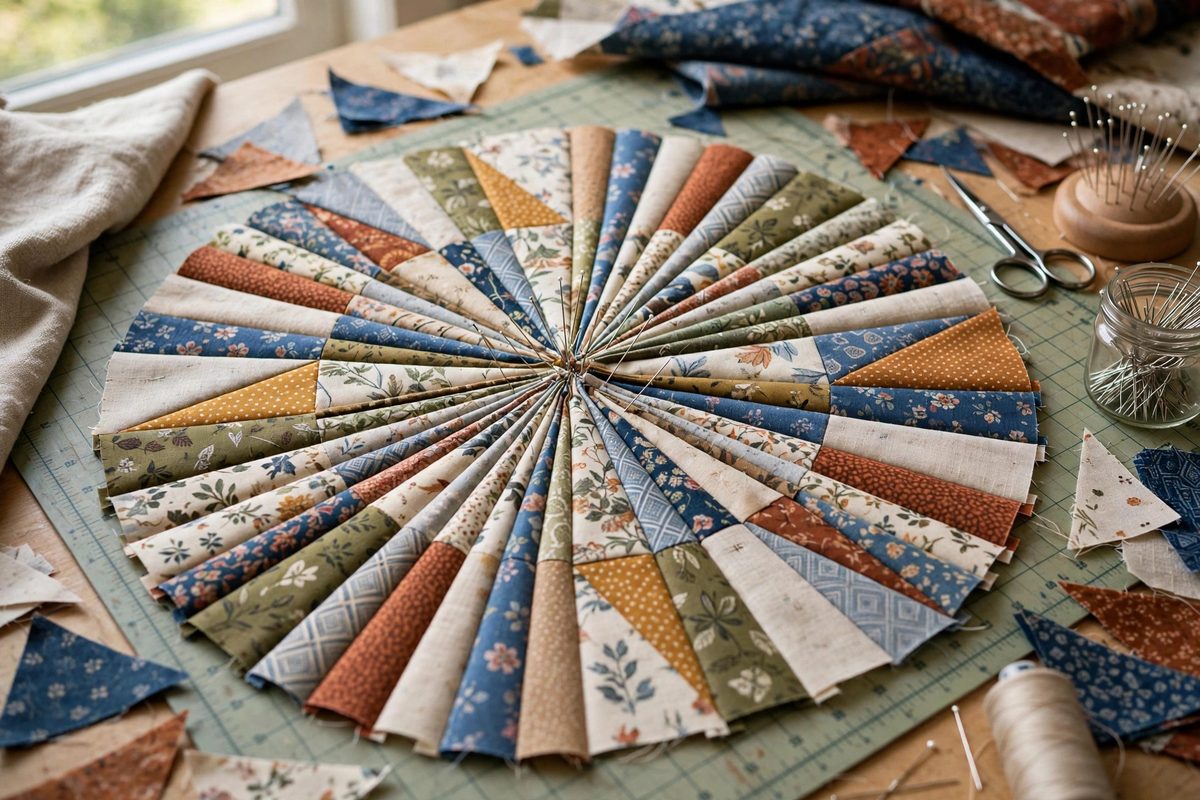
Kaleidoscope quilts live or die at their intersections. Dozens of seams converge at single points, and if those points do not match, the kaleidoscope shatters into a mess of near-misses. Trueing the intersections, making every seam meet exactly, is the precision work that makes the pattern sing.
Why intersections are the hard part
Each seam in a kaleidoscope block is simple on its own; the difficulty is that they all must agree at shared points. A sixteenth of an inch off in one seam becomes an eighth off where three seams meet, and the error compounds across the block. The eye is ruthlessly good at spotting mismatched points; it forgives a slightly wavy seam but not a point that misses. Precision at the intersections is not fussiness; it is the entire visual logic of the quilt.
Cutting accuracy as the foundation
True intersections start at the cutting table. Pieces cut inaccurately cannot sew together accurately, no matter the piecing skill. Use a sharp rotary blade, a true ruler, and a flat cutting surface; replace the blade at the first sign of dragging. Cut the pieces for one block and check them against each other before sewing: the triangles should match, the angles should agree. An hour of careful cutting saves many hours of fighting mismatched seams.
Pinning for point matching
Pin the intersections, not just the edges. Place a pin directly through the matching points of the two pieces, perpendicular to the seam, so the points cannot shift as you sew. Pin every intersection in the seam, even if it means a dozen pins in a short seam. Sew slowly over the pins or remove them just before the needle arrives, according to your comfort. The pins are doing the precision work; the sewing machine just follows. Skipping pins at the points is how points miss.
Seam allowance consistency
A wandering seam allowance moves every intersection. Check that the machine is sewing a true quarter inch: sew a test seam, measure it, and adjust the needle position or the guide. Use the same presser foot and the same guide edge for the whole quilt; switching feet mid-project introduces variation. When a point misses, the seam allowance is the first suspect, because it is the variable most quilters never verify. A quarter inch is a promise the machine must keep.
Pressing for flat intersections
Bulky intersections distort the block and pull neighboring points off. Press seams to reduce bulk at the convergence: press to one side, open, or spiral the seams around the center, whichever distributes the layers most evenly. Trim or grade the seam allowances at the point to reduce the lump. A flat intersection is a true intersection; a lumpy one shifts under the next seam. Press every seam before crossing it with another; unpressed seams compound their errors.
Checking and correcting blocks
Check each block before joining it to its neighbors. Measure it: it should be the right size and square. Sight along the intersections: the points should meet. If a block is off, decide whether to correct or remake; a slightly off block can sometimes be eased into place, but a badly off one will poison every block it touches. The discipline to remake a bad block is what separates a stunning kaleidoscope from a disappointing one.
Cut true, pin the points, sew a verified quarter inch, press the bulk flat, and check every block. The intersections will meet, the kaleidoscope will turn, and the precision will look effortless, which is the highest compliment a quilt can earn.
Related Guides
- Matching Diagonal Seam Intersections in Star Blocks: Star blocks are the showpieces of patchwork: radiating points, crisp intersections, geometric precision that reads as skill. The make-or-break detail
- Quarter Inch Seam Allowance Trueing for Scant Patchwork: Patchwork accuracy lives or dies on the seam allowance. A block made of twenty pieces, each sewn a thread's width too wide, finishes noticeably
- Aligning Grain Direction in Scant Miters: Scant miters, mitered seams sewn just shy of the drawn line to account for the thread and fabric taken up in the fold, are the precision joints of
- Balancing Floating Bobbin Tension for Fine Silk Quilt: Silk quilts demand the best of every technique: the fabric is unforgiving of puckering, the sheen shows every irregularity, and the fine threads