
A hand-cranked jig with the right flywheel feels like it powers itself: one push and it carries smoothly through the hard part of the stroke. The same jig with the wrong flywheel is either jerky and tiring or sluggish and hard to start. Getting the weight right is the core of the design.
What the flywheel actually does
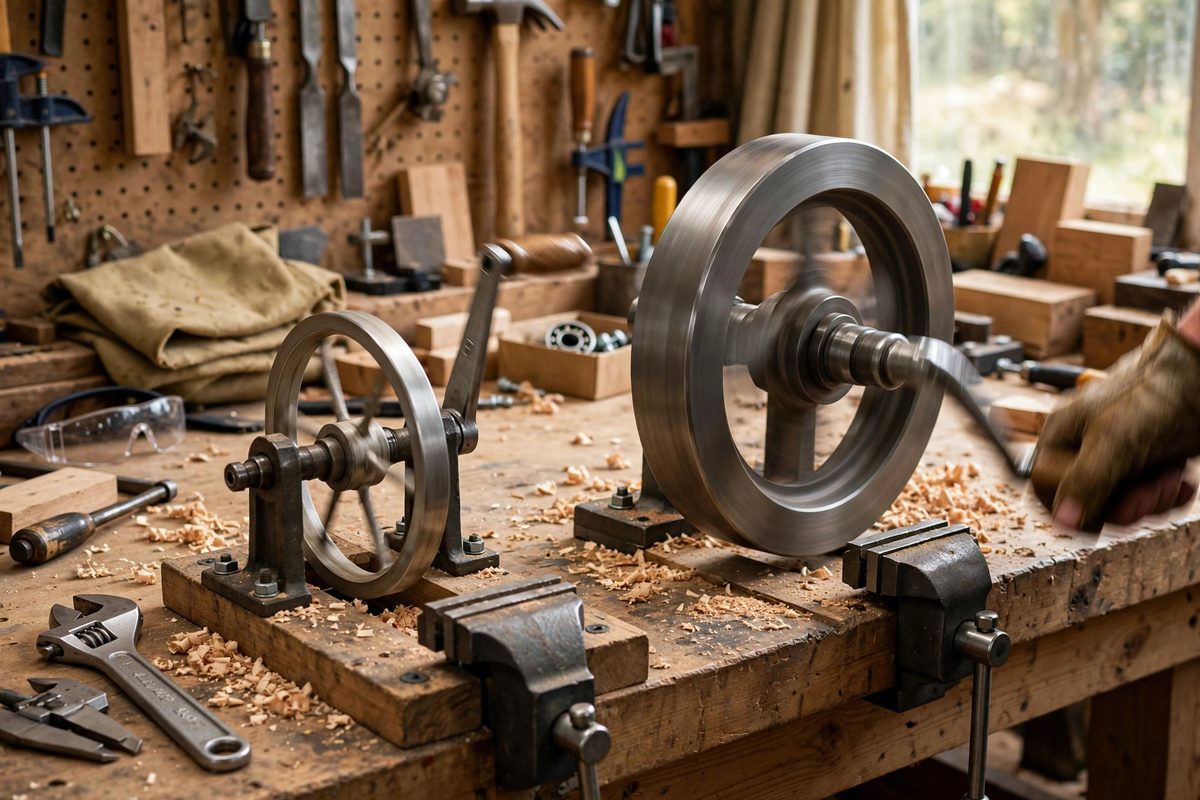
The flywheel stores energy during the easy part of the crank stroke and releases it during the hard part. Most hand-driven operations are not uniform: there is a cutting or pressing moment that demands a burst of torque and a return moment that demands almost none. Without a flywheel, your arm supplies the burst and tires quickly. With one, the steady effort of your whole stroke gets smoothed into the momentary peak, and the jig runs at a more constant speed. The heavier the flywheel, the more smoothing, but also the more effort to start and stop.
Too heavy versus too light
An oversized flywheel is a burden. It takes real effort to get moving, fights you when you need to stop quickly, and on a jig with a hard stop it can carry the mechanism into the stop with damaging force. An undersized one does almost nothing; the jig still jerks through the working stroke. The sweet spot is the lightest wheel that smooths the worst part of the stroke. You find it by feel, adding weight until the jerk disappears, then stopping. More is not better once the motion is smooth.
Mass placement matters more than total mass
A flywheel's stored energy grows with the square of its radius, so weight at the rim counts far more than weight near the hub. A modest wheel with a heavy rim, like a thick outer band, outperforms a heavy solid disc of the same weight and spins up easier. When building the wheel, concentrate material at the outside: a plywood or steel disc with an added rim band is the practical approach. This is why old treadle wheels and grinding wheels are rim-heavy by nature; the form follows the physics.
Balancing the wheel itself
An unbalanced flywheel is worse than none. Even a small imbalance at crank speeds produces a pulsing vibration that shakes the jig, loosens fasteners, and tires the operator. True the wheel on its axle before mounting: spin it freely and watch for the heavy spot settling at the bottom, then remove material from that spot or add a counterweight opposite it. Repeat until the wheel stays put in any position. A balanced wheel spins silently; an unbalanced one tells you about it immediately.
Gearing and the human engine
The crank ratio sets the relationship between your hand speed and the flywheel speed. A faster flywheel stores more energy but asks your hand to work quicker; a slower one is easier to crank but stores less. Most hand jigs work well with the flywheel turning somewhere between one and three times per crank revolution, depending on the load. The handle radius matters too: a longer crank handle trades speed for leverage. Tune the gearing and handle together so the effort feels like steady work, not a sprint and not a grind.
Safety on a spinning wheel
A flywheel stores enough energy to hurt you. Guard the wheel so fingers, sleeves, and hair cannot reach it while it spins, and remember that a heavy wheel keeps spinning after you stop cranking. Mount the jig solidly so the wheel's gyroscopic and vibration forces do not walk it across the bench. A wheel that comes off its axle at speed is a projectile; use proper bearings, lock the axle hardware, and inspect it periodically. Respect the energy you stored.
Size the wheel to the stroke, put the mass at the rim, balance it true, and gear it to your hand. A well-flywheeled jig turns a tiring operation into a rhythm, which is exactly what a jig is supposed to do.
Related Guides
- Zero Clearance Insert Tolerances on Saws: A zero-clearance insert is the throat plate with a slot cut by the blade itself, so the opening matches the blade exactly and the workpiece is
- Dovetail Router Jig Finger Offset Spacing Precision: A dovetail router jig cuts both sides of the joint, tails and pins, using a template with fingers that guide the router. The critical dimension is
- Micro-Adjustable T-Track Stops for Crosscut Sleds: A crosscut sled is only as accurate as its stop block. The sled guarantees a square cut; the stop guarantees the length, and on a good sled the stop
- Dial Indicator Calibration on Table Saw Miter Fences: A miter fence that is off by half a degree will ruin a picture frame, a segmented turning, or any joint where small errors multiply across multiple