
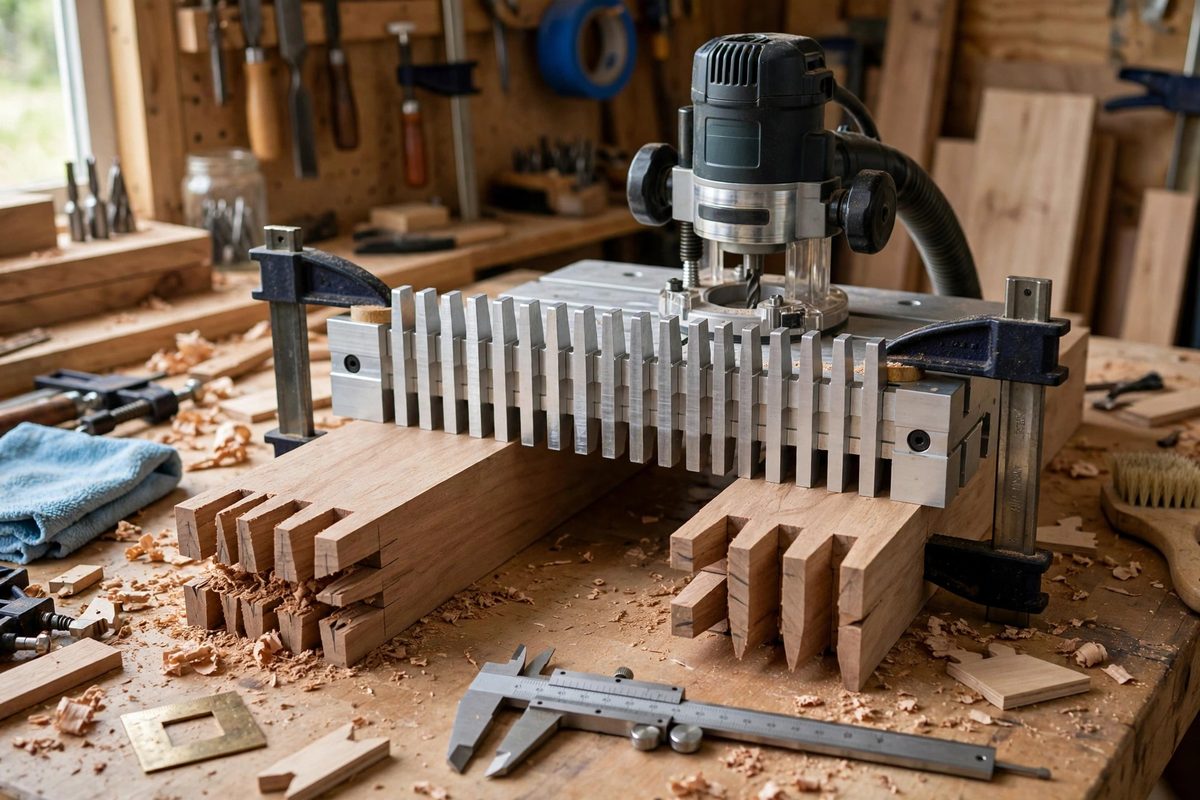
A dovetail router jig cuts both sides of the joint, tails and pins, using a template with fingers that guide the router. The critical dimension is the finger offset: the spacing relationship between the tail template and the pin template that makes the two halves mate. Get the offset right and the joint slides together with hand pressure; get it wrong by a fraction of a millimeter and the joint either falls apart or will not assemble. Understanding what the offset controls, and how to calibrate it, turns the jig from a frustrating gadget into a production tool.
What the Offset Does
The router bit follows the template fingers, but the bit has diameter: it cuts a path offset from the finger edge by the bit's radius, as mediated by the guide bushing. The tails and pins are cut with the same bit and bushing but from complementary templates, and the finger offset is the built-in compensation that makes the pin sockets exactly match the tails. In practical terms, the offset determines the joint's fit: increasing it loosens the joint, decreasing it tightens it. The jig manufacturer sets a nominal offset for the supplied bit and bushing combination, but nominal is not actual: bit diameters vary slightly, bushing diameters vary, and the fit you want, a hand-pressure assembly that holds without glue, is tighter than the average of manufacturing tolerances. Calibration to your actual bit and bushing is not optional fussiness; it is the step that makes the jig work.
Calibrating With Test Cuts
Calibration is empirical: cut test joints and adjust. Mill a short test tail board and pin board in scrap of the actual project wood, because wood species and moisture affect the fit. Assemble and assess: if the joint will not start, the fit is too tight and the offset needs increasing; if it slides together with no resistance, it is too loose. Adjust the jig's offset mechanism, usually a fine screw or sliding scale, in small increments, recut, and retest. Change one variable at a time and keep notes: the offset setting, the bit and bushing used, the wood species. The goal is a joint that assembles with firm hand pressure and stays together dry, indicating the correct slight interference that glue will perfect. Once calibrated for a bit-bushing-wood combination, record the setting permanently; recalibrate when any of the three changes.
Finger Spacing and Joint Strength
Beyond the offset, the finger spacing pattern determines the dovetails' proportions: the ratio of tail to pin width along the joint. Wider tails with narrow pins maximize the mechanical locking, since the tail's flared shape is what resists pull-apart; narrow tails with wide pins waste the dovetail's advantage and approach a finger joint's behavior. The jig's template fixes this ratio, and most commercial templates use proven proportions, but understanding the principle helps when choosing between template options or diagnosing a weak joint. Spacing uniformity matters too: the fingers must be evenly spaced and parallel, because any variation telegraphs directly into the joint as uneven gaps. Inspect the template itself before blaming the offset: a damaged or worn template finger produces a correspondingly damaged joint feature, and no offset adjustment fixes a bent finger.
Setup Discipline for Repeatability
A calibrated jig only repeats if the setup repeats. Clamp the workpiece firmly against the jig's registration surfaces with the same pressure each time; inconsistent clamping shifts the workpiece relative to the template and changes the effective offset. Keep the router base flat on the template and the guide bushing fully engaged with the finger edges throughout each cut; tilting the router changes the cut geometry. Maintain consistent feed direction and speed: climb-cutting versus conventional cutting changes the cutting forces and can alter the effective cut width slightly. Clear chips frequently, because packed chips between the bushing and the template finger act as a shim, shifting the cut. These disciplines sound tedious, but they are what make the twentieth joint match the first, which is the entire point of using a jig.
Troubleshooting Fit Problems
When joints misbehave despite calibration, diagnose systematically. Joints tight at one end and loose at the other indicate the workpiece was not parallel to the template, a clamping or registration issue. Uniform looseness after calibration suggests bit or bushing wear: measure both, because a worn bit cuts undersize and a worn bushing guides oversize, both loosening the fit. Tearout on the tails or pins, rather than a fit problem, points to feed direction, bit sharpness, or the need for a backing board. Seasonal wood movement changes the fit of stored calibration settings: a jig dialed in during humid summer cuts joints that fit differently in dry winter, so recalibrate when the shop climate shifts significantly. Keep the test-cut habit: a quick test joint before each production run catches every one of these issues before it ruins project parts.
The dovetail jig's finger offset is the fit control: calibrate it empirically to your bit, bushing, and wood, then protect the calibration with disciplined setup. Test-cut before production, keep notes, and the jig will cut joints that assemble like they were made for each other, because they were.
Related Guides
- Zero Clearance Insert Tolerances on Saws: A zero-clearance insert is the throat plate with a slot cut by the blade itself, so the opening matches the blade exactly and the workpiece is
- Balancing Flywheel Weight in Custom Hand Crank Jigs: A hand-cranked jig with the right flywheel feels like it powers itself: one push and it carries smoothly through the hard part of the stroke. The
- Micro-Adjustable T-Track Stops for Crosscut Sleds: A crosscut sled is only as accurate as its stop block. The sled guarantees a square cut; the stop guarantees the length, and on a good sled the stop
- Dial Indicator Calibration on Table Saw Miter Fences: A miter fence that is off by half a degree will ruin a picture frame, a segmented turning, or any joint where small errors multiply across multiple