
The bevel on a turning gouge, the ground surface just behind the cutting edge, is the turner's autopilot: when the bevel rubs the wood, it steadies the tool and sets the cutting angle automatically. But the bevel only works this magic when its angle is consistent. A bevel ground at varying angles around the edge produces a tool that cuts cleanly in one spot and catches in another, and the turner blames technique for what is really geometry. Grinding and maintaining a consistent bevel angle is the unglamorous foundation of clean bowl turning.
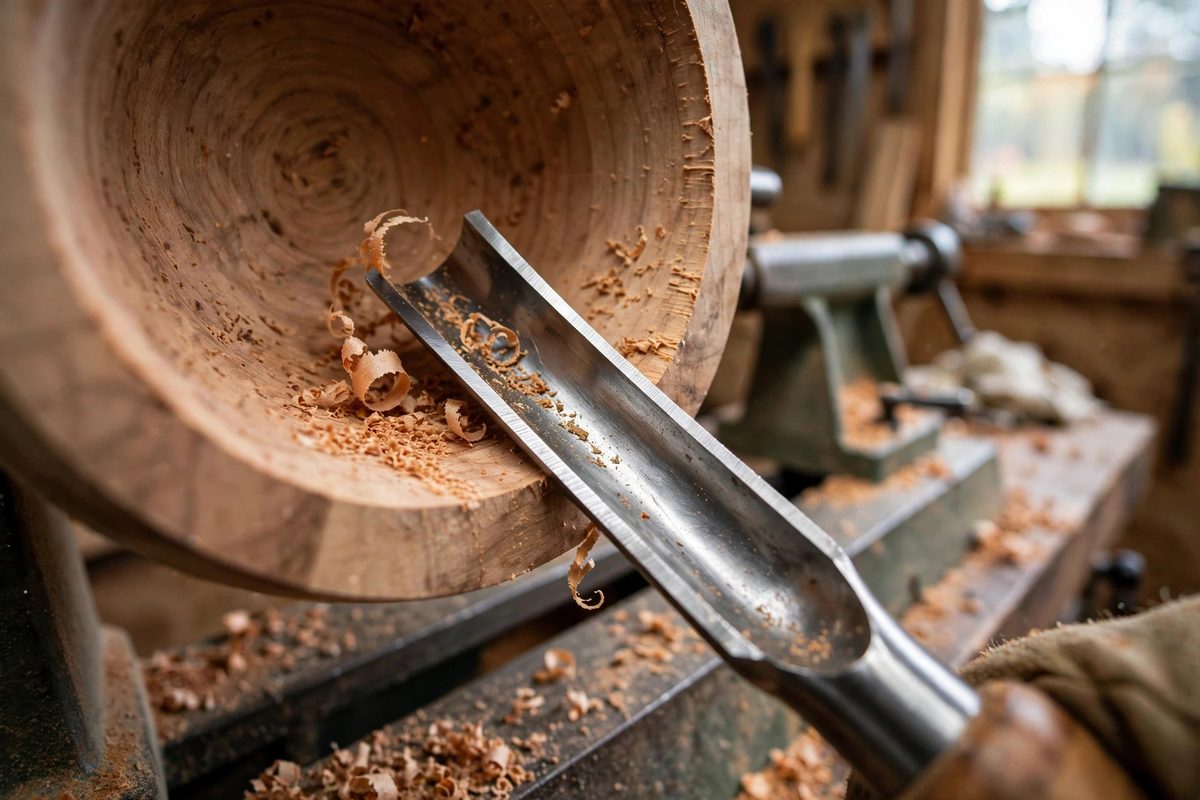
What the bevel does
In bowl turning, the gouge cuts with its edge while the bevel rides on the wood just behind the cut, acting as a depth stop and stabilizer. The bevel's contact prevents the edge from digging in too deeply, which is what causes catches, and it burnishes the just-cut surface slightly, improving the finish. This only works if the bevel's angle matches the presentation: the turner holds the tool so the bevel lies flat on the wood, and the edge then cuts at exactly the bevel's angle. If the bevel angle varies along the edge, no single tool position works everywhere; part of the edge will be riding while another part digs or floats. Consistent bevel angle means the tool behaves predictably through the whole cut, which is the precondition for developing smooth, confident technique.
Grinding a consistent bevel
Consistency starts at the grinder. Use a grinding jig that holds the gouge at a fixed angle and controls its rotation; freehand grinding can produce excellent edges in experienced hands, but it introduces variation that beginners should eliminate. Set the jig for your chosen bevel angle: for bowl gouges, the cutting bevel typically runs around 40 to 60 degrees depending on the grind style, with the popular swept-back grinds at the higher end. Grind with light pressure, cooling the steel frequently, and check the bevel under good light as you go; the bevel should show as an even, uniform band around the entire edge, with no wide spots or narrow spots. A platform or jig with positive stops reproduces the same angle every time you sharpen, which is the real goal: not one perfect grind, but a repeatable one.
Why consistency matters more than the specific angle
Turners debate bevel angles endlessly, but the dirty secret is that a consistent 50 degrees outperforms a wobbly 45 every time. The specific angle tunes the cut's character: lower angles cut more aggressively with a finer finish but are more catch-prone, higher angles are more forgiving and better for roughing. Any angle in the normal range works fine when it is consistent, because the turner adapts their presentation to the tool they have. What does not work is an edge whose angle changes from one side to the other, forcing the turner to unconsciously adjust mid-cut. Pick an angle that suits your work, grind it consistently, and spend your learning energy on tool control rather than fighting geometry. When you eventually experiment with different grinds, change deliberately and regrind the whole bevel to the new angle.
Maintaining the bevel through sharpening
Every sharpening should restore the existing bevel, not reinvent it. Use the same jig settings every time, and sharpen before the edge gets truly dull; touching up a slightly dull edge takes seconds and removes minimal steel, while grinding back a battered edge takes minutes and changes the geometry. Hone the edge between grindings with a slip stone or a leather strop to extend the time between trips to the grinder; honing maintains the bevel angle while refining the edge. Watch for the bevel growing longer with repeated sharpening, which happens as the edge retreats up the flute; when the bevel gets excessively long, it is time to reshape the tool properly at the grinder. Keep a record of your jig settings for each tool so every sharpening reproduces the geometry.
Lathe safety
Sharp tools and consistent bevels make turning safer, since catches are the main hazard and consistent geometry prevents them. Still, observe the fundamentals: wear a face shield, not just safety glasses, because bowl blanks throw chips and occasionally larger fragments. Keep the tool rest close to the work and adjusted as the diameter shrinks. Never wrap the tool's handle or your fingers in ways that trap you if a catch occurs; hold firmly but be ready to let the tool move. Check the blank's mounting security before every session, and stand clear of the rotation plane when starting the lathe. A well-ground bevel and safe habits together make bowl turning the joyful craft it should be.
Grind the bevel to one angle, hold that angle with a jig, sharpen before dull, and let consistency do the work. The bevel is the tool's autopilot; keep it true and it flies the cut for you.
Related Guides
- Bevel Skew Angle Dynamics in Roughing Gouges: The roughing gouge is the first tool to touch most spindle blanks, hogging square corners into cylinders. Its bevel angle and the skew of that bevel
- Bevel Rubbing Mechanics on End Grain Hollows: Hollowing end grain on the lathe, boring into the end of a spinning blank to make a box, goblet, or hollow form, is where bevel rubbing either saves
- Shear Scraping Outside Curves on End Grain Goblets: An end grain goblet, turned with the grain running vertically through the form, presents the turner with end grain across the entire outside curve